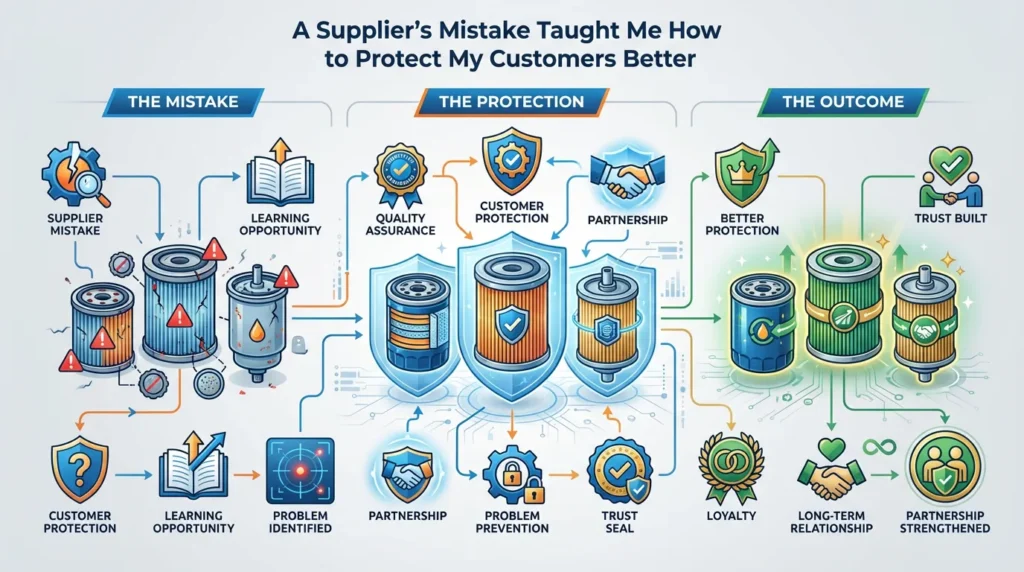
In international manufacturing, we often talk about:
- delivery time
- price competitiveness
- catalog coverage
But there is a quieter, more dangerous variable that can decide whether a brand grows or collapses:
How you handle your suppliers’ mistakes.
Not your own mistakes.
Not visible, obvious failures.
But the hidden deviations in raw materials that almost no one sees — until they become a problem in the field.
A few years ago, one such mistake from a raw‑material supplier forced me to make a tough choice:
keep production on schedule, or protect my customers’ brands at my own cost.
That decision completely changed how I define responsibility in the supply chain.
The Day a “Normal” Filter Media Batch Didn’t Feel Right
1.1 The Delivery Looked Perfect on Paper
A few years ago, one of our filter media suppliers delivered a batch that:
- matched the specified technical parameters on paper
- passed their own internal checks
- visually looked normal
The specification sheet showed:
- correct basis weight
- correct fiber composition
- correct nominal filtration level
Even the appearance — color, texture, roll condition — looked typical.
To most factories, this would simply pass:
- the supplier certification is valid
- the document shows compliance
- the media looks fine
To many suppliers, this would be considered:
- “acceptable tolerance”
- “within normal range”
And production would move forward without a second thought.
1.2 A Small Detail That Didn’t Feel Right
But during QC sampling on our side, something felt slightly off.
When our team handled the media, they noticed:
- the stiffness was not completely consistent
- the “feel” of the sheet was just a bit different from usual
This wasn’t a clear, dramatic defect.
It was a subtle deviation — the kind you only notice if you know your materials extremely well.
Instead of ignoring that feeling, we:
- stopped and looked closer
- treated it as a potential risk sign, not just a “small variation”
That decision led us to dig deeper.
Going Deeper: From Suspicion to Technical Reality
2.1 Testing Beyond the Surface
We decided to investigate the batch in more detail. Our team:
- compared it with previous lots of the same specification
- checked physical properties more closely
- evaluated resin penetration
Resin penetration is critical because:
- it stabilizes fiber structure
- it affects dust‑holding behavior
- it supports mechanical durability under airflow and pressure
Even when everything looks correct on the spec sheet, a deviation here can change how the media behaves under real‑world, high‑load conditions.
2.2 Running Airflow and Performance Evaluations
We didn’t stop at basic checks. We:
- ran airflow simulations
- evaluated pressure drop and distribution
- tested dust loading patterns
The conclusion:
👉 The material could cause increased dust bypass under high‑load conditions.
Important details:
- Not in every unit
- Not immediately at the beginning of life
- But in challenging environments and over longer usage
In other words:
- the media was not completely “bad”
- but it introduced a downstream risk for our customers
A risk that might:
- show up as unexpected engine wear or contamination
- appear as early clogging or instability
- trigger field complaints months later
From a narrow perspective, someone might say:
- “Most parts will work.”
- “Failure rate will be low.”
But from a brand protection perspective:
- Even a small, predictable risk is unacceptable.
The Two Choices: Keep Quiet or Protect the Customer
3.1 Option 1: Use the Material and Stay on Schedule
At that moment, we had two choices.
Choice 1:
- ❌ Use the material
- No one outside our factory would know
- No immediate failures would appear
- Production could stay fully on schedule
Short‑term benefits:
- no delay
- no extra cost
- no tough conversations with customers
From a very narrow, short‑term point of view, it would be the “easy” decision.
3.2 Option 2: Reject the Batch and Take the Hit
Choice 2:
- ✔ Reject the material
- ✔ Halt or re‑plan production
- ✔ Inform customers about the issue and expected delay
Short‑term consequences:
- delay to some shipments
- internal disruption
- need to manage expectations and possible frustration
- extra cost from rejecting a full batch of raw material
But long‑term, this decision would:
- protect our customers from hidden risk
- preserve their brand promises to the market
- maintain our own reputation as a responsible manufacturer
I chose the second option.
We rejected the batch.
Communicating the Problem Before Customers Felt the Impact
4.1 Informing Customers Before They Asked
After rejecting the batch, we didn’t wait for customers to notice a delay and start asking questions.
We proactively informed them:
“We detected a material deviation from our supplier.
We rejected the batch.
Your shipment will be delayed, and here is the revised plan.”
Our message included:
- what deviation we found (in principle, not necessarily disclosing all lab specifics)
- why we considered it unacceptable
- how we would adjust production
- updated ETD / ETA planning
- our commitment to avoid this kind of risk
Some customers:
- were surprised
- had never received such transparent production‑risk communication from a supplier before
Some customers:
- immediately appreciated it
- understood the value of this decision
4.2 The Feedback I’ll Never Forget
One customer said something that has stayed with me ever since:
“Bruce, by rejecting your supplier, you protected our brand.
This is what real partners do.”
That sentence changed how I define responsibility in the supply chain.
It became very clear to me that:
- Our responsibility is not just to protect our own brand
- It’s to stand in front of our customers and protect their brand as well
From that moment, our internal mindset shifted even more toward:
“We are the final filter between supplier risks and customer markets.”
The Lesson: Your Supplier’s Mistake Is Still Your Responsibility
5.1 Responsibility Does Not Stop at the Factory Gate
In international supply chains:
👉 Your supplier’s mistake is still your responsibility.
Your customer doesn’t see:
- the paper trail of material certificates
- the excuses of sub‑suppliers
- the “acceptable tolerances” someone tries to defend
They only see:
- whether the product they sell performs or fails
- whether their brand is growing or being damaged
So even if a supplier:
- claims the material is “within spec”
- pushes you to accept a marginal batch
your duty to your customers does not change.
5.2 The Real Job: Protecting Customer Reputation
Our job is not simply to:
- push products out
- hit shipment dates no matter what
Our real job is to:
Protect our customers’ reputation and market position.
Anyone can:
- ship on time
- push borderline quality and hope nothing goes wrong
But not everyone is willing to:
- stop production
- take a loss on raw materials or time
- explain a delay honestly
- directly say “We will not take this risk on your behalf”
This is the difference between:
- a transactional supplier
- and a long‑term strategic partner
5.3 Short‑Term Cost vs Long‑Term Trust
Rejecting that media batch had:
- a short‑term cost
- extra stress to reorganize production
But it built:
- long‑term trust
- stronger loyalty
- a clear signal: “We stand between you and risk.”
That’s the equation of real partnerships:
Short‑term cost. Long‑term trust.
Why Overseas Buyers Care So Much About This
6.1 The Pressures Distributors Face
European, Middle Eastern, and North American distributors live under multiple pressures:
- Warranty claims
- Costly, time‑consuming, damaging to reputation
- Retailer complaints
- Penalties, delisting risk, lost placements
- Market reputation
- One serious failure can undo years of brand building
- High logistics cost
- Returns, replacements, and emergency shipments are expensive
- Strict quality expectations
- Professional customers expect stable performance
- Competitive pressure
- Many brands compete on the shelf — one error and you lose space
In this context, a single material deviation — even a small one — can affect the entire chain:
- product performance
- complaint rate
- retailer relationship
- distributor cash flow
- brand image
6.2 What Type of Suppliers They Actually Need
They do not need suppliers who say:
- “It won’t fail.”
- “Don’t worry; it should be OK.”
- “Let’s just use it this time.”
That type of answer pushes risk onto the customer.
They need suppliers who say:
“We won’t take the risk.”
Suppliers who are willing to:
- reject material that might create failures later
- accept internal cost to protect the market
- be transparent about deviations and delays
- prioritize brand safety over short‑term convenience
This is the behavior that:
- earns long‑term loyalty
- turns suppliers into true partners
How Beling Filters Stands Between Customers and Risk
At Beling Filters, that experience led us to strengthen and formalize the way we manage upstream risk.
We manufacture OE‑level Air / Cabin / Oil / Fuel filters with a strong focus on raw‑material integrity and process control.
7.1 Strict Raw‑Material Verification
We apply strict raw‑material verification to every batch:
- checking certificates against our internal specifications
- physical inspection of roll condition and appearance
- verification of key parameters such as:
- basis weight
- thickness
- stiffness
- resin penetration behavior*
*Resin penetration is critical for filter media stability. We treat any unusual pattern as a potential red flag, even if a supplier calls it “acceptable.”
7.2 Multi‑Stage QC From Incoming to Final Product
We use a multi‑stage QC system:
- Incoming material inspection
- Basic checks and sampling
- Comparison with reference samples
- In‑process QC
- Monitoring during pleating, curing, sealing
- Testing intermediate components
- Final product QC
- Dimensional checks
- Visual and structural inspection
- Random performance tests as required
This layered approach means:
- problems can be detected at multiple stages
- deviations are less likely to slip through to the final product
7.3 Supplier Scoring & Audit System
We maintain a supplier scoring and audit system:
- rating suppliers on:
- material consistency
- documentation accuracy
- responsiveness to deviations
- ability to implement corrective actions
- conducting regular audits where necessary
This creates:
- continuous pressure for improvement
- clear visibility of which suppliers are reliable
- a foundation for long‑term cooperation with quality‑focused partners
7.4 Rejection Authority for Any Deviation
Within our system, QC and responsible engineers have real rejection authority:
- if a batch is not safe, they can stop it
- decisions are based on technical and quality criteria, not just production convenience
There is:
- no “just run it” culture
- no forced acceptance of marginal material to keep the line moving
7.5 IATF 16949 Traceability
Our processes operate under IATF 16949 discipline:
- full traceability of materials and production lots
- clear records of which materials went into which batches
- structured non‑conformance and corrective action procedures
This ensures that:
- if an issue is suspected, we can trace it
- corrective actions are based on data, not guesswork
7.6 Zero‑Compromise Policy on Materials
We follow a zero‑compromise policy on materials:
- no silent downgrades to hit a price
- no acceptance of borderline quality to avoid delays
- no “nobody will notice” attitudes
If a material, component, or process creates a predictable risk for our customers’ brand, we:
- stop
- re‑evaluate
- reject if necessary
Because we don’t just protect our product.
We protect your business.
Beling – Save Your Time & Cost
A supplier’s mistake once forced us to choose between staying on schedule and protecting our customers’ brands.
We chose to:
- reject the material
- halt production
- inform customers proactively
It cost us in the short term.
But it built deeper trust — and clarified our role:
We stand between our customers and risk, not behind excuses.
At Beling Filters, we manufacture OE‑level Air / Cabin / Oil / Fuel filters with:
- ✔ Strict raw‑material verification
- ✔ Multi‑stage QC
- ✔ Supplier scoring & audit system
- ✔ Rejection authority for any deviation
- ✔ IATF 16949 traceability
- ✔ Zero‑compromise policy on materials
If you’re looking for a supplier who will stand between you and risk, not hide behind excuses:
Let’s connect and build a supply chain that safeguards your brand.
📩 bruce.gong@belingparts.com
🌐 www.belingparts.com
Your valuable automotive filter partner since 2008.