In international B2B trade, almost every supplier dreams of the “perfect customer”:
- good volume
- quick decisions
- friendly communication
- pays on time
And sometimes, at the beginning, it really looks perfect.
But a delayed payment can quickly test:
- how strong your credit policy is
- how mature your risk management is
- and how honest your relationship really is
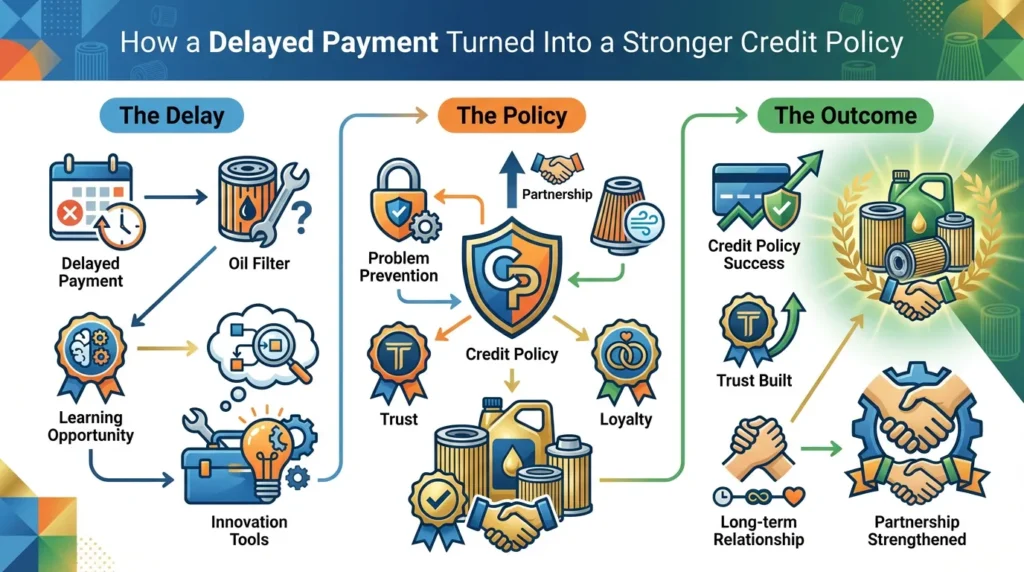
This is the story of how one delayed payment:
- created stress
- forced uncomfortable conversations
- but in the end, helped us build a clearer, safer credit policy
and a healthier long‑term cooperation.
The “Perfect” New Customer: Smooth Start, No Red Flags
A few years ago, I started working with a new customer.
From the beginning, he looked ideal:
- Good volume potential – his market was active, and he had channels.
- Quick decisions – no long delays, no “we will see next year.”
- Very friendly on calls – easy to talk with, cooperative, positive.
For the first two orders, he paid 100% in advance.
Everything was smooth:
- we received the money
- we arranged production
- we shipped on time
- he received the goods and gave positive feedback
From a supplier’s point of view, this is the kind of start that builds confidence.
So when he asked for a change on the third order, I was ready to listen.
The Request: “Can We Do 30 Days Credit This Time?”
On the third order, he said:
“Bruce, can we do 30 days credit this time?
We already trust each other.”
I stopped and thought.
From my side, I did a quick check:
- ✅ Previous payments – on time, 100% advance
- ✅ Company background – stable, not a brand‑new company
- ✅ Market – normal risk level, not extremely unstable
Nothing looked dangerous.
So I agreed.
We changed the terms for that order to:
- 30 days credit from shipment date (or document date)
- standard procedure
- clear understanding that this was our first credit step together
The goods were shipped.
On paper, everything was still fine.
Then the days started passing.
When “Next Week” Never Comes: The Delay Starts
30 days passed.
No payment.
I thought:
- maybe internal banking delay
- maybe he is just a bit late
- no need to panic immediately
I followed up politely.
He replied:
“Don’t worry, next week.”
I chose to believe him.
But then:
- 45 days passed
- still no payment
Emails were:
- answered slowly
- without clear commitment
- always with some version of:
“Don’t worry, next week.”
Soon, “next week” became a recurring phrase.
I started feeling a familiar tension.
The Pressure: Finance vs. Relationship
On one hand, I had:
- 😓 pressure from my finance team
- “Bruce, this invoice is overdue.”
- “We need to control our risk.”
- “If he doesn’t pay, it hits our cash flow too.”
On the other hand, I had:
- 😕 my own wish to protect the relationship
- “He was good before.”
- “Maybe it’s just a temporary issue.”
- “If I push too hard, will I damage the trust?”
This is a very common situation in B2B:
- Sales wants to keep the relationship and volume
- Finance wants to protect cash flow and risk
Both are right.
The challenge is to handle it without:
- ignoring the problem
- becoming emotional
- or destroying the relationship unintentionally
At a certain point, I realized:
Email was not enough anymore.
I needed a direct, honest conversation.
The Honest Call: Asking for the Real Situation
I decided to call him directly.
On the phone, I spoke clearly and respectfully:
“I understand business can be difficult.
But if we don’t respect the payment terms,
there is no way to build long‑term cooperation.
Tell me clearly: what is the real situation?”
This is an important turning point.
Instead of:
- being aggressive
- threatening
- or pretending everything was fine
I chose to:
- be transparent about my concern
- show that I understood business reality
- but still stand firm on the importance of payment terms
This opened a door.
The Truth: He Was Using Our Credit to Bridge His Cash Flow
This time, he finally opened up.
He explained:
- His main customer had delayed their payment to him.
- His cash flow was stuck.
- He used the 30‑day credit from us as a bridge
to keep his business running.
In other words:
- He wasn’t trying to disappear.
- He was trying to survive a cash flow gap.
But there was still a problem:
- He hadn’t been transparent from the beginning.
- He had kept saying “next week” instead of explaining the situation.
This lack of honesty created:
- stress for us
- extra suspicion
- damage to the trust we had built
However, because he finally told the truth,
we still had a chance to repair the situation.
The Negotiated Plan: Structure Instead of Emotion
Once we had the real picture, we moved from emotion to structure.
We discussed a concrete plan:
- 🔹 He would pay in three smaller parts over 60 days
- This made it realistic for his cash flow.
- It gave us a clear, time‑bound agreement.
- 🔹 All new orders would go back to advance payment
- No new credit until old issues were fully solved.
- This protected us from increasing risk.
- 🔹 We would review the situation after one year
- If everything was respected, we could reconsider limited credit later.
He agreed to this plan.
And most importantly:
- He respected it.
- He made the three payments as promised.
- He cleared the full balance.
We decided to continue working together,
but under much clearer rules.
Today, we are still partners.
What Changed in My Credit Approach After This Experience
This case had a strong impact on the way I think about:
- credit
- risk
- relationship management
I changed my approach in four key ways.
8.1 Lesson 1 – Don’t Decide Credit on “Good Feeling” or 1–2 Good Orders
Before, it was tempting to think:
- “He paid two orders in advance, so he is safe.”
- “We get along well on the phone, so I can trust him.”
Now I believe:
Credit should never be decided only by
“good feeling” or 1–2 good orders.
Instead, we consider:
- payment behavior over a longer period
- the market situation in his country
- references or external signals, when possible
- internal risk limits per customer and region
Credit is a tool, not a gift.
It must be based on data and policy, not emotion.
8.2 Lesson 2 – Always Have Written, Simple Credit Terms
Another change:
We now always have written, simple credit terms
that both sides understand and sign.
For example:
- payment terms (e.g. 30 days from BL date)
- consequences of delay:
- interest (if applicable)
- suspension of new orders
- maximum credit limit
- conditions to increase or reduce credit
The document doesn’t need to be 20 pages.
But it must be:
- clear
- practical
- accepted by both sides
This reduces:
- misunderstandings
- “I thought this was flexible” discussions
- emotional negotiation when something goes wrong
8.3 Lesson 3 – When There Is a Delay, Face It Directly
In many companies, when a customer delays payment, people react in two extreme ways:
- either they avoid the topic, hoping it will solve itself
- or they attack aggressively, damaging the relationship
I learned to choose a different path:
When there is a delay,
face it directly, but not emotionally.
That means:
- contact the customer early
- ask for clear information
- keep your tone professional and calm
- focus on solutions, not blame
If the customer is honest and cooperative,
you can often find:
- payment schedules
- partial payments
- temporary adjustments
If the customer avoids, lies, or disappears,
you also get a clear signal that your risk policy needs to tighten.
8.4 Lesson 4 – Say “No” to New Credit Until Old Problems Are Solved
This experience also taught me:
When there is an unresolved overdue payment,
you must be ready to say “no” to new credit.
That can mean:
- only accepting new orders on advance payment
- or even pausing new orders
until the old balance is settled
This is not about punishing the customer.
It is about:
- protecting your own company
- keeping things fair for all partners
- avoiding a snowball effect of growing unpaid balances
If a customer truly values the relationship,
they will understand this point of view.
Why a Delayed Payment Is More Than a Financial Issue
Many people think:
“A delayed payment is just a financial problem.”
But in reality, it’s more than that.
A delayed payment is:
- a stress test for trust
- a test of your internal systems and policies
- a mirror that shows how well both sides manage risk
If you handle it:
- with transparency
- with firmness
- and with a long‑term view
you can actually come out of it with:
- stronger cooperation
- clearer rules
- and better protection for both sides
But if you:
- ignore it
- or handle it only emotionally
you risk:
- losing money
- damaging the relationship
- and repeating the same mistake with other customers
For Distributors and Importers: What This Means for You
If you are a distributor or importer of automotive filters (or any product),
this story also has lessons for you.
From your side:
- Asking for credit is not wrong.
- Cash flow challenges are common.
But to build a long‑term partnership, it helps if you:
- are transparent when you foresee delays
- don’t hide behind “next week” forever
- are willing to follow a plan when things go wrong
- respect written credit terms as much as you want us to respect shipment dates and quality
Suppliers also have:
- cash flow
- salaries
- material costs
- commitments
When both sides respect the rules,
trust grows and larger projects become possible.
If You Want a Supplier Who Values Clear Terms and Long‑Term Cooperation
If you are looking for a filter supplier who:
- values clear payment terms
- prefers transparent communication over “nice talk only”
- focuses on long‑term cooperation, not just one big order
- is willing to discuss credit carefully, with structure and honesty
then we might be a good fit.
At Beling Filters, we:
- welcome advance payment for early orders
- can discuss limited credit for proven, stable partners
- use simple written agreements to protect both sides
- handle problems directly but respectfully when they occur
If that’s the kind of relationship you want with your supplier:
📩 bruce.gong@belingparts.com
🌐 www.belingparts.com
A delayed payment doesn’t have to destroy a relationship.
Handled correctly, it can become the starting point
for a stronger, safer way of working together.