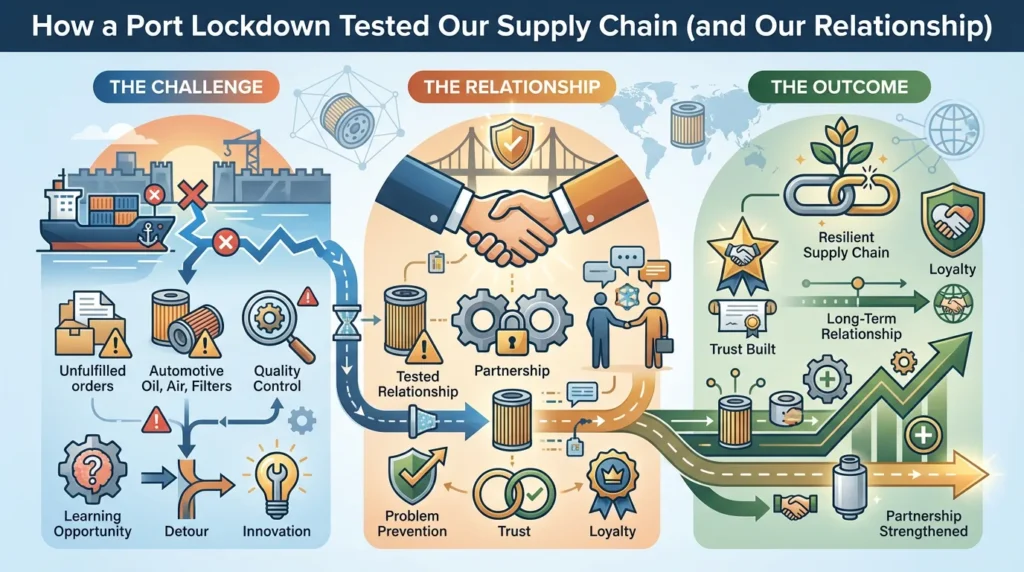
“Port will be closed from tomorrow. All export containers delayed.”
I received this message on a Friday evening.
At the same time, one of my European clients was waiting for a shipment of automotive filters for a promotion that started in just three weeks.
If the goods were late, he would:
- miss his marketing campaign
- lose trust with workshops
- question whether to keep Beling as a core supplier
There was no time to complain, blame, or wait.
We had to react. Fast.
This is not just a story about a port lockdown.
It’s about how we handle supply chain emergencies,
how we protect our clients’ business,
and how a crisis can either damage or strengthen a relationship.
When a Port Lockdown Hits: Real-World Supply Chain Stress Test
1.1 The Friday Evening Message No Exporter Wants
Anyone who has managed international shipments knows this feeling:
- You think everything is going according to plan.
- Container is at port.
- Documents are ready.
- Client has planned sales and marketing around the ETA.
Then you get a message like:
“Port will be closed from tomorrow.
All export containers delayed until further notice.”
In our case:
- the shipment was a full container of automotive filters
- destination: Europe
- purpose: a promotion that would begin in 3 weeks
For our client, this shipment was:
- tied to marketing budgets
- linked to workshop promotions
- connected to his own reputation in front of his customers
If we failed here, it wasn’t just a logistic delay.
It was a business risk for him.
1.2 What Was at Stake for the Client
If the container arrived too late, he would:
- miss his planned promotion window
- fail to deliver filters to workshops on time
- possibly lose his position as “reliable supplier” in his market
And from our side, the risk was:
- he might question whether to keep Beling as a core supplier
- our reliability as a long-term partner would be damaged
- future projects, campaigns, and new SKUs could be put on hold
So the situation was simple and urgent:
Either we found a way to protect his promotion,
or we would slowly lose his trust.
Hour 1 – In a Logistics Crisis, Be Honest, Not Optimistic
2.1 Why “Wait and See” Is the Worst Strategy
Many suppliers react to bad news with silence or vague optimism:
- “Let’s wait and see, maybe it will be solved soon.”
- “I will check with the forwarder and update you later.”
By the time “later” arrives:
- the delay is already a fact
- the client has no time left to adjust plans
- trust is already damaged
My first move was exactly the opposite.
2.2 Transparent Bad News + Clear Next Step
Within the first hour, I sent him this message:
“We just received official notice about a sudden port lockdown.
Your container is affected.
Give me 2 hours to come back with options.”
Notice what this message does:
- it admits the problem directly
- it gives no excuses, no sugar-coating
- it sets a clear time frame for solutions (“2 hours”)
- it promises options, not empty reassurances
This is what I believe in:
In supply chain emergencies, bad news must travel fast.
Delaying the truth only makes the impact worse.
By being transparent in Hour 1, we bought something very valuable:
the client’s patience and cooperation for the next steps.
Hour 3 – Build Plan A, B and C for Supply Chain Emergency Response
3.1 Calling Everyone Who Matters
In the next two hours, I did not sit and read the news.
I started calling:
- our main forwarder
- two alternate forwarders we trust
- a nearby port operator who could potentially handle rerouted cargo
The goal was simple:
Don’t just confirm the problem.
Design multiple solutions around it.
3.2 Designing Three Concrete Options
After several calls, we built three clear action plans.
Plan A – Reroute the Container to a Nearby Open Port
- Move the container from the locked-down port to a nearby open port.
- Involved extra trucking cost from the depot/yard to the alternative port.
- Departure time (ETD) would be similar, delay minimal.
Pros:
- goods still move by sea
- cost increase controllable
- risk of missing promotion relatively low
Cons:
- additional coordination between trucker, port, and forwarder
- extra cost not originally budgeted
Plan B – Split Urgent SKUs by Air
- Identify the most urgent SKUs needed for his promotion.
- Send those by air freight directly to his warehouse.
- Keep the rest of the goods in the container shipment.
Pros:
- urgent SKUs arrive in time for the promotion
- sales and workshop campaigns can proceed
- his reputation with customers is protected
Cons:
- higher freight cost per unit
- extra documentation, packing, and handling
- requires quick decision-making from the client
Plan C – Delay Shipment 7–10 Days
- Keep everything as it is.
- Accept that the container will be delayed 7–10 days or more.
- No extra cost for either side.
Pros:
- cheapest option in terms of direct logistics cost
- no need to rebook or split cargo
Cons:
- high risk that he misses the promotion window
- potential stock-out at workshops
- damage to his market reputation
3.3 Presenting the Options Honestly
On our call, I laid it out clearly:
“From a cost view, Plan C is best for us.
From a business view, Plan A + partial Plan B is best for you.
I recommend we protect your promotion first.”
In other words:
- I did not hide which option was cheaper for us.
- I still recommended what was better for his business.
He chose Plan A + B:
- reroute the container (Plan A)
- air ship the most urgent SKUs for the promotion (Plan B)
This decision was only possible because:
- we brought him options fast, not excuses
- he could clearly see the trade-offs
Hour 6 – Share the Pain, Keep the Trust
4.1 Cost Can Be Shared, Responsibility Cannot
Extra logistics cost was now unavoidable:
- additional trucking to another port
- air freight cost for urgent SKUs
If we pushed all the cost to the client, he would feel:
- “They created a problem and made me pay for it.”
- “They only protect their margin, not my promotion.”
If we took all the extra cost alone, we would:
- absorb a significant loss
- set an unrealistic long-term expectation
So we did what we believe is fair in a partnership.
4.2 Proposing a Shared-Cost Solution
I told him:
“We will cover part of the extra trucking.
You cover part of the air freight for the urgent SKUs.
Let’s share the cost so we can protect the sales.”
What this message communicated:
- we are treating his problem as our problem
- we are willing to invest in his success
- we see this as a long-term relationship, not a one-time transaction
He agreed immediately.
Not because it was cheap,
but because he saw that:
We were not hiding behind “force majeure”.
We were actively trying to protect his revenue.
In B2B export business, these decisions build or break trust.
Week 3 – Final Results of Our Port Lockdown Response
5.1 What Happened Logistically
Three weeks later, the outcomes were clear:
- the air shipment of urgent SKUs arrived before his promotion started
- the rerouted container arrived only 4 days later than the original schedule
- his promotion ran normally, with no stockout
From a pure logistics point of view:
- we turned a sudden port closure into only a minor delay
- we preserved the functional outcome: stock where it needed to be, when it needed to be there
5.2 What Happened to the Relationship
Later, he said:
“I don’t judge suppliers by whether problems happen.
I judge them by what they do in the first 24 hours.”
That sentence stayed with me.
Because in global supply chains:
- problems will happen
- ports will close
- vessels will delay
- regulations will change
The real question is:
When something goes wrong,
does your supplier hide, delay, or protect you?
Lessons We Apply to Every Supply Chain Emergency
From this case, I keep three core principles that we now use as a standard at Beling when dealing with logistics disruptions.
6.1 Lesson 1 – Bad News Must Travel Fast
In international trade:
- hiding bad news doesn’t make it go away
- waiting “to see if it gets better” removes time for solutions
- clients feel betrayed if they find out too late
So our rule is:
- as soon as we confirm a serious issue (port lockdown, customs delay, vessel omission), we inform the client immediately
- we include:
- what happened
- how it affects their shipment
- when we will come back with concrete options
This approach:
- builds credibility
- allows clients to adjust their plans
- makes us part of the solution, not part of the problem
6.2 Lesson 2 – Customers Need Options, Not Excuses
Explaining the problem is not enough.
Clients don’t just need:
- “Port is closed.”
- “Forwarder delayed.”
They need:
- alternative routes
- alternative modes (sea + air)
- clear plans with pros, cons, and costs
In this case:
- Plan A: reroute to another port
- Plan B: split urgent SKUs by air
- Plan C: delay with no extra cost but high business risk
This structure can be applied to many emergencies:
- strike at port → consider alternate ports + partial air
- customs inspection → split a second shipment + support documents
- container rolled-over → rebooking + express service for key items
6.3 Lesson 3 – Cost Can Be Shared, Responsibility Cannot
In supply chain emergencies:
- costs may be negotiable
- responsibility for communication and action is not
We believe:
- we must take responsibility for managing the crisis
- we must be willing to share financial impact when it makes sense
- we must always prioritize the client’s market and reputation
That’s why we said:
“We will cover part of the extra trucking.
You cover part of the air freight.
Let’s protect your promotion together.”
It turned a crisis into a joint decision, not a blame game.
How Beling Handles Supply Chain Emergencies for Automotive Filter Export
7.1 Our Practical Process When Something Goes Wrong
When a logistics disruption happens (port lockdown, carrier change, customs delay), our internal response looks like this:
- Immediate Confirmation
- verify information with forwarder, port, or carrier
- check actual impact on specific containers / BLs
- Client Notification
- inform client within hours, not days
- share what we know and when we will return with options
- Scenario Planning (Plan A / B / C)
- coordinate with multiple forwarders
- evaluate alternative ports, transshipments, or air options
- calculate time line + cost of each scenario
- Joint Decision
- present clear options with pros, cons, and costs
- recommend the option that protects their business, not just our cost
- Cost Sharing Discussion
- evaluate which part we absorb
- propose a fair split where appropriate
- Execution + Updates
- confirm bookings, new routes, or air shipments
- send updated ETDs / ETAs
- keep client updated until goods arrive
- Post-Event Review
- analyze what we can improve
- adjust safety lead time or routing for future high-risk periods
7.2 Why This Matters for Automotive Filter Buyers
If you are:
- an importer of automotive filters
- a distributor planning promotions with workshops
- a brand owner who sells to large retail chains
then you know:
- your sales and reputation depend on stock availability
- a missed campaign can damage your relationship with workshops and retailers
- you do not have time for suppliers who “disappear” when problems happen
At Beling, we manufacture:
with:
- 17+ years of industry experience
- 32 million annual capacity
- exports to 30+ countries
But what really keeps our clients with us is not just capacity.
It’s how we behave when a crisis hits.
From Port Lockdown to Stronger Partnership
Looking back, that port lockdown could have become:
- a story of blame
- a broken promotion
- a damaged relationship
Instead, it turned into:
- a test we passed together
- a real-life demonstration of trust and transparency
- a stronger commitment on both sides
Today, this European client:
- still runs promotions with our filters
- plans his campaigns with confidence that we will support him
- often tells his team:
“Problems will happen. What matters is how fast your supplier reacts and what solutions they bring.”
And for me, as a B2B export salesperson at Beling, this experience became a reference point:
In logistics emergencies,
our job is not to look perfect.
Our job is to show up, tell the truth, and act fast.
If you are looking for an automotive filter manufacturer who:
- tells you bad news quickly
- brings real options, not excuses
- is willing to share pain to protect your business
we might be a good partner for you.
📩 bruce.gong@belingparts.com
🌐 www.belingparts.com