A few years ago, I opened my inbox and saw the subject line no supplier enjoys:
“Quality Issue – Urgent”
A European distributor reported:
“Bruce, a small number of cabin filters show slight deformation after installation. No safety risk, but our mechanics aren’t confident.”
Situations like this are crossroads. As a manufacturer, you can:
- defend: “It’s within tolerance.”
- minimize: “It’s only a few pieces.”
- redirect: “Maybe installation was wrong.”
Or you can lean in and treat the complaint as free market intelligence.
I chose the second path.
Within 24 hours, we had:
- high-resolution photos of the filters in question
- batch and production data
- workshop comments from the mechanics who handled them
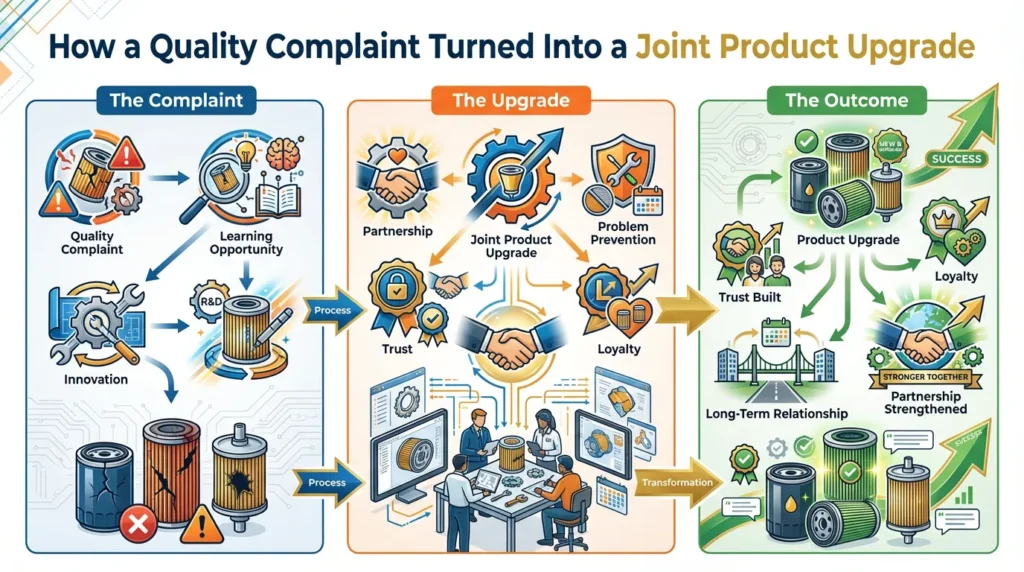
From there, we moved faster, deeper, and more collaboratively than a typical “complaint handling” process—because this was a chance to build something better, not just defend what already existed.
- Turning a Complaint Into a Co-Development Project
1.1 Immediate Response: Facts, Not Feelings
When the customer first reported the deformation issue, I responded:
“Thank you for telling me.
Let’s treat this as a project, not a problem.
Can you send detailed photos, batch numbers, and workshop feedback?”
This shifted the tone from confrontation to collaboration. He understood that:
- we were not dismissing his concern
- we wanted specifics so we could investigate properly
- we were ready to work with him, not just “handle a claim”
Within a day, he sent:
- high-quality photos (from the mechanics themselves)
- batch numbers and production dates
- install feedback (where exactly deformation was observed, under what condition)
This level of detail helped us jump straight into meaningful analysis.
1.2 Internal Task Force
I called our engineering and QC teams immediately.
We reviewed everything together:
- frame rigidity under stress
- foam density and compression set
- fitment tolerances in OE housings
- packaging pressure during transport (especially long sea shipment stacking)
We pulled historical data from our ERP and compared:
- material lots
- process parameters
- previous customer feedback on the same model
Within 48 hours, we had a clearer picture of what might be happening.
- Root Cause: Multiple Factors, Not One Blame Point
2.1 What We Found
Our combined investigation revealed three contributing factors:
- Carton stacking pressure during long sea shipments
- cargo loaded higher than usual due to shipment consolidation
- inner boxes slightly compressed at the bottom layers
- Slightly softer foam on that specific batch
- still within spec, but closer to the lower hardness range
- under high compression, the frame lost a little rigidity
- Tight OE housings in one specific vehicle model
- the European mechanics were working on a high-end variant
- the cabin filter slot was less forgiving than standard
None of these factors alone caused a major failure.
Combined, they created enough deformation to make mechanics uncomfortable.
2.2 The Risk of Defensiveness
Now imagine if we had responded with:
- “Your mechanics installed it wrong.”
- “Our QC passed, so it’s not our issue.”
- “It’s just a few pieces; please ignore.”
We would have:
- lost credibility with the distributor
- missed the chance to understand a real-world issue
- weakened our relationship with the mechanics and workshop network
Instead, treating it as a shared improvement project unexpectedly opened the door to something far better.
- Co-Creating the Upgrade with Our Buyer
3.1 Reframing the Conversation
Rather than sending a defensive report, I called the buyer on Zoom:
“Let’s upgrade this together.
We’ll improve the frame strength and adjust packaging.
You collect more mechanic feedback; we’ll run new tests.”
This language was intentional:
- “Together” – we are partners, not supplier vs. buyer
- “Upgrade” – let’s improve the product, not patch a problem
- “Mechanic feedback + tests” – we combine field insight with lab validation
He agreed immediately. In fact, he was relieved to hear that we wouldn’t hide behind a tolerance range.
3.2 The Improvement Actions We Implemented
Over the next weeks, we:
- Increased frame rigidity
- reinforced structural ribs
- adjusted the polymer blend for better stiffness under load
- Optimized foam hardness
- tightened acceptable hardness window
- selected a slightly higher Shore value for this model
- Improved inner box support
- added internal spacers to reduce compression during stacking
- updated packing method for long-distance sea shipments
- Updated installation notes
- provided practical guidance for mechanics handling tight housings
- highlighted the best orientation and insertion angles
We backed everything with:
- finite element analysis (for deformation prediction)
- lab stress tests on the frame and foam
- transportation simulation for carton stacking pressure
3.3 Field Testing and Market Feedback
Once modifications were complete, we sent the distributor a fresh batch of samples.
His feedback was immediate:
“Bruce, our mechanics like this version even more than the original.
We can market this as an upgraded line.”
Not only did the “complaint” disappear—it turned into:
- a better-performing product
- a field-approved upgrade
- a positive story his brand could tell
- a deeper level of trust between us
- The Strategic Value of Treating Complaints as Audits
4.1 Complaints Are Free Market Audits
A complaint is not an attack.
It’s a free audit from the market.
Mechanics, installers, and distributors don’t send complicated feedback because they enjoy it. They do it because:
- they see real-world behavior
- they carry the risk of returns and reputational damage
- they want proof their supplier stands with them
If we treat that input with ego (“we’re right; you’re wrong”), we lose.
If we treat it with curiosity, we grow.
4.2 Moving from Defense to Co-Creation
Traditional complaint handling often looks like:
- Customer complains
- Supplier defends
- Both sides argue about data
- Maybe a replacement is issued
But modern B2B partnerships require a different flow:
- Customer reports an issue
- Supplier thanks them and asks for details
- Both sides investigate root cause
- They co-create an upgrade
- Both sides benefit from improved market competitiveness
This mindset is at the core of how we operate at Beling Filters.
- Beling Filters’ Complaint-to-Upgrade Workflow
We turned this experience into a repeatable process:
5.1 Step 1 – Gather Complete Evidence
- photos and videos from workshops
- batch numbers, production dates, QR traceability
- mechanic commentary (in their own words)
- environmental details (vehicle model, region, climate if relevant)
5.2 Step 2 – Internal Cross-Functional Review
- engineering analyzes structural and material aspects
- QC reviews the batch history, raw material lot, test logs
- supply chain checks transport and packing records
5.3 Step 3 – Identify Combined Factors
We don’t stop at the “biggest issue”.
We identify all contributing factors, even small ones.
5.4 Step 4 – Build a Joint Improvement Plan
- propose specific modifications
- align on testing method, timeline, and validation criteria
- share updates transparently
5.5 Step 5 – Field Validation and Storytelling
- send upgraded samples for workshop testing
- collect mechanic reactions
- help the buyer turn the improvement into a marketing story (“Upgraded version!”)
- Lessons Learned: Trust Is Built in the Tough Moments
In the automotive aftermarket, trust is built when:
- you respond, not react
- you prioritize real-world performance over internal convenience
- you prove you’re as invested in the buyer’s reputation as they are
This story taught us:
- even small issues can reveal design improvement opportunities
- supporting a customer under pressure creates loyalty that no discount can buy
- mechanics and distributors remember who listens and acts
“The best suppliers don’t just defend their products.
They co-create improvements with their customers.”
That’s what we aim to do every day at Beling Filters.
- Looking for a Supplier Who Listens and Co-Creates?
If you’re an importer, distributor, or aftermarket brand manager looking for:
- real technical support
- a supplier who never hides behind QC data
- a partner who treats feedback as a growth opportunity
- proactive improvement projects instead of reactive firefighting
then we should talk.
📩 bruce.gong@belingparts.com
🌐 www.belingparts.com
We turn real-world feedback into OE-level upgrades, so your mechanics and customers trust every box that carries your brand.