One of our European distributors had a recurring problem with our filters.
Not a quality problem.
A transport damage problem.
Every few months, we received similar photos:
- 📸 crushed carton corners
- 📸 slightly deformed filter caps
- 📸 dirty boxes from torn outer cartons
The claims were not huge,
but they were constant.
Each claim:
- took time to handle
- created tension with his retailers
- slowly increased one big doubt in his mind:
“Is your packing strong enough for our logistics?”
At first, we reacted like many suppliers do:
- replaced damaged pieces
- added more “FRAGILE” stickers
- asked the forwarder to “take care”
But nothing really changed.
The damage continued.
The emails continued.
The doubt continued.
It wasn’t until I spent a morning in his warehouse
watching how the goods actually moved
that we finally found the real solution.
And the solution was not inside the filter.
It was around it.
The Hidden Cost of “Small” Transport Damage in B2B
From the factory perspective, the damage looked small:
- a bent corner here
- a slightly crushed box there
- a few caps deformed
Easy to think:
- “Not a big deal.”
- “We’ll just replace a few pieces.”
But for the distributor, the impact was much larger.
1.1 Repeated Claims Erode Confidence
Every few months, the same pattern:
- Retailer receives stock with some damaged boxes.
- Retailer complains to distributor.
- Distributor complains to us.
- We investigate, reply, and send replacements.
No single claim was dramatic.
But over time, the distributor started to think:
- “If this keeps happening, maybe the packing is not good enough.”
- “Can I really push this brand confidently to my retailers?”
In B2B relationships, that kind of doubt is dangerous.
1.2 Damage Creates Friction With Retailers
For his retailers, damaged boxes meant:
- more time checking goods
- reduced confidence in the brand
- reluctance to display “ugly” boxes on shelves
- sometimes, refusal to accept certain pieces
Even if the filter itself still functioned well, the perception of quality dropped.
1.3 Replacement Handling Is Not Free
Each claim, even small, costs:
- time to send emails and photos
- administration to issue credits/replacements
- extra shipping costs
- internal discussion about responsibility
Multiply that by many small cases over a year, and the total cost is far from small.
The situation clearly needed more than:
- extra stickers
- generic instructions to the forwarder
We needed to understand what was really happening to the boxes between our warehouse and his retailers.
Why “Fragile” Stickers Didn’t Solve Anything
Our first reaction was typical:
- we replaced damaged units quickly
- we added more fragile labels on cartons
- we told the forwarder: “please be careful with this shipment”
But the damage continued.
Here’s why those actions were not enough.
2.1 Stickers Don’t Change Logistics Reality
In real logistics:
- pallets are moved fast
- vans are loaded and unloaded multiple times
- cartons get stacked, pushed, pulled and sometimes dropped
A “fragile” sticker does not:
- strengthen the carton
- prevent an inner product from hitting another inside the box
- change the road conditions, speed bumps or sharp turns
It only changes the ink on the surface.
2.2 Replacing Products Treats Symptoms, Not the Cause
By replacing damaged units:
- we kept the relationship alive
- we showed goodwill
But we did not:
- reduce total damage
- improve retailer experience
- remove the root cause
We were treating the pain, not the disease.
So we decided to do something different.
The Visit That Changed Everything: Watching the Real Journey
On one visit to this distributor, instead of spending the whole time in the meeting room,
I asked to spend a morning in his warehouse.
The goal was simple:
“Let me see how our boxes live after they leave the container.”
I followed the flow:
- from pallet
- to shelf
- to van
- to retailer (simulated loading/unloading)
What I saw explained a lot.
3.1 Outer Carton: Good for Sea Freight, Weak for Local Distribution
Our outer cartons were:
- strong enough for container loading
- tested for stacking in pallets
- acceptable for long‑distance sea freight
But his local logistics model was:
- many multi‑stop deliveries
- frequent loading/unloading in vans
- boxes being moved and re‑stacked several times a week
In this environment:
- corners took more impacts
- cartons were often handled individually, not just on pallets
- they were more exposed to compression and small drops
The conclusion:
The carton that was “OK” for sea freight was not strong enough for his last‑mile reality.
3.2 Inner Packing: Too Much Movement Inside the Box
Inside the box:
- filters had space to move
- when a carton was dropped or hit, filters could collide
- caps and edges could deform slightly
From a factory angle:
- “We packed them correctly; they’re not loose.”
From a practical perspective:
- there was enough internal freedom for impact damage to occur
- especially when boxes were slightly compressed or turned
The second conclusion:
The inner structure did not prevent filters from hitting each other under rough handling.
Now we had two clear technical findings:
- Outer carton strength was mismatched to local delivery conditions.
- Inner packing allowed too much movement of filters inside.
Instead of Arguing, We Proposed a Test
We could have argued:
- “It’s the forwarder’s fault.”
- “Your drivers should be more careful.”
- “This is normal handling; damage is inevitable.”
But that would not solve his problem or protect our brand.
Instead, we proposed something simple and measurable:
Run a small test shipment with one key packing change.
4.1 The Simple Packing Change We Implemented
We focused on his top 20 moving SKUs— the references with the highest volume and claim frequency.
For these 20 SKUs, we:
- 👉 added a reinforced inner divider
- to separate filters
- to prevent direct contact and collision
- 👉 used a slightly thicker outer carton
- to improve edge and corner resistance
- to better handle multi‑stop distribution stresses
We did not completely redesign the packaging.
We made targeted, practical adjustments:
- small increase in material strength
- smart inner segmentation
4.2 Short‑Term Cost vs Long‑Term Benefit
Yes:
- unit packing cost went up a bit
- our packing team needed time to adjust processes
- the first run took extra attention
But this was an investment to answer a clear question:
“If we improve the packing,
will the real‑world damage and claims go down significantly?”
We wanted data, not just opinions.
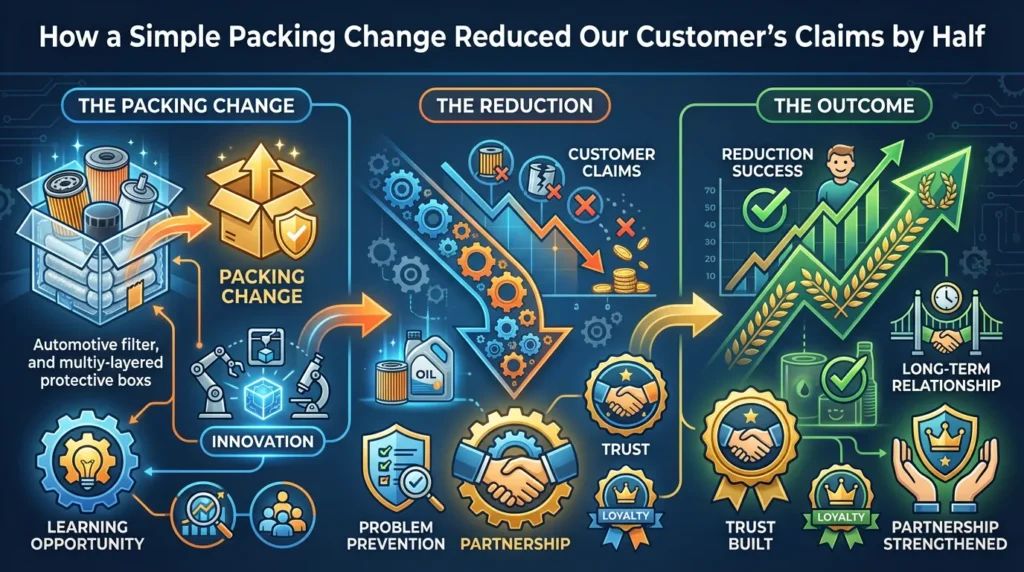
The Result After Three Months: Claims Down by Almost 50%
Three months after that test shipment, I received an email from him.
The message was short but powerful:
“Bruce, claims for those 20 SKUs are down by almost 50%.”
Nothing else in the chain had changed:
- same transport route
- same drivers
- same retailers
- same warehouse
The only difference was:
- inner divider
- thicker carton
In other words:
Same logistics reality.
Different packaging behavior.
The numbers spoke clearly:
- fewer photos of crushed corners
- fewer complaints about deformed caps
- fewer dirty, torn boxes
We had cut his claims almost in half
for the top 20 moving references.
The Unexpected Bonus: Better Shelf Image and Perceived Quality
There was another impact we hadn’t fully anticipated.
He told me:
“Retailers started to notice:
‘The filters from this brand arrive in better shape,
and the boxes look more premium on the shelf.’”
This small packing change gave us:
- ✅ fewer damage claims
- ✅ a stronger brand image at point of sale
- ✅ a distributor who felt we were genuinely on his side
When boxes arrive:
- clean
- sharp
- not crushed or dirty
customers and retailers automatically associate that with:
- higher quality
- better care from the brand
- professionalism
Even though the filter inside was exactly the same,
the perceived value increased simply because:
- the presentation improved
- the damage rate dropped
This is subtle, but very powerful in real markets.
How Better Packing Made a Slightly Higher Price Easier to Accept
Because we had clear before/after data from the test:
- number of claims before
- number of claims after
- time saved
- retailer satisfaction improved
it became much easier for the distributor to accept:
- a slightly higher unit price for those items.
Why?
Because he could see that his total cost was actually lower:
- fewer replacements
- fewer customer complaints
- less admin time for handling claims
- better shelf presentation → easier to sell
He understood:
“I’m not just paying for thicker carton.
I’m paying for fewer headache and a more premium brand presence.”
This is a key point for B2B:
- price per unit is only one part of the equation
- claims, damage and brand perception are often more expensive
Once we proved the benefits with real data, the conversation shifted from:
- “Why is the packing cost higher?”
to:
- “This is a good investment in my business.”
Lessons for Auto Parts Distributors: Don’t Ignore the “Boring” Packing
In B2B, we often spend hours discussing:
- product specs
- performance data
- pricing
- warranty terms
But we ignore the “boring” part: packing.
In reality, packaging is:
- the first thing your retailer sees
- the first thing your end customer touches
- the last line of defense against transport abuse
A few millimeters more carton or a smarter inner structure can:
- save thousands in claims
- protect your brand image
- reduce friction with your network
If you are facing recurring damage issues, ask yourself:
- Are my outer cartons adequate for my actual delivery scenario
(multi‑stop van, long‑distance truck, frequent re‑handling)? - Is my inner packing stopping products from colliding when dropped or compressed?
- Do I have data comparing claims before and after any packing change?
Sometimes the fastest way to add value is not:
- adding new features to the product, but
- improving the world around the product.
How We Approach Packaging Optimization with Customers
This case changed how we think about packaging as a filter supplier.
Now, when a customer reports repeated damage issues, we don’t just:
- send replacements
- blame the logistics
- send more “FRAGILE” stickers
We follow a simple process.
9.1 Step 1 – Understand the Real Logistics Chain
We ask:
- How many times are the boxes loaded/unloaded?
- Are they mostly moved on pallets, or piece by piece?
- How far are the retailers from the warehouse?
- Are there cross‑dock platforms or multiple distribution centers?
If possible, we:
- visit the warehouse
- observe handling
- measure stacking height and pallet configuration
9.2 Step 2 – Analyze What Type of Damage Appears
We study:
- where cartons are crushed (corners, sides, top)
- how filters are deformed (caps, bodies, connectors)
- whether damage is cosmetic or functional
This tells us:
- whether to strengthen outer structure
- whether to redesign inner separators
- whether to adjust box size or material
9.3 Step 3 – Run a Controlled Test on Key SKUs
We rarely change everything at once.
Instead, we:
- pick top moving SKUs or most affected references
- implement a packing improvement
- track claims for 3–6 months
Then we compare:
- damage rate before vs after
- feedback from distributors and retailers
- cost impact vs benefit
With data in hand, we can decide:
- whether to roll out the change to more SKUs
- whether to adjust further
This approach keeps improvements:
- practical
- measurable
- win‑win
If You’re Facing Recurring Damage Issues with Filters or Other Auto Parts
If you see patterns like:
- repeated photos of crushed cartons
- dirty or torn boxes arriving at customers
- slight deformation of product parts
- constant small claims that never fully stop
You might not need a new forwarder.
You might need a better packing design for your reality.
Look for a supplier who is willing to:
- visit (or virtually analyze) your warehouse flow
- adapt inner and outer packing for your logistics
- run test shipments and compare data
- discuss total cost, not only carton cost
Because every time a box is handled:
- your brand is being judged
- your logistics are being tested
- your long‑term relationship is being influenced
The right packaging can be your silent protector in every step.
A Supplier Who Solves Problems Around the Product, Not Just Inside It
This story reminds us:
Sometimes, the fastest way to add value is not inside the product, but around it.
We are proud of our filter quality.
But we also recognize:
- if packaging fails,
the product can be perfect but still be perceived as “problematic”.
That’s why we invest in:
- listening to real logistics feedback
- adjusting packing for specific markets
- running tests and measuring real impact
If you’re facing recurring transport damage with filters or other auto parts, and you want a supplier who:
- doesn’t just send replacements and blame the forwarder
- is willing to adapt packing based on your logistics conditions
- understands how packaging affects brand perception and claims
- works with you to reduce total cost, not just unit price
let’s talk.
📩 bruce.gong@belingparts.com
🌐 www.belingparts.com
Because every improved box is one less complaint, and one more step toward a stronger brand in your market.