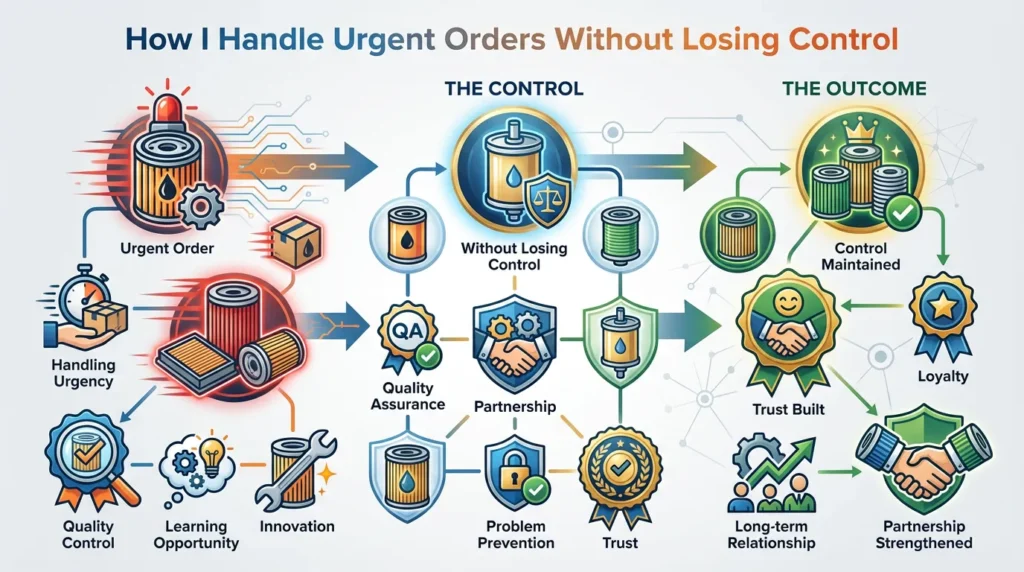
In the automotive aftermarket, urgent orders are not an exception.
They are part of daily reality.
- A promotion performs better than expected
- A competitor cuts price aggressively
- A forecast misses a trend
- A vessel delay causes unexpected stockouts
So it was no surprise when a distributor once messaged me late at night:
“Bruce, we are running out of stock.
Can you ship 4 SKUs earlier?”
For many suppliers, “urgent order” means chaos:
- rushed production
- pressure on QC
- unrealistic promises
- late‑night “we will try” messages
Urgency doesn’t scare me —
because at Beling Filters, we manage it with structure, not emotion.
Here’s how I handled that order, and how we handle urgent orders in general without losing control of quality or schedules.
Why Most “Urgent Orders” Turn Into Chaos
Before explaining our method, it’s important to understand why urgent orders are so painful for many factories.
Typical reaction patterns in less controlled environments:
- Sales says “yes” immediately to please the customer
- Production squeezes in a new job without revising the schedule
- QC is asked to “move faster” or “skip some steps just this time”
- Packing and logistics scramble to rebuild plans
- Other customers’ orders quietly get delayed
Result:
- one urgent order gets “saved”
- two or three normal orders get damaged
- QC risks increase
- planning becomes unpredictable
In other words:
The factory solves one problem and creates three more.
We decided we needed a different approach.
Step 1 – Assess First, Answer Second
2.1 Why I Don’t Say “No Problem” Instantly
That night, when the distributor asked:
“Can you ship 4 SKUs earlier?”
I did not reply with:
- “No problem”
- “We will try”
- “We will push the factory”
Instead, I paused and assessed the reality.
Because a promise without assessment is:
- not professional
- not respectful to other customers
- not safe for quality
2.2 What I Check Before Committing
Before replying, I checked:
- ✔ Current production load
- Which orders are running?
- Which lines are occupied?
- Where are we in the daily and weekly plan?
- ✔ Material availability
- Do we have enough filter media, PU, steel, components for those SKUs already in stock?
- If not, when will they arrive?
- ✔ Machine occupancy
- Are the pleating and assembly machines free at any realistic window?
- What setups and changeovers are required?
- ✔ Curing time flexibility
- For PU or resin curing, can timing be optimized?
- Can we use existing curing slots without overloading?
- ✔ Pending QC checkpoints
- What inspections or tests are scheduled?
- Will this urgent order collide with critical QC work?
- ✔ Packing timeline
- Can we realistically pack and palletize earlier?
- Do we have the manpower and packing materials ready?
Only after understanding the real situation did I reply with a responsible commitment.
This is the first rule:
Urgency does not justify careless promises.
Step 2 – Activating Our “Priority Slot” System
3.1 Why We Reserve Capacity for Unpredictable Orders
We know that:
- urgent orders will happen
- forecasts are never perfect
- distributors sometimes underestimate demand
So we don’t treat urgent orders as “rare emergencies.”
We treat them as normal reality.
That’s why we reserve small capacity pockets each week:
- not for last‑minute panic
- but as planned, controlled flexibility
We call this our “priority slot” system.
3.2 How the Priority Slot Helped That Distributor
That night, after checking the schedule, we:
- used our weekly priority slot capacity
- fit his 4 SKUs into the earliest possible window
Importantly:
- we did this without disrupting other customers’ orders
- we didn’t push or cancel existing commitments
- we didn’t overload our machines beyond safe utilization
This allowed us to:
- help one customer who had an urgent need
- maintain our reliability to everyone else
Because an urgent order that solves one customer’s problem by harming others is not a solution — it’s just moving the risk.
Step 3 – Protecting QC Time: No Shortcuts, Ever
4.1 The Temptation to Cut Corners
In urgent situations, many factories think:
- “Let’s simplify testing this time.”
- “We already know this SKU well.”
- “If we reduce sampling, we can ship faster.”
This is dangerous.
A fast shipment that creates downstream problems is worse than a slower one.
It leads to:
- warranty claims
- retailer complaints
- product returns
- damaged brand reputation
4.2 Our Rule: Urgency Does Not Change QC
So I told the customer clearly:
“We can ship earlier, but QC procedures remain the same.”
In our system:
- QC timing is protected, not negotiable
- urgent orders must pass the same checks as regular ones
- sampling plans and test standards don’t get relaxed
We would rather:
- ship a little later
- than release a product that might cause avoidable issues
This is how we keep urgent flexibility from becoming quality instability.
Step 4 – Communicating With Evidence, Not Optimism
5.1 Why “We Are Working On It” Is Not Enough
When buyers place urgent orders, they are under pressure themselves:
- from sales teams
- from retail customers
- from management
Vague messages like:
- “We are trying our best”
- “We will see what we can do”
don’t really help them. They need:
- concrete information
- visual confirmation
- reliable timeframes
5.2 What I Shared With the Customer
To make urgency manageable, I shared:
- ✔ Photos of materials in stock
- Showing the actual media, PU, components ready on hand
- ✔ Updated production timeline
- When the SKUs would enter and exit each process stage
- ✔ Pallet plan preview
- How the units would be combined and loaded
- ✔ Estimated packing completion
- A realistic date and time window
- ✔ Vessel schedule options
- The soonest realistic sailings we could match
With this level of transparency:
- urgency becomes structured
- the distributor can plan internally
- our promise is backed by data, not hope
Urgency becomes manageable when information is transparent.
Step 5 – Giving Choices Instead of Creating Pressure
6.1 Designing Practical Options
Rather than telling the customer,
“Take it or leave it,”
I gave him options — each with clear trade‑offs.
We presented:
- Option A — 3 SKUs early + 1 SKU with regular lead time
- Focus on the highest‑risk stockouts
- Protect his most critical references first
- Option B — Consolidate everything into next week
- Slight delay vs “earliest possible,” but simpler logistics
- One combined shipment, less freight cost
- Option C — Partial air shipment for the fastest‑moving SKU
- Fastest possible replenishment
- Higher logistics cost, but controlled and targeted
6.2 The Customer’s Choice and Reaction
He chose Option A:
- 3 SKUs shipped earlier
- 1 SKU kept on the normal schedule
His feedback:
“Bruce, this flexibility saved our month.”
The key was not “magic capacity.”
It was:
- structured thinking
- realistic planning
- giving him clear choices, not pressure
The Lesson: Urgent Orders Need Systems, Not Miracles
Urgent orders don’t require miracles.
They require systems.
A strong urgent order management system includes:
- 👉 A buffer in production
- Defined priority slots
- Planned flexibility, not last‑minute improvisation
- 👉 A realistic scheduling model
- Understanding what can and cannot be moved
- Respecting existing commitments
- 👉 A QC process that never breaks
- No shortcuts
- No “urgent exceptions”
- 👉 Transparent communication
- Sharing real constraints
- Showing progress visually and factually
- 👉 Multiple options for the customer
- Time vs cost vs scope trade‑offs
- Clear decisions, not emotional pressure
Urgency becomes stressful only when the supplier is unprepared.
A prepared supplier stays calm,
even when the situation is urgent.
Why Overseas Buyers Value This Structured Approach
8.1 What They Fear During Urgent Orders
European and American distributors often tell me they worry about:
- ❌ Delayed promises
- Being assured “no problem” and then surprised later
- ❌ Quality drops during rush orders
- Complaints spike after “special urgent” shipments
- ❌ Poor communication
- Only hearing about issues once it’s too late to react
- ❌ Disruptions to other SKUs
- One urgent SKU causes other references to be delayed
In other words, they fear chaotic urgency.
8.2 What They Appreciate Instead
They appreciate suppliers who:
- ✔ Stay calm under pressure
- ✔ Think structurally, not emotionally
- ✔ Protect quality even when schedules are tight
- ✔ Solve problems without chaos
- ✔ Communicate proactively and clearly
Reliability during normal times is expected.
Reliability under pressure is what builds real trust.
How Beling Filters Manages Urgent Orders in a Controlled Way
At Beling Filters, we built our urgent order approach on top of solid systems and capacity.
9.1 Priority Production Slots
We maintain:
- ✔ Priority production slots every week
These are:
- pre‑reserved pockets of capacity
- used to absorb real‑world fluctuations and urgent needs
This avoids:
- overloading lines
- disrupting existing orders
9.2 Stable Material Reserves
We keep:
- ✔ Stable material reserves for key SKUs and platforms
This helps us:
- respond faster when urgent orders arrive
- avoid last‑minute upstream scrambling
Our material planning is aligned with:
- historical consumption
- seasonal patterns
- key customer forecasts when available
9.3 Strict QC Timing
We maintain:
Meaning:
- incoming inspection
- in‑process checks
- final product QC
are all:
- planned
- measured
- non‑negotiable
Urgent orders go through the same QC framework.
9.4 Flexible Pallet Planning
We use:
- ✔ Flexible pallet planning
So we can:
- adjust loading plans
- split pallets across shipments if needed
- prioritize fastest‑moving SKUs
This supports urgent orders without wasting freight.
9.5 Multi‑Channel Communication
We work with:
- ✔ Multi‑channel communication
Including:
- email
- messaging platforms (e.g. WhatsApp, WeChat, etc.)
- shared documents or schedules when appropriate
This allows:
- fast updates
- clear status tracking
- less misunderstanding
9.6 IATF 16949‑Controlled Processes
All of this sits on top of:
- ✔ IATF 16949‑controlled processes
Which means:
- documented procedures
- root cause analysis when issues arise
- continuous improvement
We don’t panic under urgency —
we plan for it.
Beling – Save Your Time & Cost
In the automotive aftermarket, urgent orders are inevitable.
What matters is how your supplier responds.
When a distributor told me, “Bruce, we are running out of stock. Can you ship 4 SKUs earlier?” I:
- assessed the real situation first
- activated our priority slot system
- protected QC time
- communicated with evidence
- gave him options instead of pressure
He chose a balanced solution and later said:
“Bruce, this flexibility saved our month.”
At Beling Filters, we manage urgent orders with:
- ✔ Priority production slots
- ✔ Stable material reserves
- ✔ Strict QC timing
- ✔ Flexible pallet planning
- ✔ Multi‑channel communication
- ✔ IATF 16949‑controlled processes
If you need a partner who handles urgent orders with clarity and control —
not panic and excuses —
Let’s connect and build a supply chain that stays stable,
even when plans change.
📩 bruce.gong@belingparts.com
🌐 www.belingparts.com
Your valuable automotive filter partner since 2008.