On paper, our oil filters looked perfect.
- Correct dimensions
- Correct micron rating
- Strong materials
- All lab tests: ✅ Passed
From an engineer’s perspective, everything was “within spec.”
From a catalog perspective, the product was “good enough.”
But one distributor kept giving me the same feedback:
“Bruce, mechanics don’t love them yet.
They say ‘it works’, but not ‘this is better’.”
That one sentence changed the way I think about product development in the automotive aftermarket.
Because in this business, the person who really decides if your product wins is not:
- the engineer
- the purchasing manager
- the salesman
It’s the mechanic, under the car, with dirty hands and limited time.
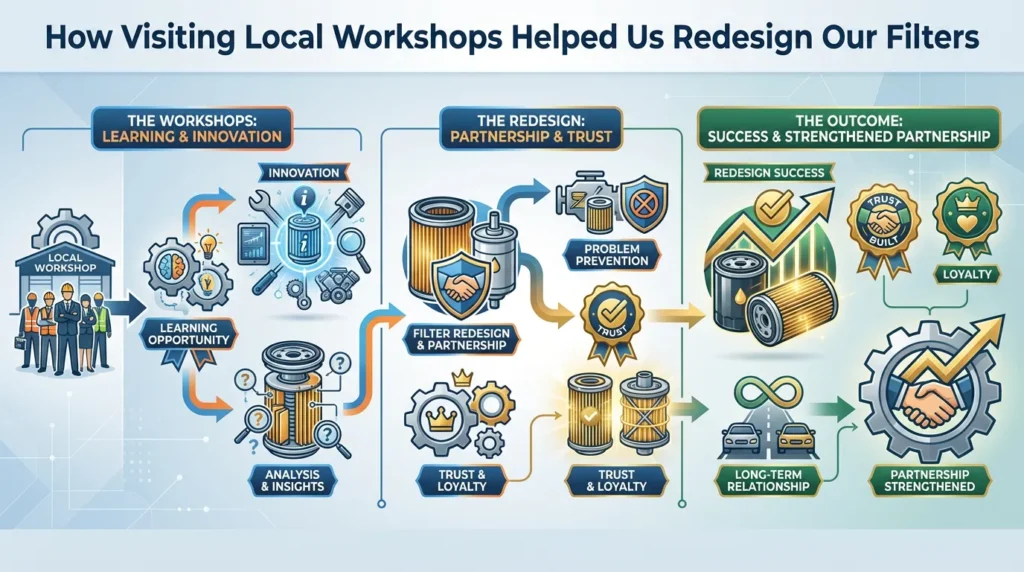
This is the story of how visiting local workshops and listening to mechanics helped us redesign our filters and move from “it works” to “this feels right.”
When Lab Performance Is Not Enough in the Aftermarket
At the beginning, our mindset was very typical:
- follow OE dimensions
- meet or exceed OE filtration efficiency
- use strong, reliable materials
- pass all the lab and bench tests
On paper, this is exactly what a “good filter” should be.
Our testing covered:
- burst pressure
- filtration efficiency
- flow rate
- anti‑drainback valve function
- sealing performance
The results were solid.
Our internal reports looked great.
Yet, our distributor’s message stayed the same:
“They work, but mechanics don’t prefer them.
If there’s another brand in stock,
they don’t actively choose yours.”
This is a very important distinction:
- “It works” = technically OK, but emotionally neutral
- “This is better” = preferred, recommended, requested
In the aftermarket, that difference can decide:
- which filter the workshop reaches for first
- which brand mechanics recommend to car owners
- which product gets repeat orders organically
So I realized:
If we wanted to become a preferred brand, not just an acceptable one,
we had to get out of the office and into the field.
Field Visit: From Meeting Room to Workshop Floor
On my next trip to visit this distributor,
I changed my normal routine.
Instead of spending most of the time in:
- office meetings
- PowerPoint discussions
- Excel review sessions
I asked him a simple question:
“Can you take me to the workshops you supply?”
He agreed.
We spent two full days visiting local garages and workshops.
There was:
- no formal presentation
- no projector
- no big speeches
Just:
- coffee
- dirty hands
- and real conversations with the people who use our filters every day.
This kind of visit is very different from a trade show or a conference:
- you see reality, not theory
- you see what people actually do, not what they say on a survey
- you see hundreds of small details that never appear in a lab report
Observing Mechanics: How Filters Are Really Used
During those 2 days, I tried not to “sell” anything.
I just watched and asked questions.
I paid attention to how mechanics:
- removed the old filter
- grabbed and held the new filter
- positioned their hands when tightening
- handled the used filter after removal
- moved around the vehicle during an oil change
Some specific observations stood out.
3.1 How They Removed the Old Filter
I watched:
- what tools they used (wrench, hand, strap, etc.)
- how much force was needed
- how much oil spilled during removal
Sometimes, the mechanic had to:
- use extra tools to get a good grip
- wipe the filter just to hold it properly
- adjust his body position multiple times
You could see small signs of frustration, even if they didn’t complain verbally.
3.2 How They Grabbed and Held the New Filter
This was especially interesting.
I focused on:
- how they picked the new filter from the box
- where they naturally placed their fingers
- whether the surface was easy to grip, especially with oily hands
One small detail really opened my eyes:
One mechanic wrapped tape around the filter
to give himself a better grip while tightening.
From a lab perspective, our filter shell was perfectly fine.
From his perspective, it was too smooth for real working conditions.
3.3 How They Dealt With Oil Drain and Cleanliness
I also watched how they handled oil drainage:
- how they positioned the used filter
- how they tried to get as much oil out as possible
- where they let the oil drip
Another moment stood out:
A mechanic hit the filter against the floor
to let oil drain faster and more completely.
It looked a bit “rough,” but it was his way of:
- saving time
- reducing mess
- making sure the filter didn’t leave too much oil trapped inside
Our lab tests didn’t include:
“mechanic hitting filter on floor to speed up oil drain.”
But in real life, it happens.
3.4 What They Said About Seals and Installation
Several mechanics commented on the sealing ring:
- “The seal is OK, but a bit too hard in winter.”
- “In cold days, I need more force to get it seated comfortably.”
Again, on paper:
- seal hardness was within standard range
- sealing test results were fine
But in the workshop:
- the feeling during installation mattered
- especially in low temperatures
None of these things are part of a typical lab specification sheet.
But for the person under the vehicle,
they matter a lot.
What We Learned: Lab Reality vs. Workshop Reality
After two days of observing and talking to mechanics, one thing became clear:
There is a gap between “engineer reality” and “mechanic reality.”
On the engineer side, we think about:
- filtration efficiency
- burst pressure
- material strength
- technical specifications
On the mechanic side, they feel:
- grip
- comfort
- speed
- effort
- small annoyances
Both views are important, but only one happens under the car, every day.
Some key insights we took home:
- A filter can be technically correct, but not pleasant to work with.
- Tiny details (like surface texture or seal softness) can make a big difference in daily use.
- Mechanics often adapt the product to their needs (tape, hitting, extra tools) when the design doesn’t fully support them.
These insights reshaped how we approached product design.
Back to China: Turning Workshop Feedback Into R&D Actions
I went back to China with a different mindset.
I didn’t just bring photos and notes.
I brought stories of real people:
- the mechanic who wrapped tape around the filter
- the one who hit it on the floor to drain oil
- the ones who talked about seal hardness in winter
Together with our R&D team, we reviewed:
- our existing designs
- workshop feedback
- potential adjustments that would not compromise technical performance
We focused on three main areas.
5.1 Adjusting the Shell Texture for Better Grip
First, we addressed the grip issue.
We asked:
- how can we help mechanics hold the filter more securely,
especially with oily hands and in tight spaces?
We adjusted:
- the surface texture of the shell
- used a design that provided more friction
- without affecting the structural strength or appearance
This was a small change in production,
but a big change in handling.
Now, instead of needing tape or extra tools,
a mechanic could grip the filter more confidently with a gloved hand.
5.2 Softening the Sealing Ring for Low Temperatures
Next, we focused on the sealing ring hardness, especially in cold climates.
We worked on:
- slightly softening the compound used in the sealing ring
- making sure it still kept excellent sealing performance
- ensuring durability over the full service interval
The goal was:
- easier seat and compression in low temperatures
- more comfortable installation torque
- no negative impact on long‑term sealing behavior
We validated the new seal design through:
- lab testing
- environmental (temperature) testing
- and then real field feedback
5.3 Improving the Inner Design for Cleaner Oil Drain
Finally, we looked at the inner design related to oil drainage.
We explored:
- internal geometry that would allow oil to flow out more completely
- reducing the tendency for oil to get “trapped” inside the filter after removal
The result:
- when mechanics removed the filter and let it drain,
more oil came out more quickly - less mess
- easier handling and disposal
Again, this is something you don’t see in a standard data sheet,
but it changes the daily experience of using the product.
The Follow‑Up Visit: Quiet Confirmation from Mechanics
On my next visit to that market,
I brought the updated filters.
We didn’t arrive with:
- big marketing speeches
- printed brochures saying “New Improved Design!”
- or a long technical explanation
We simply:
- visited the same workshops
- met the same mechanics
- and put the new filters in their hands
Then we watched.
Their reactions were simple and honest:
- “Ah, this is easier.”
- “Now this feels right.”
No dramatic comments.
No “wow, this is revolutionary.”
Just:
- smoother installation
- more comfortable grip
- better feeling at the seal
And in real life, that quiet satisfaction is exactly what you want.
Because when mechanics feel:
- “This filter is comfortable to use”
- “This feels right in my hand”
they are much more likely to:
- choose your brand first
- recommend it to others
- ask the distributor to keep stocking it
No big marketing claims.
Just daily preference from the people who matter most.
The Lesson: Design for the Mechanic’s Hands, Not Only the Drawing
This whole journey taught me something important:
Real product improvement doesn’t start in the meeting room.
It starts where the product is used.
If you design only for:
- the engineer’s drawing
- the specification sheet
- the lab report
you may create a product that is:
- correct
- functional
- acceptable
But if you design also for:
- the mechanic’s hands
- the workshop workflow
- the real environment (oil, cold, tight spaces)
your product can become:
- a preferred choice
- a brand that mechanics trust and like to use
In the aftermarket, this difference is huge.
Because the mechanic is not just another user.
He is your real product tester, every day.
What This Means If You’re a Distributor or Importer of Auto Filters
If you are an importer or distributor,
you know how important mechanics are in your market.
They decide:
- which filters are “OK”
- which filters are “better”
- which brands they recommend when the car owner says:
“What do you suggest?”
When you choose a filter supplier, look beyond:
- catalog specs
- price per piece
- lab reports
Ask questions like:
- “Have you visited workshops in our type of market?”
- “What changes have you made based on mechanic feedback?”
- “How do you integrate field visits into your R&D process?”
Because a supplier who listens to mechanics and adjusts products accordingly is more likely to:
- support your brand positioning
- reduce complaints from workshops
- help you build loyalty at the mechanic level
That loyalty is what creates:
- repeat orders
- stable volumes
- predictable growth over time
If You Want a Filter Supplier Who Listens to the Field
We don’t just sit in meeting rooms and look at drawings.
We believe in:
- visiting workshops
- talking directly to mechanics
- watching how filters are used in real conditions
- bringing those insights back to our R&D and production teams
If you want a filter supplier who:
- is willing to go into the workshops with you
- listens to local mechanics
- adapts products to how your market really works
- balances lab performance and field comfort
I’d be happy to discuss your needs:
- key vehicle parc in your market
- special climate or usage conditions
- mechanics’ habits and preferences
- where your current filters are “OK” but not yet “preferred”
📩 bruce.gong@belingparts.com
🌐 www.belingparts.com
When you design for the mechanic’s hands –
not only for the engineer’s drawing –
your filter stops being “one more option”
and starts becoming the first choice.