A few years ago, a distributor from South America told me:
“Bruce, I’m tired of pushing other people’s brands.
I want to build my own – but I don’t know where to start.”
He expected a price list for generic filters with his logo printed on the box.
We offered something very different:
not just filters with his name, but a roadmap to a real brand. 🧭
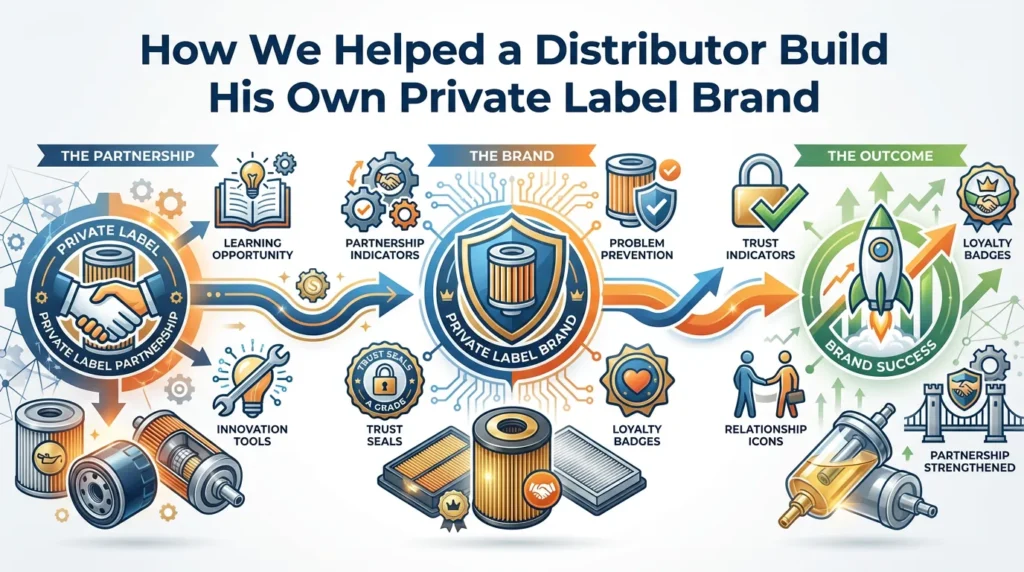
This is how we helped him move from “selling boxes” to building a brand customers ask for by name.
The Distributor’s Challenge: From Reseller to Brand Owner
1.1 Tired of Building Other People’s Brands
This client had been in the automotive aftermarket for years:
- importing air, oil, fuel, and cabin filters
- distributing well-known international brands
- supporting their promotions, posters, and catalogues
He had built a solid business.
But he had also built something else – other people’s brand equity.
Every time:
- a mechanic recommended a filter
- a retailer explained options
- a driver asked for “that brand they trust”
it was the supplier’s brand name, not his.
He told me:
“If one day these brands change distributor, what do I have left?
My customers know their names, not mine.”
He wanted to change this.
1.2 He Thought Private Label Just Meant “Put My Logo on the Box”
At first, he thought private label was:
- choose a name
- send it to a factory
- get a price list
- print the logo on filters and boxes
This is exactly how many factories treat private label:
- same product
- different logo
- superficial customization
But if you do only that, you are not really building a brand.
You are just printing your name on someone else’s idea.
He needed more than logo printing.
He needed a strategy.
Step 1 – Define the Brand, Not Just the Logo
The first thing we changed was the starting point.
Instead of asking:
we started by asking:
- “What should this brand stand for in your market?”
2.1 The Questions We Asked Before Doing Any Artwork
We asked him:
- 🔹 Which vehicles do you focus on?
- passenger cars?
- working trucks and light commercial vehicles?
- heavy-duty fleets?
- 🔹 Do you want to be premium, value, or economy?
- are you targeting mechanics who want the cheapest option?
- or fleet managers who care more about durability and uptime?
- 🔹 How do your mechanics and retailers describe a “good filter”?
- “strong and durable”?
- “airflow and fuel economy”?
- “no complaints from customers”?
- “good value for working trucks”?
We didn’t open Adobe Illustrator.
We opened our ears.
2.2 Turning His Answers Into a Brand Positioning
From his answers, we understood:
- his main business was working trucks and light commercial vehicles
- his customers were:
- mechanics
- small fleet owners
- people who use their vehicles to earn a living
These customers did not need:
- fancy marketing claims
- “racing performance” language
- complicated technical jargon
They needed:
- filters that do their job, day after day
- at a fair price
- with consistent quality
So we positioned his new brand as:
“Reliable quality for working trucks – no fancy promises, just honest performance.” 🚚
This positioning guided:
- packaging
- messaging
- product selection
- and even the tone of the texts on the box
It was not “just a logo”.
It was a promise that his market could understand and believe.
Step 2 – Make the Product Speak the Same Language
Once we had defined what the brand should stand for, we moved to design and product details.
The key rule was:
Every design decision must come from his market reality, not our taste in the office.
3.1 Designing a Simple, Strong Logo for Real-World Use
Together we:
- 🎨 designed a simple, strong logo
- clear and easy to read
- visible from a distance on shelves
- suitable for:
- boxes
- labels
- catalogues
- and future digital use
We avoided:
- overly complex graphics
- fine lines that disappear when printed small
- colors that are hard to reproduce consistently
For a real aftermarket brand, a good logo is not “art”.
It’s a tool:
- to be recognized fast
- to look solid and professional
- to survive dust, scratches, and handling in warehouses and workshops
3.2 Choosing the Right Carton Strength for His Warehouse Reality
Next, we looked at carton strength and packaging structure.
We discussed:
- his warehouse conditions
- stacking height
- humidity
- and how products are transported and stored
Then we:
- 📦 chose an outer carton strength suitable for tough warehouse conditions
- enough to handle stacking
- enough to avoid boxes getting soft or collapsing
- strong enough to protect the “new brand image”
Weak packaging can destroy a new brand’s perception quickly:
- if boxes arrive crushed
- if corners are broken
- if packaging looks cheap
even a good filter inside will be judged negatively.
3.3 Bilingual Labels for Local Confidence and International Credibility
We also knew his market needed to connect:
- local trust
- with international legitimacy
So we:
- 🧾 created bilingual labels
- local language (for mechanics, drivers, warehouse staff)
- English (for technical teams, catalogues, and future expansion)
This helped:
- local users feel the brand is theirs
- international partners see that the brand is serious and export-ready
3.4 Building a Focused Mini Catalogue on the Top 80 References
Instead of starting with a huge catalogue, we:
- 📚 built a mini catalogue
- focused on his top 80 references
These were:
- his fast-moving parts
- the ones his customers ask for daily
- the references that would create early visibility for the brand
The mini catalogue:
- kept things simple for retailers and mechanics
- made it easier for his sales team to present the brand
- reduced confusion and complexity at launch
Later, as the brand grew, he could expand:
- more references
- more vehicle coverage
- more detailed catalogues
But for the launch, simplicity and focus were key.
Step 3 – Plan the Brand Launch Like a Campaign, Not Just a Shipment
Many private label projects:
- rush to print boxes
- place a big first order
- and hope the market will “figure it out”
We proposed a different approach:
Treat the launch like a campaign, not just a shipment.
4.1 Start With Fast-Moving References Only
First, we suggested:
- 1️⃣ start with the fast movers only
Why?
- these references move faster
- mechanics see them more often
- feedback from the market comes quickly
This allowed him to:
- test the brand’s acceptance
- adjust any detail if needed
- reduce risk of slow-moving stock under a new name
4.2 Introduce a “Switch Program” for Existing Customers
Second, we designed a simple but powerful “switch program”.
The concept was:
- 2️⃣ Offer a “switch program”:
“Bring your old brand invoice, try 1–2 cartons of the new brand at special terms.”
This did several things:
- rewarded existing customers for trying his new brand
- reduced their risk (small trial quantity, special conditions)
- created a smooth path from old brands to his private label
Instead of saying:
- “Stop buying your usual brands, just trust this new one”
he was saying:
- “You can test this new brand with very little risk”
In B2B, testing beats forcing.
4.3 Support Retailers With Simple, Visible Brand Tools
Third, we worked on point-of-sale presence.
We suggested:
- 3️⃣ use posters and simple counter displays for key retailers
These materials:
- showed the brand name clearly
- communicated the “reliable quality for working trucks” message
- made it easier for retailers to promote the new name
When a mechanic asked:
the retailer had:
- visual support on the wall
- a clear message to explain
- and sample boxes ready to show
Overcoming the Big Fear: “Will Customers Trust a New Brand?”
Naturally, he was nervous.
He said:
“What if customers don’t trust a new brand?”
This is the biggest psychological barrier for distributors considering private label.
They worry that:
- mechanics will ask for international brands they already know
- customers will see a new brand as “cheap” or “risky”
- switching will damage their reputation
We addressed this fear directly.
5.1 Putting Our Credibility Behind His Brand
To reduce his risk and increase credibility,
we printed on every box:
“Produced by an ISO-certified manufacturer
with more than 15 years of export experience.”
This messaging did two important things:
- It reassured his customers that there is a serious factory behind the new name.
- It allowed him to say, when asked:
- “This is my brand, produced by a manufacturer with solid international experience.”
His brand was on the front.
Our credibility and manufacturing strength were on the back. 🤝
It became a partnership:
- his market knowledge + our production expertise
- his identity + our manufacturing reputation
The Result After Six Months: Customers Asking for His Brand
Six months after the launch, he sent me a message:
“Bruce, now my customers ask for my brand name,
not the international brands I used to distribute.”
This meant:
- mechanics were remembering and requesting his brand
- retailers were comfortable recommending it
- the market had started to accept and trust his identity
And then something interesting happened.
6.1 Improved Margin and Negotiating Power
Because it was his own brand:
- his margin improved
- he was not limited by the fixed structure of big international brands
- he had more flexibility on pricing
- his negotiating power improved
- he was less dependent on one or two big suppliers
- he controlled his own brand strategy
He moved from:
- “just another distributor”
to:
- “brand owner and market reference”
6.2 Other Suppliers Wanted to Go Under His Brand
Ironically, after some time:
- other suppliers started asking to supply filters under his brand
They saw:
- his brand was becoming known in the market
- mechanics trusted it
- retailers stocked it
Now, other manufacturers wanted to benefit from his brand,
just as he once helped build other people’s brands.
That is the power of successful private label done with strategy, not just printing.
The Lesson: Selling Boxes vs. Building a Brand
In the aftermarket, there are two levels of business:
Selling boxes
- importing products
- distributing them
- competing on price
Building a brand that customers remember and request by name
- creating identity
- building trust
- gaining long-term leverage
Both are business.
But the second gives you:
- more control
- more stability
- more strategic value
A good manufacturing partner should not only:
It should also:
- help you define a clear brand positioning
- design packaging and labels for your real market conditions
- support you with a launch strategy, not just a packing list
Thinking About Creating or Upgrading Your Private Label?
If you are a distributor considering:
- creating your first private label
- upgrading an existing “logo-only” brand into a real identity
- moving from selling international brands to building your own name
we can support you in a practical, step-by-step way:
- product selection for your fast-moving references
- brand positioning and message
- logo and packaging design aligned with your market reality
- bilingual labels and catalogues
- launch plan and “switch program” ideas
For air, oil, fuel, and cabin filters,
we combine:
- more than 15 years of export experience
- ISO-certified manufacturing
- and real-world lessons from distributors across Latin America, Europe, the Middle East, and beyond
If you want a partner who cares not only about putting your logo on a box,
but about helping you sell your identity in your market,
let’s talk:
📩 bruce.gong@belingparts.com
🌐 www.belingparts.com
Your brand can be more than a label.
It can be an asset that works for you every day,
long after a single shipment is forgotten.