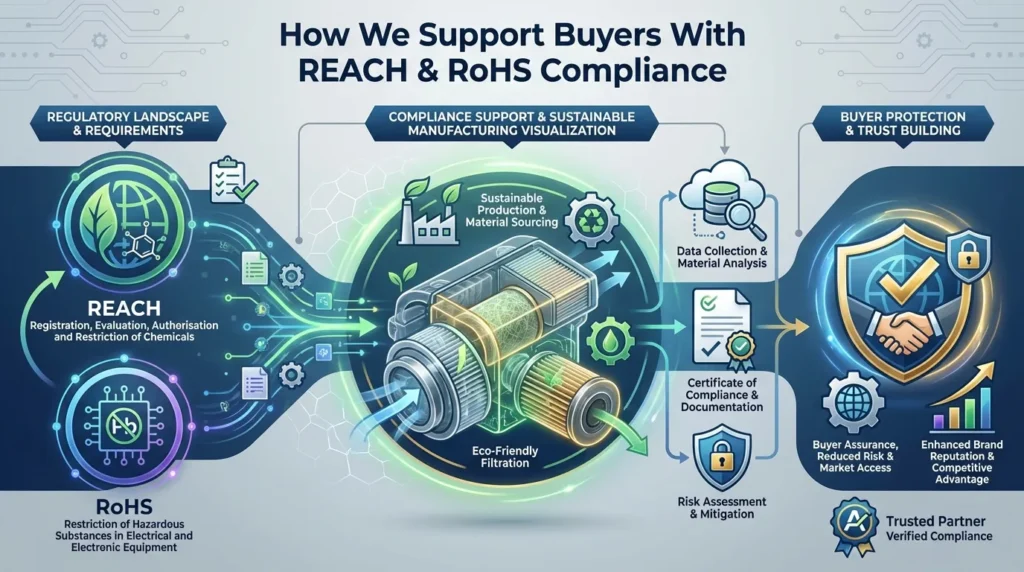
For many buyers, REACH and RoHS feel like a moving target.
- Rules are updated
- Customers ask for deeper documentation
- One missing paper can delay or block a shipment
If you are selling automotive filters into the European Union or other regulated markets, “we are compliant” is not enough.
Your customers, your quality team, and sometimes even your legal department need:
- Proof – clear documentation and test reports
- Structure – a system that can be audited and repeated
- Speed – the ability to respond quickly when someone asks for evidence
At Beling Filters, we learned this early.
We don’t treat REACH and RoHS as a one-time statement.
We treat them as a managed system around materials, suppliers, and documents.
Below is how we support REACH & RoHS compliance for automotive filters for buyers who are selling into the EU and other sensitive markets.
Why REACH and RoHS Compliance Matters for Automotive Filters
REACH and RoHS compliance are no longer “nice-to-have” checkboxes for EU-focused distributors and brand owners. They are directly tied to:
- Your ability to sell in regulated markets
- Your brand reputation with OEM, retail, and workshop customers
- Your risk exposure if an authority or key client performs an audit
For automotive filters, the challenge is practical:
- Filters contain rubber, plastic, metal, adhesives, paper media
- These materials can involve substances of very high concern (SVHC) under REACH
- Certain components must meet RoHS substance limits if they fall under relevant categories (e.g., electronic components in more complex assemblies)
Even when a specific filter is outside strict RoHS scope, many buyers still align their internal policy with RoHS limits across their entire automotive product range, to keep risk and messaging consistent.
We see three main pain points on the buyer side:
- Confusion about which rules actually apply to their product and market
- Difficulty getting consistent, traceable documentation from suppliers
- Time wasted chasing declarations and test reports every time a customer asks
Our approach is to build a repeatable process around these pain points, not just send ad-hoc PDFs.
Understanding REACH RoHS Requirements for Automotive Filters and Buyer Markets
Before we talk about documents or labs, we start with your market and your customer.
This is where REACH RoHS requirements for automotive filters become concrete.
We always begin a project with three key questions:
- Where will you sell these filters?
- EU, UK, EEA, or other regulated/sensitive markets
- Export destinations via your own customers
- What is the main sales channel?
- OEM (vehicle or system manufacturers)
- Retail chains (auto parts stores, e-commerce, hypermarkets)
- Workshops / garages
- Do you have specific REACH/RoHS clauses in your contracts?
- Customer-specific documentation formats
- Audit rights or reporting frequency
- Requirements for third-party testing vs. supplier declarations
Based on your answers, we can determine:
- How strict and detailed the documentation needs to be
- Whether supplier declarations are enough or you will need lab test reports
- What kind of naming, file structure, and language your customers expect
Our goal is to match our documentation strategy to your real-world compliance obligations, not only to abstract regulations.
Building a Controlled Material List for Filter REACH & RoHS Compliance
The core of controlled material list for filters is simple:
if you don’t know what materials you are using, you can’t prove compliance.
For our automotive filters, we maintain a controlled, documented material framework:
- Approved raw material list
- Rubber compounds
- Plastics and resins
- Adhesives and glues
- Metals (end caps, center tubes, springs, etc.)
- Filter paper / non-woven media
- Supplier declarations & MSDS (Material Safety Data Sheets)
- We collect and update REACH-related information from key material vendors
- We track RoHS-relevant substance content where applicable
- Internal records of material changes
- If a material is changed or a supplier is switched, we record it
- We understand which filter families are impacted
This means that when buyers ask for REACH or RoHS documentation:
- We are not starting from zero and “chasing papers”
- We already know what went into each part family
- We can respond faster and more accurately, backed by real data
This material backbone is what makes later declarations, lab tests, and compliance updates credible and auditable.
Coordinating REACH RoHS Testing for Automotive Filters With Accredited Labs
For some partners, especially those selling into:
- The EU
- Large retail chains
- Brand owners with strict compliance programs
supplier declarations are not enough. They need third-party test reports.
This is where REACH RoHS testing for automotive filters becomes essential.
In these cases, we support buyers by:
Helping select appropriate test items
- Identifying which substances and parameters are truly relevant
- Avoiding unnecessary tests that add cost but no value
- Aligning with your internal or customer-specific test scope
Coordinating samples and lab communication
- Preparing representative samples by part number or part family
- Sending them to accredited laboratories that are recognised in your market
- Handling logistics, forms, and technical discussions in Chinese when needed
Aligning report format with buyer requirements
- Ensuring reports contain the data fields you or your customers need
- Making sure they are usable in your compliance system
- Linking reports to part numbers / product families clearly
The goal is not just to get a “PASS” on a test.
The goal is to get test reports that fit your real documentation workflow and that you can actually show to customers and auditors.
REACH RoHS Documentation Management: Simple, Searchable and Standardised
Many companies struggle not because they lack documents, but because they lack order.
They end up with:
- 10 versions of the same file
- Files saved under different names by different people
- No easy way to respond when someone asks for RoHS or REACH for multiple part numbers
Our approach to REACH RoHS documentation management is to make it:
- Simple
- Searchable
- Standardised
We do this through:
Standardised templates for declarations
- REACH declaration templates
- RoHS compliance declarations
- Sometimes combined formats if that fits the buyer’s system
Clear file naming by part number / part family
- Example: REACH_Declaration_AirFilter_Family_XYZ_2026-06.pdf
- This makes it easy to see what applies to which product group
Centralised storage and internal access
- Our team knows where to find the latest version
- We avoid inconsistent replies coming from different people
Result: when a buyer asks,
“Can you send me REACH/RoHS for these 20 items?”
we can answer quickly and consistently, instead of starting a mini internal investigation every time.
Communicating REACH RoHS Limitations and Buyer Expectations Clearly
In real projects, not every document request is reasonable or necessary.
Some buyers ask for:
- Documents that are not relevant for their market or product type
- Very broad or deep documentation for a small volume or low-risk project
Our principle around REACH RoHS limitations and buyer expectations is honesty and clarity.
When this happens, we prefer to explain:
- What we can provide immediately
- Existing declarations
- Current lab reports
- Available material and supplier data
- What requires extra time or cost
- New lab tests for specific parts
- Special formats or customer-specific templates
- Additional sampling or verification steps
- What is realistically necessary for their risk level
- Based on the destination market
- Based on the sales channel (OEM vs. workshop)
- Based on typical customer expectations in that segment
This style of communication helps you:
- Set realistic expectations with your own customers
- Avoid over-promising on documentation that does not exist yet
- Protect your margins by not over-loading small projects with unnecessary testing
In our experience, honest discussion builds more trust than saying “yes” to everything and later failing to deliver.
Our Process for REACH RoHS Compliance for EU Automotive Filters and Sensitive Markets
Pulling it all together, this is our practical process for REACH RoHS compliance for EU automotive filters and other sensitive markets:
Market & Customer Mapping
- Identify destination markets and channels
- Clarify contractual and customer-specific compliance requirements
Material & Supplier Control
- Maintain a controlled material list
- Keep supplier declarations and MSDS up to date
- Track material changes and affected filter families
Testing Strategy
- Decide when supplier declarations are sufficient
- Define when third-party lab testing is needed
- Select labs and test items in line with your expectations
Documentation System
- Use standardised templates and clear naming
- Centralise storage and internal access
- Keep records linked to part numbers and families
Transparent Communication
- Explain what is available now vs. what needs time/cost
- Align expectations with risk level and project size
- Support you in answering your customers confidently
Compliance is not only about avoiding penalties.
It is also about:
- Protecting your brand reputation
- Showing your customers that you are a responsible supplier
- Keeping your sales pipeline open in regulated markets, instead of blocked by missing documents
Work With a Filter Manufacturer That Understands REACH & RoHS
If you are selling automotive filters into the EU, UK, or other regulated markets and:
- You are tired of chasing suppliers for REACH and RoHS documents
- You struggle with inconsistent or incomplete declarations
- Your customers are starting to ask harder compliance questions
we can help you build a more structured compliance workflow around your filter program.
At Beling Filters, our export and quality teams:
- Maintain controlled materials and documentation
- Support lab testing when needed
- Deliver fast, organised responses to REACH/RoHS requests
If you want, we can share a simple REACH/RoHS checklist we use for new projects, which you can adapt for your internal supplier evaluation.
Contact Our Team
Bruce Gong – Key Account Manager, Beling Filters
Email: bruce.gong@belingparts.com
WhatsApp: +86 150 5776 4729
LinkedIn: www.linkedin.com/in/brucegong-beling
Let’s make your compliance documentation as strong as your product quality.