In the automotive aftermarket, quality isn’t what you claim – it’s what you can prove.
Every importer, distributor, and workshop owner knows the real cost of a failed part.
A filter that fails early costs far more than the unit itself:
- It damages your reputation
- It reduces trust from workshops and fleets
- It creates warranty costs, returns, and lost customers
At Beling Filters, we believe that testing is the only language the market truly trusts.
That’s why every air, cabin, oil, and fuel filter we manufacture must pass a strict series of performance and safety tests before it is approved for export to our partners in 30+ countries.
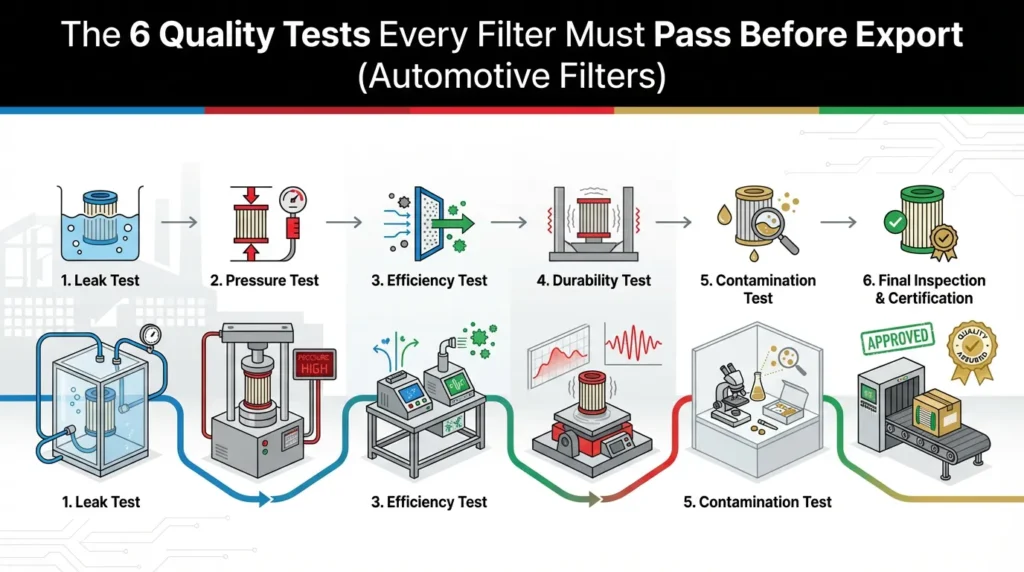
Below are the six critical quality tests we perform to ensure OE-level performance and batch-to-batch consistency.
Filtration Efficiency and Particle Separation
The most fundamental question for any filter is simple:
Does it actually stop contaminants?
A filter that looks good but cannot capture the right particles is a hidden risk – the engine, fuel system, or cabin occupants pay the price.
1.1 ISO-Standard Efficiency Testing
Using ISO-standard test dust, we measure:
- Filtration efficiency percentage – e.g., 99.8% efficiency at 20 microns (example value)
- The ability of the filter to remove a defined proportion of contaminants at specific particle sizes
We verify:
- Micron Rating Accuracy
- If a filter is specified for a certain micron rating, we confirm it in the lab
- This proves the filter media performs to the claimed filtration level
- Multi-Layer Media Performance
- Many filters use multi-layer media (e.g., support layer + fine filtration layer)
- We test how these layers work together to trap dirt without blocking prematurely
This is especially important for:
- Air filters operating in dusty environments (silica dust, road dust)
- Cabin filters that must capture pollen, PM particles, and sometimes gases (with carbon)
- Oil and fuel filters protecting precision components like injectors and bearings
1.2 Why It Matters
This test answers the core question:
“Will this filter actually protect the vehicle as promised?”
When we say our filter is OE-level, it’s because the measured efficiency and particle separation meet OEM-style targets – not because we wrote it on the box.
Airflow Restriction and Pressure Drop Testing
A filter that traps dirt but blocks airflow is almost as bad as no filter at all.
Excessive restriction leads to:
- Engine suffocation
- Reduced power and poor fuel economy
- Weak air conditioning or heater performance in the cabin
To avoid this, we conduct Airflow Restriction and Pressure Drop tests, especially for air and cabin filters.
2.1 Initial and Final Restriction Tests
We measure:
- Initial Resistance (New Filter)
- The pressure drop across the filter when it is brand new
- Ensures that the filter allows the engine or blower to “breathe” properly from day one
- Final Resistance (Loaded Filter)
- The pressure drop after the filter has accumulated test dust to its rated capacity
- Confirms that airflow remains within acceptable limits over the service life
2.2 Matching OEM Pressure Drop Curves
We aim to:
- Match or stay within the OEM’s pressure drop window
- Ensure good balance between filtration efficiency and airflow
If resistance is too high:
- The air filter can reduce engine performance and fuel economy
- The cabin filter can lead to poor ventilation and customer complaints
By validating our filters on restriction test benches, we ensure that they:
- Protect the engine or cabin
- Still allow airflow that matches OEM expectations
Oil Filter Burst Pressure and Structural Integrity
Oil filters operate under high pressure, especially:
- During cold starts (when oil is thick)
- At high RPMs
- In turbocharged or high-performance engines
A structurally weak filter can:
- Bulge or deform
- Crack or burst
- Cause catastrophic oil loss and engine damage
3.1 Burst Pressure Testing
We subject our oil and fuel filters to Burst Pressure Tests that simulate extreme conditions:
- Pressure is gradually increased above normal operating levels
- The filter must withstand a defined burst pressure far higher than what it will see in real use
We verify:
- Canister Strength
- The metal housing must not deform, crack, or rupture
- Wall thickness and construction are designed for safety margins
- Base Plate & Crimping Integrity
- The joint between the metal can and base plate must remain solid
- No separation, cracking, or oil leakage is acceptable
3.2 Why This Matters
These tests ensure our filters are engineered for safety, not just for “normal days”.
Even under extreme driving conditions, pressure spikes, or cold climates, the filter structure remains intact – protecting the engine and your brand’s reputation.
100% Leakage and Seal Testing (Oil & Fuel)
A leaking filter is a critical failure.
It can cause:
- Low oil pressure and engine damage
- Fuel seepage and fire hazards
- Dashboard warning lights and customer panic
- Expensive warranty claims and brand damage
At Beling, we operate with a zero-tolerance policy for leaks.
4.1 100% Leakage Testing – Every Single UnitFor spin-on oil filters, we perform:
- 100% Leakage Test on Every Filter
- Each filter is pressurized and checked for leaks before packaging
- No filter passes the line without a leak test result
This ensures that:
- Canister, base plate, and rolled seams are leak-free
- Threaded areas and gasket interfaces are secure
4.2 Anti-Drain Back Valve and Seal Tests
We also test:
- Anti-Drain Back Valve Function (Oil Filters)
- Verifies that oil remains inside the filter when the engine is turned off
- Prevents dry starts where engine components run without lubrication
- Gasket Sealing Performance
- Checks gasket thickness, compression behavior, and elasticity
- Ensures a tight seal when installed with the correct torque
4.3 No Leaks = No After-Sales Headaches
This combination of testing means:
- Zero tolerance for leaking filters leaving the factory
- Fewer after-sales complaints and costly field problems
- More confidence for workshops installing your branded filters
Filter Media Strength and Pleat Stability
Even if a filter has good efficiency initially, it must also:
- Maintain its structure under pressure
- Resist collapse as it loads with contaminants
Weak media or unstable pleats can:
- Collapse and allow unfiltered air or oil to bypass
- Create channels where dirt passes through
- Reduce service life dramatically
5.1 Media Strength and Burst Tests
We test media strength to ensure:
- Filter paper or nonwoven does not tear under normal and elevated pressure
- Media can withstand continuous flow and pressure cycles
5.2 Pleat Stability & Bonding Integrity
We validate:
- Pleat Stiffness & Shape Retention
- Pleats must stand straight and maintain uniform spacing
- No “bunching” or collapsing into each other
- Bonding Strength
- Glue or PU (polyurethane) bonding the media to end caps must not separate
- Tested under temperature, vibration, and time conditions
- Curing Quality
- Ensures adhesives and PU are fully cured and chemically stable
- Prevents soft seals, poor adhesion, or outgassing problems
5.3 Why It Matters
This guarantees that the filter:
- Maintains its shape, sealing, and filtration area throughout its entire service life
- Continues to perform even as it gradually fills with dirt
For importers and workshops, that means fewer “early failure” surprises and more predictable maintenance intervals.
Dimensional Fitment Accuracy
The best filter in the world is useless if it doesn’t fit.
Fitment issues are the #1 cause of returns in the aftermarket:
- Threads that don’t match
- Gaskets that don’t seal properly
- Filters that are slightly too tall, too short, or too loose
- Cabin filters that don’t lock in securely
6.1 Digital Measurement and Fit Checks
We use digital measurement tools and fixtures to verify dimensional accuracy:
- Thread Pitch and Diameter (Oil & Fuel Filters)
- Ensures the filter screws on smoothly and correctly
- Prevents cross-threading and installation difficulty
- Gasket Thickness & Position
- Critical for proper sealing and compression
- Too thin or too thick can cause leaks or installation problems
- Outer and Inner Diameter
- Must match OE specifications exactly or within extremely tight tolerances
- Ensures proper fit within housings and filter boxes
- Height and Overall Geometry
- Confirms that the filter fits without interference
- Avoids contact with other parts that can cause noise or damage
- Locking Tabs and Guides (Cabin & Panel Filters)
- Ensures cabin filters click into place securely
- Prevents vibration, noise, and air bypass
6.2 First-Time Fit – Every Time
We design and check filters against:
- OE reference parts
- Technical drawings and 3D data (where available)
For the mechanic, this means:
- No forcing, no modifying, no guessing
- The part from the Beling box fits like it should
This is crucial for workshops – if they lose time or face a fitment issue, they remember the brand on the box.
Why These Tests Matter to Importers & Private Label Brands
Consistent quality is not luck.
It is the result of:
- Clear technical standards
- Strict testing procedures
- Disciplined manufacturing systems
By partnering with Beling, these six tests translate into real business value:
1. Lower Complaint and Return Rates
- Reliable performance means fewer calls from angry customers
- Your sales team spends less time on problem-solving and more on growth
- You avoid negative online and word-of-mouth feedback in your market
2. Higher Workshop and Fleet Trust
- Mechanics quickly learn which brands “just work”
- When your filters consistently fit and perform, workshops recommend your brand
- Fleets and professional buyers are more likely to sign long-term contracts
3. Reduced Warranty and After-Sales Costs
- Fewer failures = fewer warranty claims
- Less reverse logistics and administrative workload
- Better protection of your margin and profitability
4. Stronger Long-Term Brand Reputation
By building your filter program on tested, certified quality, you:
- Position your brand as a professional choice, not a “cheap alternative”
- Gain confidence to expand into new markets and higher-value customers
- Build a private label presence that can last 10+ years in the market
Don’t risk your reputation on untested products.
Get Certified Quality for Your Brand
If you need a supplier that can provide actual test reports, not just verbal promises, we are ready to cooperate as your technical partner.
We can support you with:
- Detailed test data (efficiency, pressure drop, burst, leakage, etc.)
- Material specifications and traceability information
- Samples for your own lab or field verification
Contact Our Technical & Export Team
Let’s discuss your quality requirements and how we can support your filter program.
Bruce Gong – Key Account Manager, Beling Filters
Email: bruce.gong@belingparts.com
WhatsApp: +86 150 5776 4729
LinkedIn: www.linkedin.com/in/brucegong-beling
Work with a manufacturer that understands:
In the aftermarket, quality is not a slogan – it’s a test report.