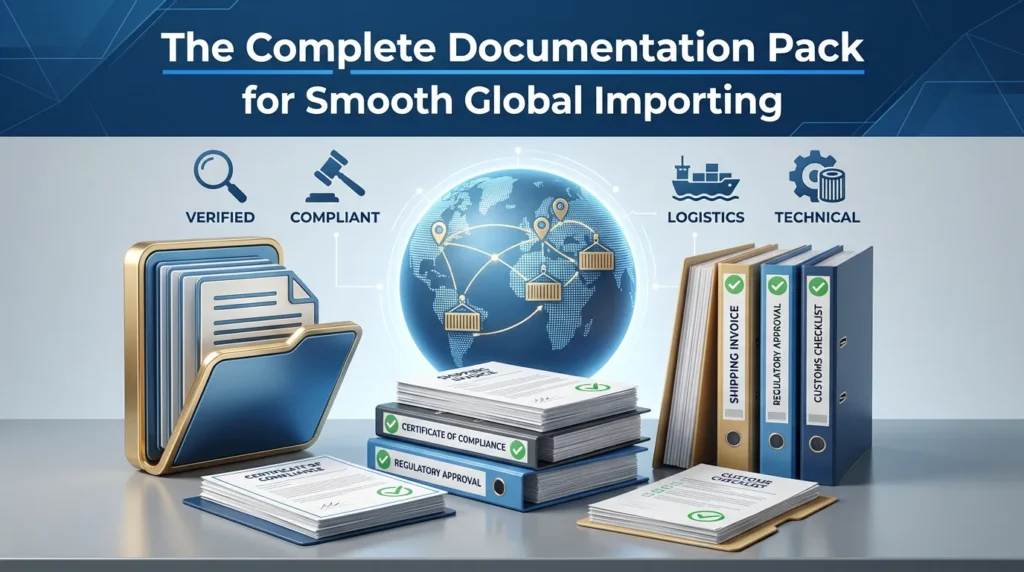
Many import problems don’t start at the port.
They start with the documents.
- HS code mismatch
- Invoices not matching the packing list
- Missing certificates
- Confusing product descriptions
By the time customs flags an issue, it is usually too late:
- Containers are already at the port
- Demurrage and storage charges start to add up
- Your customer is waiting and calling every day
For automotive filters, where margins are tight and lead times matter, these document issues can kill profit and damage relationships.
Over the years, we have built a complete documentation pack for automotive filter imports that makes global importing smoother and more predictable for our partners.
Below is how we structure it and what serious buyers expect from their filter supplier in 2026.
Clear, Consistent Commercial Documents for Automotive Filter Imports
At the core of our documentation pack is clear and consistent commercial documentation. This is the first layer that customs, banks, and logistics partners see.
Our rule:
If a customs officer looks at your documents for the first time, they should still understand them without extra explanation.
For each shipment, we focus on:
- Commercial invoice & packing list fully aligned
- Quantities must match line by line
- Product descriptions must be consistent
- Values must correspond correctly
- HS codes consistent with product type
- Automotive air, cabin, oil, and fuel filters classified correctly
- No random mix of different HS codes on the same line
- Descriptions that customs can understand
- Clear indication: “automotive air filter”, “cabin filter”, etc.
- Avoiding vague descriptions like “spare parts” or “filter” only
- Country of origin & Incoterms clearly shown
- Standard format for “Made in China” / “Country of Origin: China”
- Incoterms (e.g. FOB, CIF, DAP) clearly indicated with location
This structure reduces:
- Questions from customs
- Extra document requests from banks (for LC or trade finance)
- Confusion for your own internal accounting and inventory
When commercial documents are simple and logical, everything else becomes easier.
Technical Documentation and Quality Support for Automotive Filters
Global buyers don’t only look at price and packaging.
They need technical and quality documentation to:
- Compare suppliers
- Convince their internal teams
- Answer questions from their own customers
Our technical documentation for automotive filters includes:
- Product specification sheets
- Key dimensions
- Filter media type
- Fitment or application references (where applicable)
- Basic test reports / performance data
- Initial efficiency and capacity data where relevant
- Internal test results according to agreed standards
- Quality certificates
- ISO 9001, IATF 16949 or other relevant QA certifications
- Validity dates and scope clearly shown
- Warranty & claim procedure
- Clear explanation of how we handle complaints
- What evidence we need (photos, batch numbers, etc.)
- Timeframes for response and resolution
We keep these documents ready and structured, not “searching when you ask”.
For new projects, this technical/quality pack helps buyers:
- Confidently introduce our filters to their teams
- Build product files for OEM, retail, or workshop channels
- Answer early technical questions before the first shipment arrives
In 2026, serious buyers expect documentation-backed quality, not just promises.
Compliance and Market-Specific Documentation for Filter Imports
Regulations and customer requirements are tightening every year, especially for:
- EU
- UK
- Other regulated or sensitive markets
That’s why a modern compliance documentation for filter imports pack is essential.
Depending on the destination and customer, we provide:
- REACH / RoHS declarations
- Basic declarations stating compliance with relevant REACH and RoHS requirements
- Supported by material and supplier information internally
- Material lists or supplier statements
- Material breakdown for key components (rubber, plastic, metal, media, adhesive)
- Supplier declarations or MSDS from critical material vendors
- Support with third-party lab tests when needed
- Coordinating samples to accredited laboratories
- Helping select the right test items
- Aligning report formats with buyer or retailer requirements
We adapt the documentation pack to the destination market, not one template for all.
Example:
- A distributor selling into EU retail chains might need:
- REACH/RoHS declarations
- Lab test reports for certain product families
- Quality certificates and clear traceability
- A buyer selling into workshops in less regulated markets may need:
- Basic quality certificates
- Technical data sheets
- Standard declarations and commercial documents
Our goal is to make sure the documentation fits the real risk level and customer expectations of each market.
Packaging and Labeling Documentation for Automotive Filter Logistics
Even if customs clearance is smooth, problems can still appear at the destination warehouse if packaging and labeling are unclear.
Our packaging and labeling documentation for filters helps prevent:
- Receiving errors
- Misplaced stock
- Confusion in large distribution centers
We provide information and structure for:
- Outer carton markings
- Part number
- Quantity
- Country of origin
- Customer brand or logo (for private label) where applicable
- Barcode information (if required)
- EAN/UPC or internal codes
- Agreed position on carton or label
- Testing to ensure scannability before mass production
- Palletising plans for larger projects
- Number of cartons per pallet
- Layer configuration
- Total height and weight
- Labelling positions for pallet IDs
With this documentation, logistics teams at the destination:
- Know exactly what to expect on arrival
- Can set up their WMS (warehouse management system) in advance
- Reduce handling errors and time spent “figuring things out”
In many large accounts, good packaging and labeling documentation is just as important as the product specification.
Digital Documentation Organisation for Faster Responses
In 2026, it’s not enough to have documents.
You must be able to find and send them quickly.
Our digital documentation organisation for filter imports is built around:
- Structured by customer & part family
- Each major customer has its own documentation tree
- Within that tree, files are arranged by part family (air / cabin / oil / fuel, or by product group)
- Version-controlled documents
- Only the latest valid version is used for new shipments
- Older versions are archived but clearly marked as “historical”
- Easy retrieval for repeat orders
- When a customer repeats an order after 6 or 12 months, we can quickly pull the same or updated document pack
- No need to rebuild the file set every time
This directly benefits our partners:
- When your customer asks for REACH, RoHS, test reports, or certificates again,
you don’t have to wait days for the factory to “find the file”. - When your sales team needs technical or compliance documents for a quote,
you can respond quickly and look professional.
In global trade, speed of documentation is part of your competitive advantage.
What Serious Buyers Expect From a Filter Supplier Documentation Pack in 2026
Based on our work with distributors, brand owners, and retail chains across 30+ markets, serious buyers in 2026 typically expect their filter suppliers to deliver a complete documentation pack for filter importing that covers:
- Commercial Layer
- Clean, accurate invoices & packing lists
- Transparent HS codes and product descriptions
- Clear country of origin and Incoterms
- Technical & Quality Layer
- Specification sheets
- Test data (when applicable)
- Quality system certificates
- Defined complaint and warranty procedure
- Compliance Layer
- REACH/RoHS or other relevant declarations
- Material/supplier documentation
- Lab test reports for critical markets or key customers
- Packaging & Logistics Layer
- Carton marking standards
- Barcode and label data
- Pallet plans and packing photos (if required)
- Digital Organisation Layer
- Logical, searchable file structure
- Fast retrieval for repeat orders
- Clear version control and document updates
When these layers are in place, your importing becomes more predictable:
- Less time spent on firefighting at customs
- Fewer last-minute requests from big customers
- A more professional image in front of OEM, retail, and workshop clients
In short:
In global trade, a strong documentation pack is no longer “extra”.
It is part of product quality.
How We Build a Documentation Pack for New Automotive Filter Partners
When we start working with a new partner, we usually follow this practical process to build their documentation pack for automotive filters:
- Initial Discovery
- Understand your target markets and sales channels
- Review any specific document requirements from your key customers
- Baseline Pack Setup
- Prepare a core set of commercial, technical, and quality documents
- Share a documentation checklist for first orders
- Market-Specific Add-Ons
- Add REACH/RoHS and lab test support if needed
- Add special packaging/label formats required by retailers or large warehouse operations
- Digital Structure Alignment
- Agree on naming conventions, file types, and sharing method
- Ensure you can integrate our documentation into your own systems
- Ongoing Maintenance
- Update certificates and declarations when they are renewed
- Maintain consistency across new product lines or private label programs
This helps serious buyers:
- Launch new filter programs faster
- Satisfy internal quality/compliance requirements
- Reduce surprises when dealing with customs and large customers
Work With a Filter Supplier That Treats Documentation as Part of the Product
If you are importing filters and want fewer document surprises, ask yourself:
- Does my current supplier give me a structured documentation pack, or only send PDFs when I push them?
- How long does it take to receive complete documents for a new shipment?
- Can I confidently face my own customers’ quality and compliance audits?
At Beling Filters, we treat documentation as part of the product, not an afterthought.
We are happy to walk you through how we structure documentation for new partners and share a simple “documentation checklist” we use for first orders.
Contact Our Team
Bruce Gong – Key Account Manager, Beling Filters
Email: bruce.gong@belingparts.com
WhatsApp: +86 150 5776 4729
LinkedIn: www.linkedin.com/in/brucegong-beling
Let’s make your next container of filters simpler to import and easier to explain to your customers.