In international B2B, every supplier has the same fear:
- the container is shipped
- the customer is waiting
- everything seems routine
…until the message arrives:
“We have a serious problem.”
In the automotive aftermarket, that sentence is heavy.
Because a “serious problem” with filters rarely stays inside a warehouse.
It hits mechanics, car owners, and finally your customer’s reputation in the market.
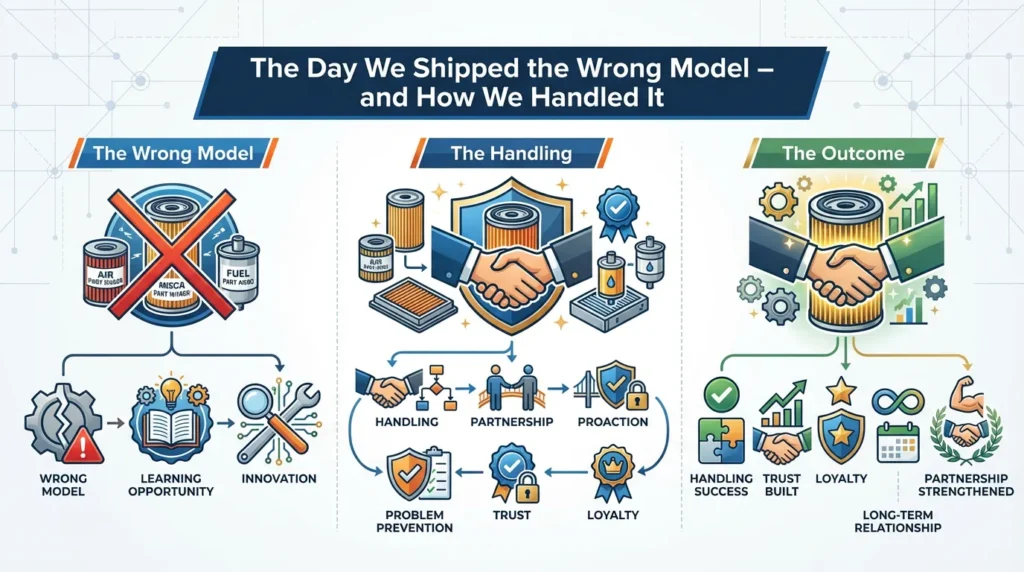
This is a real story of how we:
- shipped the wrong model in the right box
- reacted in the next 24 hours
- repaired the situation for our customer
- and used the mistake to upgrade our quality control, traceability and packaging processes
If you are a distributor, importer, or another supplier in the filter business,
you will probably recognize parts of this story.
A Routine Container Order That Went Wrong
A few years ago, one of our long‑term customers ordered a full container of filters.
From our side, it looked very standard:
- same series of automotive filters
- similar volume to previous orders
- stable cooperation history
- no special new items, no new packaging, no new specs
We processed the order as usual:
- production arranged
- quality checks performed
- packaging completed
- shipment booked and dispatched
We had done similar containers for this customer many times.
Nothing about this order looked risky or unusual.
Then, after the container arrived, my phone showed a short, serious message:
“Bruce, we have a serious problem.”
He attached photos.
The Problem: Right Box, Wrong Filter
In the photos, I immediately saw the issue.
One key model — a very fast mover in his market — had:
- the correct box design
- correct printing
- correct model number on the packaging
But inside the box?
- the wrong filter model.
- same series
- similar size
- similar appearance
…but not the exact model required for that reference.
For an end user, that difference may not be obvious at first glance.
For a mechanic, it can cause:
- fitment issues
- doubts about the supplier’s reliability
- more time spent correcting the mistake
For our customer – a distributor – this is dangerous:
- his mechanics trust him
- they expect zero surprises when they open the box
- one bad experience can make them question the entire brand
My first reactions in my head were very human:
- “How did this pass our inspection?”
- “What will this do to his reputation with mechanics?”
But there was no time to stay in the emotional stage.
I had to decide how to respond.
Two Options: Defend or Own It
In that moment, I really had two clear choices:
Defend ourselves and push the blame away
- blame the factory
- blame the workers on the line
- blame “the system” or “confusing models”
- spend energy explaining why it was “not really our fault”
Take responsibility and focus 100% on solutions
- accept it as our mistake
- move immediately into problem‑solving mode
- protect the customer’s position first
The first option might protect ego in the short term.
The second option protects trust in the long term.
I chose the second.
I called him immediately and said:
“No excuses. This is our mistake.
Give me 24 hours for a concrete solution.”
The words were simple, but very important:
- “No excuses” – I won’t waste his time defending ourselves.
- “Our mistake” – I accept responsibility, not push it away.
- “24 hours” – clear commitment and timeline.
Now I had to keep that promise.
The Emergency Audit: Finding the Root Cause
Internally, we immediately launched what I call an “emergency audit”.
The goal was not just to fix one shipment,
but to understand exactly where and how the mistake happened.
We focused on three things:
4.1 Checking Production Records and Packaging Photos
First, we went back to:
- production records
- batch numbers
- internal QC reports
- packaging photos taken before shipment
Many factories and suppliers now take photos during packing:
- packed cartons
- labels on boxes
- pallet condition
These photos are more than “nice to have” –
in situations like this, they become evidence and traceability tools.
We used them to confirm:
- the model that was planned
- the packaging line used
- whether the labels and boxes were correctly assigned
4.2 Tracing the Packing Line for That Batch
Next, we traced the specific packing line for that batch:
- who was working that day
- which two models were being packed in the same area
- whether the two similar models were on adjacent packing stations
We discovered that:
- two models from the same series, with very similar appearance and size,
were being packed on neighboring lines. - A batch of inner boxes for Model A had been accidentally mixed with Model B during the carton feeding process.
Visually, without a second‑level control,
it was easy for a worker to:
- take the wrong inner box
- put the wrong filter inside
- seal the box
- and put it into the correct master carton for Model A
Because the series looks similar,
the error was not obvious at a quick glance.
4.3 Identifying the Exact Failure Point
We identified the failure point as:
- no additional independent check
between “filter picked” and “box sealed” for those two similar models.
In other words:
- the system allowed one human mistake to pass through
- we had normal checks, but they were not strong enough for similar references
Now we had what we needed:
- root cause
- affected model
- risk scope
With that in hand, we could design a real solution.
The Solution Plan: Fixing the Customer’s Problem First
Within those 24 hours, we prepared a concrete plan and went back to the customer.
We divided our thinking into two parts:
- Immediate damage control for his market
- Medium‑term correction and logistics solution
Here’s what we proposed and executed.
5.1 Immediate Production of the Correct Model
First, we committed to:
Produce the correct model immediately,
on a priority basis.
That meant:
- re‑arranging the production schedule
- pushing this reference to the front of the line
- allocating extra manpower and overtime if needed
We treated it as an emergency job, not just “next in line.”
5.2 Air Shipment for Urgent Needs
His biggest worry was peak season and mechanics waiting.
So we decided:
- to send a partial air shipment of the correct filters
- enough to cover his short‑term, urgent demand
- at our cost
Yes, air freight is expensive.
But in this case, the more important cost was trust.
By absorbing the airfreight, we were saying:
- “We understand your real pain.”
- “We take the mistake seriously.”
- “We are ready to spend money to protect your market.”
5.3 Sea Shipment for the Remaining Quantity
For the remaining quantity, we arranged:
- a replacement shipment by sea
- again, at our cost
We could have tried to share the cost,
or argue about responsibility,
but that would have damaged the relationship.
Instead, we said:
“We will handle the logistics and cost to correct this.
You should focus on your market.”
This gave him:
- a clear plan
- a sense of support
- confidence that we were not running away
5.4 Finding a Second Life for the Wrong Filters
Now we had another question:
What to do with the wrong filters already in his warehouse?
Throwing them away was one option,
but not the best.
We worked together and found a solution:
- those wrong filters still had quality
- they were suitable for other applications / segments
- they could be sold in a less sensitive channel
So we agreed:
- he would sell them in another segment
- with a special discount
- and clear communication in his own network to avoid confusion
This way:
- the products were not wasted
- he could recover part of the value
- we still carried the main cost and responsibility for the mistake
Corrective Actions: Turning a Mistake Into Better Systems
Fixing this one shipment was not enough.
We needed to make sure it would not happen again.
So we introduced several corrective actions into our quality and packaging process.
6.1 Clearer Labeling on Inner Cartons
We improved the clarity and differentiation of inner carton labels:
- bigger, bolder model numbers
- clearer color coding for close models in the same series
- additional visual symbols where possible
The goal was simple:
Even at a quick glance, a worker should easily see the difference
between close model numbers.
This reduces:
- the chance of picking the wrong box
- confusion when two similar references are packed on the same day
6.2 Extra Barcode Check Before Sealing Boxes
We added an extra barcode verification step:
- the operator scans the model barcode of the filter
- the system checks if it matches the box barcode
- if not, the system alerts and stops the packing
This created a digital barrier against human error.
Now, even if someone reaches for the wrong box by hand,
the barcode system acts as a second gatekeeper.
6.3 Additional Random Inspection by a Different QC Staff
We also introduced:
- a second random inspection
- done by a different QC person (not the same one who did the first check)
This “fresh eyes” approach helps catch:
- patterns that the first inspector might miss
- especially when dealing with similar models in the same shift
These changes cost us:
- extra time
- extra procedure
- a bit more internal effort
But they massively reduce the risk of packing the wrong model in the future,
especially among similar references.
The Customer’s Reaction: Frustration and Respect
Of course, the customer was still frustrated.
His concerns were real:
- he had to manage mechanic expectations
- he had to explain why a trusted brand had a batch issue
- he had to adjust part of his stock and sales planning
But after we presented:
- a clear root cause analysis
- a concrete logistics and production solution
- our internal corrective actions
he told me something I will always remember:
“Problems happen.
What matters is how fast you face them
and how much responsibility you are willing to take.”
In the end:
- his mechanics received the right filters in time for peak season
- the wrong items were moved into a less sensitive channel
- our cooperation continued – and actually became stronger than before
Because now he knew:
- how we react under pressure
- how seriously we treat mistakes
- how far we will go to protect his market
Key Lessons for Quality Control and Customer Trust in Auto Filters
This experience changed the way we think and talk about quality and mistakes.
8.1 Zero Mistakes Is the Goal – But the 1% Moments Define You
In B2B manufacturing and supply:
- the target is always “zero mistakes”
- we invest in systems, training, procedures, inspections
But reality is:
- perfection is a direction, not a guaranteed state
- no system is 100% immune to human error
So the real question becomes:
When that 1% moment happens,
how do you react?
Do you:
Or do you:
- own the problem?
- communicate fast?
- over‑deliver on the solution?
Those moments often decide whether:
- a customer stays with you for 1 year
- or remains a partner for 10 years or more
8.2 Traceability Is Not Just a Buzzword
Without:
- production records
- packaging photos
- batch tracking
- packing line documentation
we would have struggled to:
- understand what happened
- prove we had found the real cause
- convince the customer that we had fixed the process
Traceability in auto filter production is not only for audits.
It is also the foundation for credible corrective action
when something goes wrong.
8.3 Fast Reaction Protects Your Customer’s Market
In the aftermarket, timing is critical:
- peak season
- maintenance cycles
- workshop capacity
If you lose 2–3 months trying to “discuss” responsibility,
your customer loses:
- sales
- reputation
- mechanic loyalty
By reacting fast with:
- emergency production
- air shipment
- clear schedules
you help your partner protect what matters most:
his relationship with the mechanics and end users.
8.4 Accountability Builds Long‑Term Trust
Anyone can look professional when everything is going well.
But customers build their deepest trust when they see:
- how you behave under pressure
- how you handle uncomfortable news
- whether you choose ego or responsibility
Over time, this builds a different level of partnership:
- more transparency in forecasts
- more openness in feedback
- more willingness to grow together
What This Means If You’re an Importer or Distributor of Auto Filters
If you are a distributor or importer, you know:
- even one wrong filter model can cause big headaches in the field
- mechanics don’t have time to argue about packaging mistakes
- your brand is on the line every time a box is opened
When you choose a filter supplier, it’s natural to ask for:
- good prices
- attractive packaging
- stable quality
But it’s also important to ask:
- “What happens if something goes wrong?”
- “Can you show me how you trace and solve issues?”
- “Do you have examples of how you handled a mistake?”
You don’t just need a supplier who claims to be perfect.
You need one who:
- has systems for preventing mistakes
- has processes for catching and correcting them quickly
- has the mindset to take responsibility, not hide
If You Want a Supplier Focused on Traceability, Fast Reaction and Accountability
We don’t pretend to be perfect.
No real factory is.
But we are very serious about:
- traceability – from production to packaging and shipment
- fast reaction – especially when urgent problems appear
- accountability – owning issues and solving them, not hiding
If that’s the kind of partner you want for your filter business,
I’d be glad to connect and discuss:
- your market
- your fast‑moving references
- your quality and packaging expectations
- and how we handle both normal orders and “1% moments”
📩 bruce.gong@belingparts.com
🌐 www.belingparts.com
In international B2B, problems will appear sooner or later.
The real competitive advantage is how you handle them.