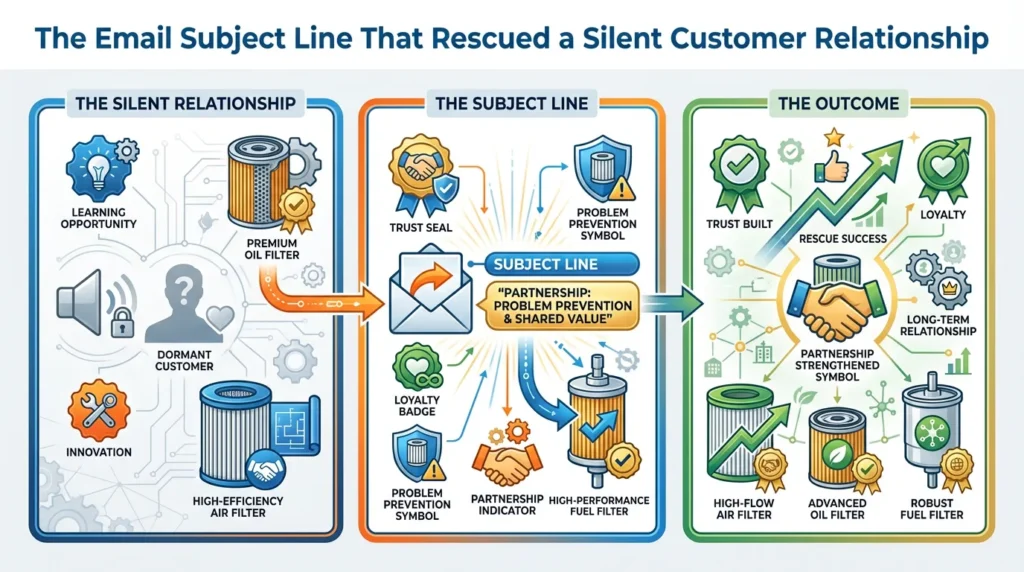
Every salesperson in B2B knows this feeling:
A good customer suddenly becomes silent.
- No complaints.
- No new orders.
- No replies.
Just… nothing.
This happened to me with a mid‑sized distributor
who used to order our filters regularly.
Then one day, his emails stopped.
I did what most people do:
- 📧 “How are you?”
- 📧 “Any new orders this quarter?”
- 📧 “New price list for your reference.”
Zero response.
I started thinking:
- “Maybe they changed supplier.”
- “Maybe my price is no longer competitive.”
- “Maybe they’re not happy but don’t want to say it.”
Then I asked myself a different question:
“If I were in his position,
what subject line would actually make me want to open an email?”
That question changed the whole approach—and rescued the relationship.
When a Good Customer Suddenly Goes Silent
In international B2B trade, silence from a customer can mean many things:
- They are testing another supplier.
- They are busy with internal issues.
- They’re under pressure from their own customers.
- They’re not satisfied but don’t want to argue.
- Or simply: your emails are not a priority anymore.
In this case, the customer was a mid‑sized distributor in our regular market:
- He used to order our auto filters consistently.
- Communication was smooth.
- Feedback was generally positive.
Then, without warning, everything stopped:
- no new inquiries
- no responses to follow‑ups
- no complaints
Just silence.
The usual follow‑up emails didn’t work:
- “How are you?” sounded generic.
- “Any new orders?” sounded like pressure.
- “New price list” sounded like just another sales email.
Nothing cut through the noise of his inbox.
And that’s when I realized something important:
I was asking for his attention,
but I wasn’t giving him a real reason to pay attention.
Shifting the Mindset: From “Chasing Orders” to “Delivering Value”
Instead of thinking:
- “How can I get him to order again?”
I asked:
- “If I were him, what email would actually help me?”
As a distributor, his daily reality is full of:
- end‑customer complaints and questions
- installation issues
- product comparisons
- pressure from competitors
- margin and stock decisions
He doesn’t wake up thinking:
- “I hope I receive some new price lists today.”
He wakes up thinking:
- “How can I reduce problems, protect my reputation, and sell more with fewer surprises?”
So I decided to do something different:
- Stop “selling”.
- Start helping.
The difference looks small in words,
but huge in impact.
The Subject Line That Changed Everything
I asked myself:
“What subject line would make ME stop and open an email—
even if I was busy, and even if I had been quiet with the supplier?”
I realized it must:
- be specific
- be relevant to his market
- offer immediate value
- not sound like a sales pitch
So I wrote this subject line:
👉 “3 issues we found in recent filter shipments to your market”
Why this worked:
- It was about his market, not about me.
- It promised specific, limited, concrete information: “3 issues”.
- It implied risk and insight, not price and promotion.
- It made clear: “Inside this email, there is something you can learn that might help your business.”
Already, before opening, the message was:
“I have something valuable and specific for you.”
Not:
“Please buy from me.”
What I Put Inside the Email (No Prices, No Pushing)
The content of the email was carefully designed to be:
- helpful
- practical
- non‑aggressive
Here’s what I included.
4.1 Real Photos from Recent Claims in His Region
I shared:
- photos from claims other customers in the same region had reported
- examples of damaged filters or packages
- pictures showing error patterns
These were not to blame anyone,
but to identify common patterns.
4.2 Common Installation Mistakes We Observed
We see many installation mistakes in the aftermarket that can cause:
- leaks
- early failure
- noise
- wrong fitment
So I summarized:
- typical installation errors in that market
- how they impact performance and warranty
- simple tips workshop mechanics can follow to avoid them
This kind of information helps a distributor:
- reduce claims
- educate their technicians or customers
- position themselves as a knowledgeable partner, not just a seller
4.3 One Packaging Improvement We Made
We had recently made a packaging improvement designed to:
- reduce damage during transport
- protect filters better in rough handling conditions
I explained:
- what change we made
- why we made it (based on real feedback)
- how it reduces damage risk
Again, the focus was:
- “Here’s something we did to reduce problems in your market,”
not - “Here’s a discount if you order now.”
4.4 One Important Sentence in the Email
I didn’t mention prices.
I didn’t ask for a PO.
I didn’t push him to “come back”.
At the end, I simply wrote:
“Thought this might be useful for your team,
even if you are buying from other suppliers as well.”
That sentence is important:
- It removed pressure.
- It acknowledged that he might be working with others.
- It positioned me as a partner sharing knowledge, not just a vendor chasing orders.
The Response: Silence Broken in Two Hours
Within two hours, he replied:
“Hi Bruce, thanks for this.
We’ve actually had similar issues recently.
Can we set up a call this week?”
On the call, he told me:
- They were testing another supplier.
- Some quality problems had appeared.
- Internally, they were debating which supplier to trust going forward.
My email arrived at exactly the right moment—not as:
- a sales attack, but
- practical support.
Because of that, I wasn’t just “the old supplier” trying to win business back.
I became:
- the supplier who brought him useful insight when he needed it most.
Two months later:
- he came back with a consolidated order,
- larger than before.
The subject line opened the door,
the value inside rebuilt the relationship.
Why This Works: The Psychology Behind Value‑First Email in B2B
In B2B, especially in international trade and aftermarket auto parts, inboxes are full of:
- “friendly reminders”
- “special offers”
- “latest price list attached”
- “follow‑up on my last email”
Buyers are busy.
They quickly learn to ignore emails that:
- look generic
- offer nothing new
- only try to push a sale
What cuts through the noise is:
- a subject line that signals relevance
- content that helps them solve real problems
- communication that respects their time and situation
When a customer goes silent, it’s easy to:
- panic
- reduce price
- send more reminders
But often, what reopens the door is not:
- “Please reply,”
but: - “Here’s something specific that might help you, regardless of where you buy today.”
That shows:
- confidence
- long‑term thinking
- a partnership mindset
How You Can Use This Approach in Your Own B2B Emails
This method is not limited to filters or auto parts.
It can work in many B2B industries.
Here is how you can adapt it.
7.1 Step 1 – Stop and Analyze What Would Really Help the Customer
Ask yourself:
- “What common problems are my customers facing in this market?”
- “What complaints or issues have we seen recently?”
- “What improvements have we made that they might not know about?”
- “What data, photos or examples could help them reduce risk?”
The key is to think like a consultant, not just a seller.
7.2 Step 2 – Craft a Subject Line That Promises Specific Value
Some examples (adapted to auto filters and aftermarket):
- “3 common installation mistakes we see with [filter type] in [country]”
- “2 packaging changes we made to reduce damage in transit”
- “Field report: top 3 causes of early filter failure in your market”
- “Market feedback: what mechanics are saying about [filter model]”
Notice:
- each one is about them, not you
- each offers a number and a topic
- each sounds like a report, not a promotion
7.3 Step 3 – Make the Content Practical and Non‑Promotional
Inside the email, focus on:
- photos
- real cases (without naming other customers)
- short analysis of why an issue happens
- simple recommendations or checklists
Avoid:
- long company introductions
- price discussions
- aggressive calls to “place your order now”
Instead, end with something like:
- “Hope this helps your team.”
- “Let me know if you’d like more details on any of these points.”
- “Even if you are buying from others, feel free to share this with your technicians.”
7.4 Step 4 – Respect the Outcome
Sometimes:
- they will reply and reengage.
- sometimes they will stay silent.
But even if they stay silent:
- you have positioned yourself as a knowledgeable, helpful partner
- you have planted a seed for future cooperation
- you have differentiated yourself from other suppliers who only talk about price
Over time, this creates a very different brand image in the customer’s mind.
What This Means for Automotive Filter Distributors
If you are a distributor, importer, or wholesaler of auto filters,
you can benefit from suppliers who:
- bring you real field feedback
- share common issues and how to prevent them
- help you educate your customers and mechanics
Emails like:
- “Here’s what mechanics in your region are doing wrong with filter installation.”
- “Here’s how to reduce transport damage with better packaging.”
- “Here’s what we’re seeing in warranty claims this quarter.”
are not just “nice to have.”
They:
- help you avoid returns
- protect your reputation
- strengthen your position as an expert in front of your own customers
When you evaluate suppliers, you can ask:
- “Do you share market feedback and problem analysis with us?”
- “Can you provide real photos and explanations of typical issues?”
- “Do you help us train our market, or just send us price lists?”
The right partner will see you not only as a buyer,
but as a long‑term ally in the market.
Our Approach: Beyond Quotes and Price Lists
This story changed how I think about customer retention and email communication.
Now, when a customer goes silent, I remember:
“Don’t ask for attention.
Earn it with value.”
As a filter supplier, we aim to:
- send not only quotations, but also field reports
- share common issues we see and how to prevent them
- bring ideas to protect our partners’ reputation, not only their margin
That means:
- sharing photos of real cases (anonymized)
- explaining root causes of problems
- suggesting technical or packaging improvements
- helping build training material for their teams
Because in B2B, the strongest relationships are built when:
- both sides help each other look good in front of their customers.
If You Want a Filter Partner Who Brings You Insight, Not Just Prices
If you want a filter supplier who:
- doesn’t just send quotes and ask for orders
- brings you market feedback and problem analysis
- shares practical tips on installation, packaging, and quality
- helps you protect your reputation in front of your customers
I’d be glad to share more about how we work with distributors and importers in different markets, including:
- common issues we see per region
- how we handle claims and turn them into improvements
- how we use photos, data and feedback to support your sales and after‑sales team
📩 bruce.gong@belingparts.com
🌐 www.belingparts.com
Sometimes, one thoughtful subject line
and one valuable email
can reopen a door you thought was closed.