
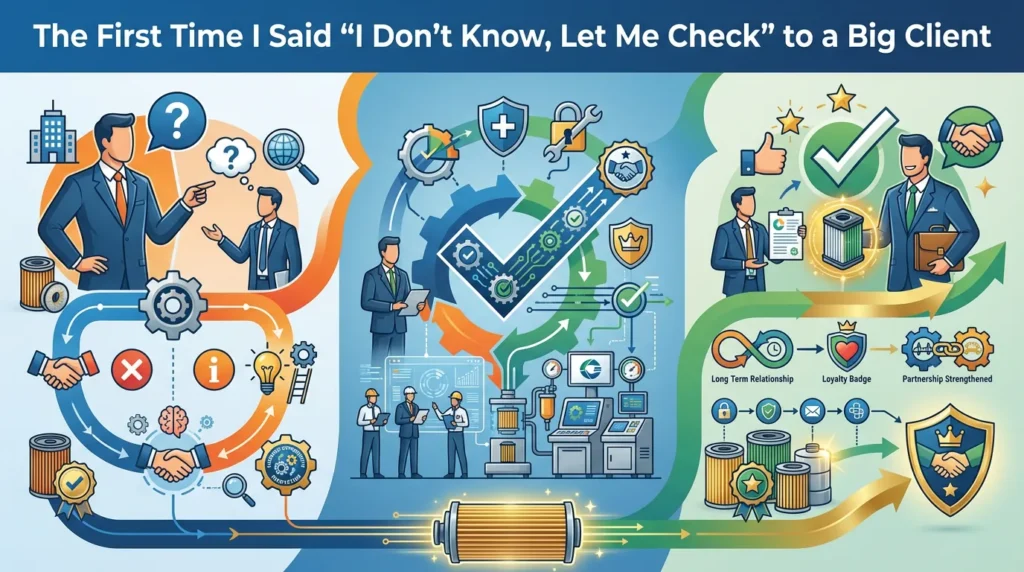
Years ago, on a call with a very important distributor,
I made a classic mistake many salespeople make:
I tried to look like I knew everything.
He asked me a very technical question about our filter’s performance under a special high‑temperature condition.
Inside, I knew I wasn’t 100% sure.
But I didn’t want to look unprofessional,
so I answered based on my “best guess.”
Later, when I checked with our engineer,
I realized my answer was not precise.
Not totally wrong,
but not fully correct either.
That feeling in my stomach…
“If the customer makes a decision based on this,
and something goes wrong,
it’s my responsibility.”
That experience changed how I see technical questions, sales, and trust in B2B.
This is the story of how learning to say
“I don’t know, let me check”
actually made customers trust me more, not less.
In B2B sales—especially when you sell technical products like automotive filters—there is a strong temptation:
On that call years ago, the distributor asked something like:
“How does your filter perform under high temperature for long operating hours with this specific oil type?”
I knew our filters were tested and solid.
I knew we had good lab results.
But the exact condition he described (specific oil, specific temperature, specific number of hours)
was not something I could quote from memory.
Instead of saying:
“I’m not sure. Let me confirm.”
I gave an answer like:
“No problem, it should be fine under that condition.”
“Should be” is a dangerous phrase in technical sales when you don’t have real numbers behind it.
Later, when I verified with our engineer:
I realized something important:
That uncomfortable feeling became a turning point.
Some time later, on another project with a different big client,
a similar situation appeared.
He asked:
“Bruce, can your filter maintain efficiency
after X hours at Y temperature
with this specific oil spec?”
This time, I paused.
I could have said “yes” immediately and hoped the lab data would support me later.
But I remembered that feeling in my stomach from last time.
So I chose another path.
I replied:
“To be honest, I’m not 100% sure.
I don’t know the exact value right now.
Let me check with our technical team
and come back to you with a confirmed answer in 24 hours.
Is that OK?”
There was silence.
For a second, I thought:
Then he said:
“Bruce, I appreciate that.
Many people just say ‘no problem’ immediately.
I prefer someone who checks.”
That one sentence told me something powerful:
Serious customers don’t need you to know everything.
They need to know that what you tell them is reliable.
After that call, we treated his question as a small project.
I went to our technical team and explained:
We reviewed:
In some cases, we already had the exact test results on file.
In other cases, we arranged additional testing:
We didn’t want to send:
We wanted:
Once the data was ready,
we prepared a clear response for the client, including:
We also included:
Then we sent him a report.
His answer was simple:
“Now I feel comfortable to present this to my own customers.”
That line is important.
Because in B2B, your client is often:
He needs:
By admitting “I don’t know yet” and then delivering a solid answer,
we helped him look professional in front of his customers.
That experience changed my mindset completely.
Today, my rule is simple:
If I’m not sure, I say:
“I don’t know yet, let me verify it and get back to you.”
Many people are afraid that saying this will:
In practice, the opposite often happens.
Here’s why.
Experienced distributors, fleet managers, and engineers know:
When they hear:
“No problem, no problem, everything is OK.”
too quickly, with no hesitation,
they actually become more suspicious.
When they hear:
“I’m not sure about this detail,
let me check and get back to you.”
they think:
In B2B, trust is not about:
Trust is about:
Honesty today protects credibility tomorrow.
I noticed something ironic:
When I started to admit what I didn’t know,
customers trusted me more with what I did know.
Why?
Because they could feel that:
Over time, this kind of behavior builds a deep, calm trust.
Today, when customers ask us technical questions about filters, we follow a more structured process.
First, we make sure we fully understand:
Sometimes, just by asking better questions,
we help the customer clarify what they really need.
We then:
If the data exists and is solid,
we can answer quickly—with numbers, not just words.
If we don’t have complete data,
or if the application is unusual,
we may:
This is not just for the customer;
it also:
When we come back to the customer,
we aim to provide:
Where useful, we also attach:
This helps both technical and non‑technical people in the customer’s organization.
In the auto filter and aftermarket world, products look similar in catalogs:
But the real difference for professional customers is often:
Distributors and fleet operators may ask things like:
If you answer these questions with vague confidence, you might:
If you answer with honest limits and real data, you might:
But you will maintain long‑term trust.
In technical B2B, that long‑term trust is worth far more than one order.
If you are a buyer, importer, or distributor of auto filters,
you’ve probably experienced both types of suppliers:
Over time, you learn:
When you evaluate suppliers, consider asking:
The right partner will:
From that first uncomfortable experience until today,
our internal principle is straightforward:
In B2B, trust is built not by always having an answer,
but by always giving an honest answer.
Short‑term “confidence” can damage long‑term relationships.
A clear:
“Let me check.”
plus a fast, accurate follow‑up is often more professional
than a quick, vague promise.
That is how we aim to work now:
This is how we want our partners to feel:
If you are looking for a filter supplier who:
我很乐意讨论:
📩 bruce.gong@belingparts.com
🌐 www.belingparts.com
我们可能无法立即给出所有问题的答案,
但我们会尽力为您提供可靠的
答案。
Privacy Policy Powered by 2uncle