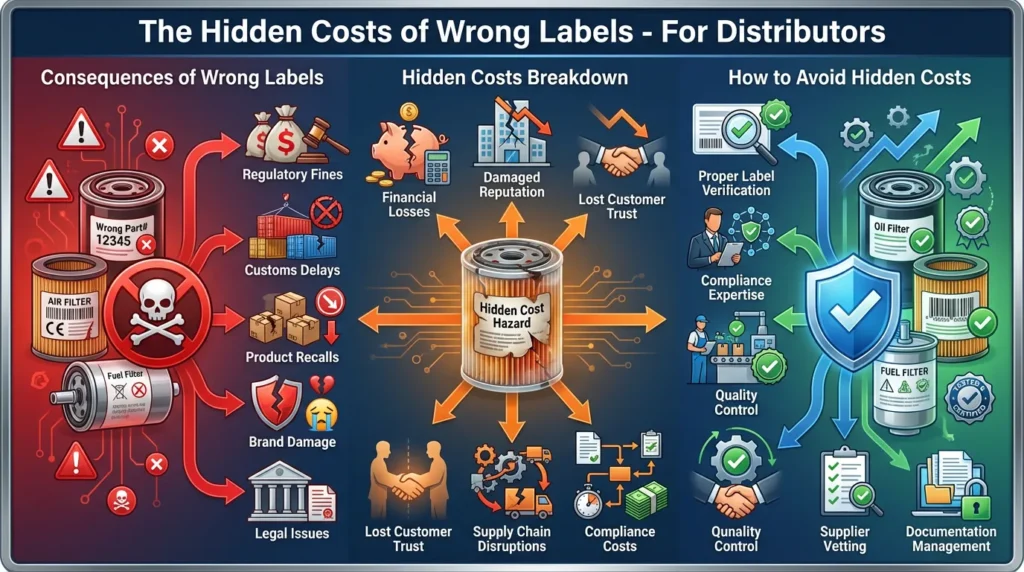
For many importers and distributors, labels look like a small detail in the overall product and packaging strategy.
But in automotive filters, a wrong, unclear, or poorly designed label can quietly destroy your margin – even if you negotiated an excellent purchase price.
Wrong labels create costs in your warehouse, in your customer service team, in your brand reputation, and even with local authorities. Most of these costs are hidden, spread across many small mistakes and extra tasks that rarely show up in a simple cost-per-piece comparison.
This article explains where the real cost of wrong labels appears, and how we design labels specifically to help distributors protect margin, efficiency, and brand image.
MisPicking in Your Warehouse: The First Hidden Label Cost
1.1 How Weak Labels Create Picking Errors
In a real distribution warehouse, teams work under pressure:
- Many SKUs
- Similar looking boxes
- Limited time to pick and ship orders
If your label is:
- Hard to read (small fonts, poor contrast, busy design)
- Missing key data (part number, application, internal codes)
- Inconsistent between unit boxand outer carton
your warehouse staff will:
- Pick the wrong referencemore often
- Spend time checking and rechecking cartonsto avoid mistakes
- Struggle to keep accuracy high as volume increases
Even small mispick rates become expensive at scale.
1.2 The Real Cost of MisPicking
Mispicking due to weak labels causes several hidden costs:
- Extra labor
- More time spent verifying parts
- Manual double checks of pick lists and physical labels
- Higher error rate
- Wrong parts shipped to customers
- Orders needing rework, replacements and apologies
- Return handling and reshipping
- Additional transport costs
- Time spent on reverse logistics and customer communication
These costs do not appear on your purchase invoice from the supplier, but they come directly out of your operational margin.
1.3 How We Design Labels for Fast, Accurate Picking
We design labels so your staff can identify parts in 1–2 seconds, even in a busy warehouse:
- Big, clear part numbers, visible from a distance
- Consistent positionof the part number and key data across all labels
- Clear descriptions and application info (depending on your needs)
- Alignment between:
- Unit box label
- Outer carton label
- Any pallet or bulk markings
By treating the label as a warehouse tool, not just a print element, we help you reduce mispicks and cut the hidden labor cost in your operation.
Returns, Wrong Installations & Reputation Damage
2.1 How Wrong Labels Reach the Customer
When labels are confusing, incomplete, or simply wrong, the problems extend beyond the warehouse:
- Customers or mechanics may install the wrong filter
- The part may physically fit but not be the right specification
- Orders arrive with references that don’t match the customer’s system or catalog
These issues often start with labels that do not correctly reflect:
- Part number
- Application
- Cross references
2.2 The Hidden Cost of LabelDriven Returns
Wrong or confusing labels can lead to:
- High return rates
- Incorrect parts sent back
- Extra transport and handling costs
- Sales and support time wasted
- Teams answering technical questions
- Sorting out which parts correspond to which applications
- Mechanics losing confidence in your brand
- If a mechanic installs the wrong filter once or twice because of unclear labels, they often stop recommending your brand altogether
The hidden cost includes:
- Replacing parts at your own expense
- Lost sales due to damaged trust
- Extra effort to repair customer relationships
2.3 Aligning Labels With Your Catalog and Market Position
We reduce this risk by:
- Aligning label information with your catalog and system:
- Part number
- Application or main usage
- Cross references to OE and aftermarket brands
- Ensuring that the wording and codes on the label match what your customers see in:
- Printed catalogs
- Online catalogs
- Ordering systems
This alignment reduces confusion at every point: warehouse, counter, mechanic, and end user.
Compliance & Fines Risk: When Labels Meet Regulators
3.1 Regulatory Expectations for Labels in Many Markets
In many countries and regions, labels are not just a marketing tool – they are part of the legal compliance package. Authorities may require:
- Local languageon labels and packaging
- Importer or distributor details(name and address)
- Clear country of originmarking
- Sometimes, specific safety or regulatory text
If these elements are missing or incorrect, authorities may consider your goods noncompliant, even if the filters themselves are perfectly fine.
3.2 The Cost of NonCompliant Labels
If labels do not meet local requirements, you risk:
- Goods being blockeduntil labels are corrected
- Forced relabeling at port or in a bonded warehouse, at your cost
- Fines or warningsfrom consumer protection or customs authorities
- Forced label changes midseason, disrupting your stock and sales plans
These issues create:
- Unexpected costs
- Delays and stock shortages
- Extra administrative work to manage corrective actions
3.3 Integrating Compliance Into Label Design From Day One
We integrate your local legal requirements into the label template from the beginning:
- Confirm what languages are required or preferred
- Add importer/distributor details in the correct format
- Place origin marking where it is clearly visible and legally robust
- Include any safety or regulatory text you must show in that market
By designing labels with compliance in mind, we help you avoid costly surprises and keep your supply chain legally secure.
Extra Handling: ReLabeling in Your Warehouse
4.1 Why ReLabeling Happens
If labels arrive from your supplier:
- In the wrong languagefor your market
- With the wrong barcodeor internal code
- With old brandingthat no longer matches your identity
- With outdated data(old cross references, old specs)
…you are forced to fix the problem locally.
This usually means:
- Printing and applying extra stickers
- Reworking boxes before shipping to customers
- Sometimes even unpacking and repacking
4.2 The Real Cost of ReLabeling
Relabeling looks like a small task, but its hidden cost includes:
- Labor
- Staff time for printing, sticking, and checking labels
- Material
- Labels, ribbons/ink, rework tape, etc.
- Delays
- Shipments that could have left today now leave tomorrow or later
There is also a clear opportunity cost:
- Your team is busy fixingsomething that should have been right at origin
- Energy and focus are pulled away from core tasks like:
- Serving customers
- Growing sales
- Optimizing inventory
4.3 Delivering OEMStyle Private Label – Ready for Your Shelf
We offer OEMstyle private label so that boxes and labels arrive:
- In the right language(s)for your market
- With your codes and barcodescorrectly implemented
- With uptodate brandingand technical data
- Ready to move directly to your shelf or warehouse, without rework
This approach significantly reduces your internal handling cost and frees your team to focus on valueadding work.
Catalog & System Mismatch: When Labels Don’t Follow Your Logic
5.1 The Problem With SupplierCentric Labels
Many suppliers print labels using only their own internal logic:
- Their part numbers
- Their wording and abbreviations
- Their own cross reference structure
But as a distributor, you operate with:
- Your ERP codes
- Your cross reference system
- Your own catalog wordingand structure
When labels don’t match your system, every order becomes harder to process.
5.2 Hidden Costs of Mismatched Label Information
When there is misalignment between labels and your internal systems, your team often needs to:
- Double check every order
- “Does this code equal that code?”
- Answer constant questions:
- “Is this the same part as the one in the catalog?”
- Manually correct pick lists and packing slips
Over time, this leads to:
- More human error
- Slower order processing
- Frustration among warehouse, sales, and customer service teams
5.3 Syncing Labels With Your ERP and Catalog
We fix this by syncing label templates with your internal logic, not just ours:
- Mapping our part numbers to your internal codes
- Reflecting your cross reference systemwhere needed
- Adapting to your naming conventions and wording
This means that:
- What your staff sees on the box aligns with what they see in the system
- What the customer reads on the label matches catalog entries
- Everyone spends less time asking “Is this the same part?” and more time shipping and selling
How We Design “CostSaving” Labels for Distributors
6.1 Understanding Your Use Case
When we set up a new label program for automotive filter distributors, we start by clarifying:
- Where will the product be used?
- Warehouse only
- Retail shelves
- Both channels
- What codes must appear?
- Your part number
- OEM references
- Competitor cross references
- EAN / barcode / internal barcodes
- Any language, origin, or importer text requirements?
- Legal obligations in your markets
- Preferences for mechanics and end users
This context determines how the label should function in your real daily operations.
6.2 Building Labels That Reduce Errors and Handling
Based on your answers, we design labels that:
- Put part number first – big and visible on multiple sides
- Keep layout stable across all references, so your team quickly learns where to look
- Match:
- Catalog information
- System fields in your ERP
- Your cross reference structure
- Respect your local compliance rules, including:
- Language
- Origin
- Importer details
We don’t just “print labels”; we create a label system that:
- Reduces picking errors
- Cuts returns and wrong installations
- Eliminates or minimizes relabeling work
- Supports your brand’s professional image in the market
By approaching labels as a costsaving and brandprotecting tool, we help you turn a small piece of paper into a real operational advantage.
Beling – Save Your Time & Cost
We don’t just print labels; we design them to protect your margin and reputation.
Your valuable automotive filter partner since 2008.
Contact Our Team
Bruce Gong – Key Account Manager, Beling Filters
Email: bruce.gong@belingparts.com
WhatsApp: +86 150 5776 4729
LinkedIn: www.linkedin.com/in/brucegong-beling
We’re happy to share how we usually adjust pallets for EU vs Middle East vs Latin America markets, and help you fine tune palletization to your warehouse system.