In international trade, especially in the automotive aftermarket, big orders can be very seductive:
- new market
- large volume
- attractive numbers on a spreadsheet
But not every big order is a good order.
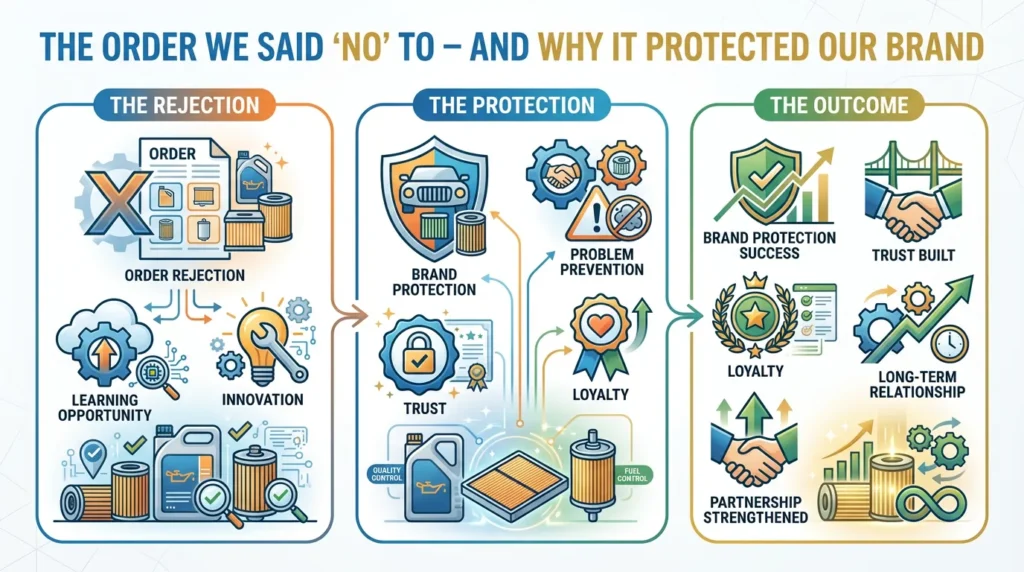
This is the story of one order we said “no” to –
and why that decision protected our brand, our serious customers,
and the mechanics who trust the name printed on our boxes.
The “Perfect” Opportunity: Big Volume, New Market, Strong Interest
A few years ago, a new buyer reached out to me.
He said:
“Bruce, I like your filters.
I want a big first order – but I need much lower prices.”
From a traditional sales point of view, this sounded promising:
- large quantity
- a new country we hadn’t entered yet
- a buyer clearly interested in our product
On paper, it looked like a perfect opportunity. 📈
Like many manufacturers, we are always looking to:
- grow into new markets
- add strong distributors
- increase production volume
So at the beginning, this inquiry looked like exactly what we wanted.
Then we had a call.
The Request: “Your Standard Quality Is Too High for My Market”
During our call, he was very direct and open.
He told me:
“Your standard quality is too high for my market.
Can you make a cheaper version – thinner media, simpler packaging,
no need for full testing. Just make it ‘look’ good.”
Let’s break down what he was really asking for.
2.1 Technically Possible, Ethically Problematic
From a technical manufacturing perspective, his request was possible:
- use thinner filter media
- reduce the amount of material inside
- simplify the internal structure
- use lower-cost packaging
- skip some of the more detailed testing
We know how to control costs.
Like every factory, we understand:
- which components drive cost
- where it’s possible to reduce material
- what level of testing is needed to guarantee certain performance
So “technically”, yes – we could have produced a cheaper version.
But there was a big problem.
2.2 One Brand, Two Qualities: The Path to Confusion
I asked him:
“Will you use the same brand name for these cheaper filters?”
He answered:
“Yes, of course. Customers don’t know the difference.”
That sentence is exactly where a lot of brand damage begins.
He wanted:
- the same logo
- the same brand name
- but different, lower quality inside
The idea was:
- make it “look” good
- but reduce the real performance
- because “customers don’t know the difference”
In the short term, maybe some customers don’t notice.
But in the long term, the market always discovers the truth.
The Risk: Weak Filters on Hard-Working Trucks
In that moment, I pictured the real life behind this request.
I imagined:
- 🔧 a mechanic installing “our” filter on a working truck
- 🚚 that truck running 12–14 hours a day, often in tough conditions
- ⚠️ the engine failing because the filter media was too weak,
letting dust or particles pass through
And then:
- the driver angry
- the mechanic frustrated
- the fleet owner counting repair costs and lost working time
- everyone looking at the box and the brand name
Would the customer say:
- “Oh, that must be the cheaper version they made only for this country”?
Of course not.
They would simply say:
“This brand is bad. Their filters caused engine problems.”
The name on the box would be blamed.
That brand might be ours.
And that was unacceptable.
The Internal Discussion: Short-Term Profit vs. Long-Term Brand
After the call, we did something many factories don’t do enough:
- we sat down internally
- we discussed the request openly
- we did some math
4.1 Short-Term: Attractive Numbers
Short term, the numbers looked good:
- a big first order
- potential for repeat orders
- a new country on our export list
- efficient production due to volume
On the financial side:
- it was clearly good profit
- in a business where margins are always under pressure
From a pure accounting perspective, it made sense.
4.2 Long-Term: Hidden Costs to Our Brand
But then we looked at the other side:
the long-term cost that doesn’t show in Excel.
We listed the risks:
- ❌ Damaged brand reputation
- If those cheaper filters failed earlier in the field,
the brand name on the box would lose trust.
- ❌ Confused distributors in other markets
- “Why is quality different in this country?”
- “Why is your filter performance not consistent?”
- Once people start asking, “Which version did I get?”
it’s very hard to recover.
- ❌ Pressure from other buyers
- as soon as one market gets a cheaper, lower-quality version,
other buyers will hear about it and say:
“Give me that cheaper version too.”
- suddenly, you either:
- accept lower quality everywhere
- or you spend your time explaining why some people get “special” quality
We realized:
- this was not only about one order
- it was about our positioning as a manufacturer
Are we the brand that:
- adjusts quality down just to win volume?
Or are we the brand that:
- stays consistent across China, Europe, South America, and beyond?
We had to choose.
The Decision: Saying “No” to the Wrong Kind of Business
After considering the short-term benefits and long-term risks,
we made our decision.
I called the buyer back and said something
most salespeople don’t like to say:
“No.
We can optimize cost,
but we will not produce a ‘looks good but fails early’ filter.
It’s not our positioning,
and it will hurt both our brands.”
5.1 What “Optimize Cost” Means – and What It Doesn’t
I also explained:
- We are open to rational cost optimization:
- adjusting packaging structure (without compromising protection)
- optimizing carton quantities to reduce logistics costs
- aligning product mix with his market reality
But we would not:
- deliberately produce a product designed to look good
but fail early in real working conditions.
That is a different level of compromise.
5.2 The Immediate Consequence
He was not happy.
- He told me other factories were willing to do it.
- He said we were “too rigid” for his market.
In the end, he:
- placed the order with another supplier
- most likely got the lower-cost, lower-quality product he wanted
From a short-term sales perspective, we “lost” the deal.
From a long-term brand perspective, we protected our identity.
Six Months Later: Fake Filters and a Serious Question
Six months later,
I received a message from a distributor in that same country.
He wrote:
“Bruce, we saw your brand on filters here.
Is that really your product?”
He sent photos.
When I opened the pictures, I saw:
- a completely different quality level
- internal construction not matching our standards
- packaging and details that clearly were not from our factory
But the boxes had:
Someone had copied our identity.
It was a fake version of our brand. 😐
The very situation we had been afraid of –
filters that “look” like ours, but perform very differently –
was already happening in that market.
Protecting Our Trademark and Strengthening Our Message
This discovery confirmed our earlier decision.
We took two parallel actions:
7.1 Legal Action: Protecting Our Trademark
We worked with a lawyer to:
- check our trademark registration status in that region
- take appropriate steps to protect our brand
- prevent further unauthorized use of our logo
This was not only about money.
It was about:
- protecting distributors who trust our brand
- protecting mechanics and drivers who think they are using our product
- keeping our name clean from problems caused by counterfeit items
7.2 Communication: Clarity About Our Positioning
We also realized we needed to communicate more clearly:
- what our brand stands for
- what we do not do
We strengthened our messaging:
“Our filters may not be the cheapest,
but they are consistent –
from China to Europe to South America.” 🌍
This consistency means:
- we use the same quality philosophy
- we do not create “secret low-quality versions” for specific markets
- if you buy our brand, you know what to expect
In the long term, this clear positioning attracts:
- distributors who value reputation
- fleet and workshop customers who care about reliability
- partners who think in years, not only in containers
Why Saying “No” Is Sometimes the Best Way to Protect Your Brand
There is a simple but powerful lesson in this story.
8.1 Not Every Big Order Is a Good Order
Sometimes, a big order with:
- new market
- high quantity
- “easy” conditions
carries a hidden cost:
- damage to your brand reputation
- confusion among your existing distributors
- loss of trust from mechanics and fleet owners
If you build your business only on:
- volume
- short-term price wins
you risk losing something more important:
- your identity in the market
- your credibility when something goes wrong
8.2 Saying “No” to the Wrong Deal Is Saying “Yes” to the Right People
When we said “no” to that order, we were really saying “yes” to:
- our good customers who trust us to be consistent
- mechanics who install our filters on vehicles that work hard every day
- fleet managers who expect performance, not surprises
- our own team, who take pride in making a reliable product
We were also saying:
- “We are not the cheapest factory, and that is okay.”
- “We are the supplier that cares about what happens after the box leaves our warehouse.”
In the long run, this attracts the partners we want to work with.
For Distributors and Importers: What Kind of Partner Do You Want?
If you are a filter distributor, importer, or brand owner,
you often face similar decisions:
- a factory offers very low prices
- they suggest cutting corners on materials or testing
- they promise to make it “look the same” as big brands
You have to ask yourself:
- What do I want my brand to stand for?
- Am I okay if mechanics say:
- “This brand is cheap, but you never know how long it will last”?
or do you want them to say:
- “This brand is not the cheapest,
but it is reliable and consistent.”
We can’t make this choice for you.
But we choose to be on the second side.
If You Want a Filter Partner Who Cares About Reputation
At Beling Filters, our philosophy is simple:
- We care about long-term reputation more than short-term volume.
- We are willing to walk away from deals that would damage our brand or yours.
- We believe:
- the mechanic who trusts the name on the box
- and the fleet that depends on their trucks
deserve a product that matches the promise printed on the packaging.
If you’re looking for an aftermarket filter partner who:
- will help you grow your market without cutting corners
- values consistency across different regions
- combines Made in China efficiency with serious quality control
- is prepared to say “no” to the wrong orders to protect the right customers
I’d be glad to discuss how we can work together:
📩 bruce.gong@belingparts.com
🌐 www.belingparts.com
In the end, your brand is more than a logo.
It’s every experience a mechanic, driver, and distributor has with your product.
Protecting that is worth more than any single order.