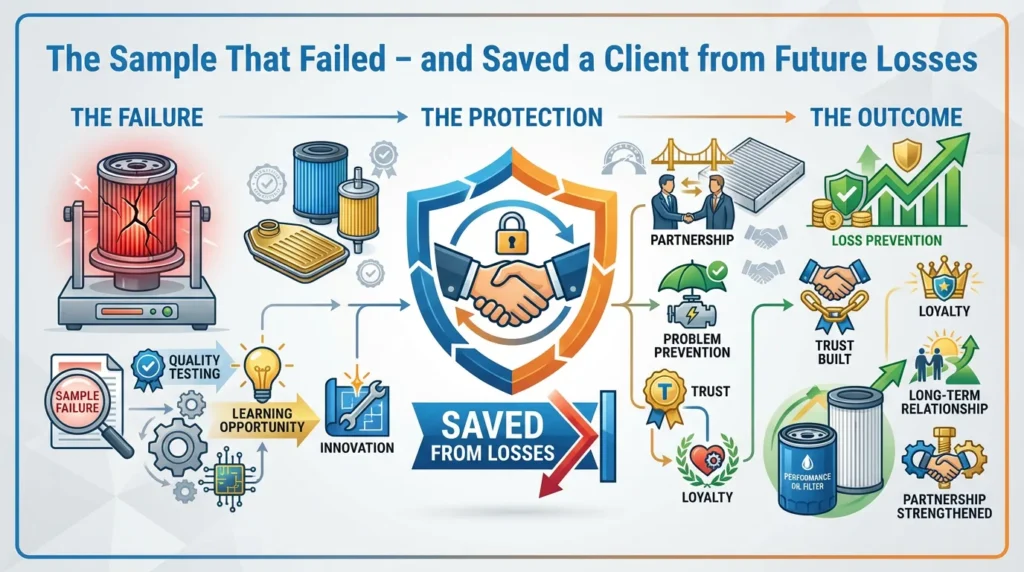
A client from the Middle East once approached us with a clear, challenging request:
“We need a new heavy-duty air filter for very harsh, dusty conditions.
High dust, high vibration, long hours, big fleet – and we can’t afford failures.”
Big fleet customer. Tough environment. High expectations.
Exactly the kind of project that decides whether you’re just a “supplier” or a true technical partner.
We accepted the project and started development.
- we analyzed his application
- we selected media and structure for dust-heavy operation
- we ran our internal lab tests
- we prepared samples and shipped them with confidence
Two weeks later, his message arrived:
“Bruce, one of your samples failed our field test.” ⚠️
For a moment, my heart sank.
But what happened next is a good example of why a failed sample at the right time can be worth more than a “perfect” sample that hides a future problem.
When a Sample Fails in Real-World Field Testing
1.1 Asking for Complete Failure Details
When he reported the failure, I didn’t argue.
I didn’t defend.
I replied and asked for details:
- 📸 Photos of the failed filter
- 🌡️ Engine compartment conditions
- 🌪️ Dust concentration and operating hours
- 🔧 Installation method and any special mounting conditions
He sent us:
- clear pictures of the filter after removal
- notes from the maintenance team
- operating conditions: long hours, desert-like dust, and aggressive vibration
1.2 What the Photos Revealed
The photos told a clear story:
- extremely high vibration around the mounting area
- long replacement intervals – the filter was pushed close to its service limit
- very fine dust – not just coarse particles, but powder-like particles that penetrate everything
The filter media itself was still intact.
The problem appeared at the seal:
- early fatigue signs
- visible stress in the sealing area
- potential risk of leakage if used even longer
It was not a disaster, but it was a warning sign.
We now had a choice:
- blame the harsh environment
- blame installation
- or treat this as valuable feedback to build a stronger product
We chose the third path.
Why We Welcomed the Failure Instead of Excusing It
2.1 No Excuses – Only Learning
I could have said:
- “Your conditions are too harsh.”
- “Maybe the installation wasn’t correct.”
- “Our internal tests passed; this is an abnormal case.”
Instead, I replied:
“Thank you for pushing this filter to the limit.
This failure is valuable.
Let’s upgrade before you go to mass orders.”
Because from a development standpoint:
- a failure during testing is cheaper than a failure during mass usage
- a failure in 10 samples can save you from 5000 failures later
- a failure with an honest customer creates trust if handled correctly
2.2 Field Tests See What Laboratories Can’t Always Simulate
We have strong lab testing capability at Beling Filters, but:
- real engines
- real roads
- real dust and vibration
can reveal stress combinations that no chamber fully replicates.
This field failure gave us exactly the data we needed to:
- understand the true severity of his environment
- see the limits of our first design
- design a second version that could confidently survive his worst cases
How We Upgraded the Heavy-Duty Air Filter Design
Together with our engineers, we went back to the drawing board.
3.1 Reinforcing the Sealing Structure
First, we focused on the weak point exposed by the field test: the seal.
We:
- reinforced the sealing structure, improving stability under vibration
- adjusted the geometry to better distribute stress and reduce local fatigue
- analyzed the contact area between seal and housing to improve consistency
The goal:
Even in extreme vibration and long service intervals, the seal should remain tight, flexible, and durable.
3.2 Changing the Rubber Formula
We also adjusted the rubber formulation:
- selected a compound with higher heat resistance
- improved its vibration fatigue resistance
- ensured it remained stable under fine dust exposure and temperature cycles
This kind of change is invisible on the surface – the filter looks the same –
but the performance margin in tough conditions becomes much higher.
3.3 Optimizing the Pleat Design
We then looked at pleat structure and support:
- adjusted the pleat design to create more stable support
- ensured the media and seal work together as a robust unit
- optimized internal support to avoid subtle shifts under vibration
Even if the media itself didn’t fail, reinforcing the overall structure reduced stress on the seal.
3.4 Second Round Samples for “Worst-Case” Testing
Once the upgrades were implemented, we produced a second round of samples and asked the client:
“Please test this version in your worst vehicles again.”
Not typical vehicles.
Not easy conditions.
We specifically requested their most aggressive, harsh-operating units.
Because if a filter can survive the worst case,
it will easily handle normal conditions.
The Result: No Failures – and a Much Safer Launch
After another testing cycle, the client wrote back:
“Bruce, no failures this time.
If the first version had passed ‘just okay’, we might have had big problems in the field later.
I’m glad it failed now, not after 5,000 pcs.” 🙌
That comment says everything:
- the failed sample had:
✔ saved him from potential returns
✔ protected his reputation with the fleet
✔ given us data to build a truly reliable product
Instead of an “invisible risk” going into mass production,
we turned it into a visible lesson that helped both sides.
Why a “Fail” in Development Can Be Good News
5.1 The Cost of Failure: Now vs. Later
In product development, not every “pass” is truly good, and not every “fail” is bad.
- A failed sample during development is:
- small quantity
- controlled environment
- limited financial impact
- huge learning value
- A weak but not-obviously-failing sample that goes into mass production can:
- lead to thousands of field failures
- create high return and labor costs
- severely damage the brand
So in many cases:
“A failed sample at the right time
is cheaper than a ‘perfect’ sample that hides a future problem.”
5.2 Serious Buyers Understand This
Experienced buyers and fleet-oriented clients know:
- harsh conditions will reveal weaknesses sooner or later
- testing that pushes products to the limit is necessary
- a supplier who accepts and analyzes failures is more trustworthy
than one who claims “zero problems, ever”
Serious buyers don’t only need low prices.
They need:
- technical honesty
- fast improvement
- risk control for large fleets and critical users
How Beling Filters Handles Test Failures
At Beling Filters, we treat every test failure as an investment in future orders.
6.1 Our Failure Analysis Approach
When something fails in:
- internal lab tests
- field tests
- sample trials
we:
- Request or collect detailed information
- photos
- installation details
- operating conditions
- duration and mileage/hours
- Identify the real weak point
- is it material?
- is it structure?
- is it assembly?
- is it environment beyond spec?
- Run root cause analysis
- isolate variables
- compare with similar models
- test alternative materials or designs
- Implement design or material improvements
- reinforce where needed
- improve margins for harsh conditions
- Re-test in the harshest conditions available
- repeat field tests if necessary
- verify stability before moving to mass production
6.2 Communicating Openly with Buyers
Throughout this process, we keep buyers informed:
- we don’t hide test failures
- we share what we learned
- we explain what changes we made
This builds a technical partnership, not just a buyer–seller relationship.
Field Testing: Essential for Harsh & Heavy-Duty Applications
For heavy-duty and harsh-condition markets (like many areas in the Middle East):
- lab testing alone is not enough
- you must combine:
- good design
- strong materials
- laboratory validation
- real-world field testing
Fleet operators in those regions face:
- intense dust (sometimes powder-like)
- long operation hours without rest
- high vibration, off-road usage, and heat
If filters are not designed for these realities, then:
- service intervals shrink
- engines suffer
- fleet downtime increases
- the brand supplying the filters loses credibility
Field testing serves as a reality check before major launches.
If You’re a Buyer: What to Expect from a Serious Filter Supplier
If you are a distributor, fleet supplier, or aftermarket brand:
You should expect your filter supplier to:
- accept that some development samples will fail
- analyze those failures, not hide them
- improve the product design instead of blaming your environment
- invite and even encourage worst-case field tests
What you should be careful about:
- suppliers who always say, “Everything passed perfect, no problem”
- but avoid showing test data
- or become defensive when you present real field issues
Real reliability is built by:
- facing problems early
- correcting them before mass orders
- working with you to protect your reputation in the field
Partner with a Supplier Who Tests Hard and Learns Fast
At Beling Filters, we believe:
- not every failure is bad news
- the most valuable failures happen before mass orders
- tough conditions and harsh field tests help us build better products
If you want an aftermarket filter partner who:
- tests hard instead of just ticking boxes
- treats test failures as valuable lessons
- improves fast when issues appear
- focuses on protecting your brand in real fleet conditions
you’re welcome to contact me:
📩 bruce.gong@belingparts.com
🌐 www.belingparts.com
We don’t develop filters just to pass internal tests.
We develop them to survive your reality.