A few years ago, I noticed a pattern in many factories:
- products met technical specifications
- QC reports were clean
- pre-shipment inspections showed no defects
Yet customers still reported “small issues” after receiving goods.
Not quality defects —
but expectation gaps.
Examples:
- label placed differently than last batch
- carton printing shade slightly lighter
- product orientation in the box reversed
- pallet layout changed without notice
Tiny operational deviations, but they created confusion for distributors and their warehouse teams.
So I created a habit —
one so simple that many overlook it:
👉 Before every shipment, I send customers a full set of packing photos.
Not marketing images.
Not staged studio photos.
Real, raw, operational visuals:
- carton label layout
- OE number visibility
- barcode placement
- box color consistency
- pallet arrangement
- stretch-wrapping quality
- container loading sequence
At first, customers were surprised:
“Bruce, no other supplier sends this level of detail.”
But within a few months, something remarkable happened:
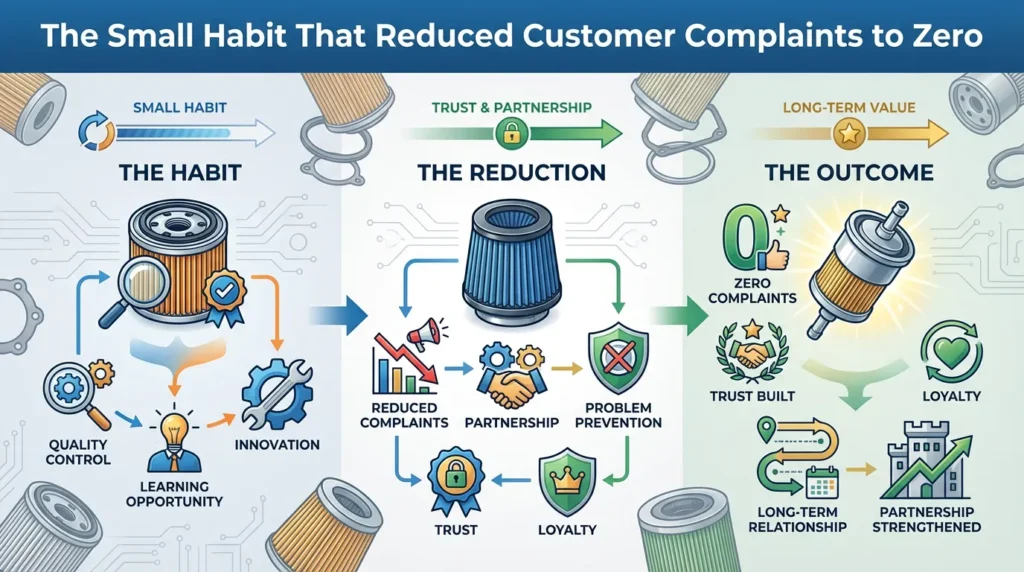
Customer complaints dropped to zero.
Not because problems disappeared —
but because we eliminated surprises.
This is the story of how one small habit became one of our biggest operational advantages at Beling Filters, and why it matters so much to overseas buyers.
The Hidden Gap Between QC Reports and Customer Reality
1.1 Why “Pass” on QC Doesn’t Mean “No Complaints”
In many factories, quality is defined like this:
- dimension within tolerance
- material meets spec
- performance test passed
- AQL visual inspection passed
On paper, this means: “Quality is OK.”
But customers live in a different reality:
- their teams handle the cartons and pallets
- their warehouse has its own receiving procedures
- their retail shelves need consistent presentation
- their scanners depend on proper barcode visibility
So even when the product itself is fine, they still face:
- “The label is on the wrong side compared to last time.”
- “This batch’s box color is slightly different; our retail shelves look inconsistent.”
- “Pallet layout changed; now it doesn’t match our warehouse system.”
These are not product defects.
They are operational mismatches.
Traditional QC focuses on what is inside the box.
Overseas customers experience:
the product + the packaging + the handling + the consistency vs. last time.
That gap is where many “small complaints” are born.
1.2 Tiny Deviations, Big Operational Headaches
Let’s look at some typical issues that cause frustration:
- Label placement changed
- Warehouse staff can’t scan easily.
- They must turn every carton manually.
- Carton printing shade slightly lighter/darker
- Retail shelves look inconsistent.
- Customers ask: “Is this original or fake?”
- Product orientation in the box reversed
- Installers or warehouse teams must rotate parts.
- Previous SOP photos no longer match.
- Pallet layout changed without notice
- Pallets no longer fit standard racks or truck space optimally.
- Receiving teams need to adjust their process.
Each one is “small” from the factory point of view.
But for a distributor with strict systems, each is a real operational cost.
I realized that:
The issue is not “quality failure”.
The issue is lack of visual alignment and no early warning.
That’s when the idea of sending packing photos before shipment became my standard habit.
The Simple Habit: Sending Full Packing Photos Before Shipment
2.1 What Kind of Packing Photos We Send
Before every shipment, we now send customers a full set of packing photos.
Not just one or two sample pictures.
We cover:
- Carton Label Layout
- where the label is placed
- how information is structured
- orientation relative to carton edges
- OE Number and Part Number Visibility
- close-up image of OE number and internal part number
- ensure it matches the buyer’s format and request
- Barcode Placement and Scan Direction
- photo of barcode location
- orientation (horizontal/vertical)
- confirm scannability area is clear
- Box Color and Design Consistency
- photos of individual inner boxes
- check that color tone and printing match previous orders or agreed artwork
- Pallet Arrangement
- top and side views of pallet stacking
- number of cartons per layer and per pallet
- pallet size and height
- Stretch-Wrapping Quality
- photos of film wrapping
- corner protection, stability, and labeling on pallets
- Container Loading Sequence
- pictures during container loading
- how pallets or loose cartons are arranged
- use of space, bracing, and protection
These are not “pretty marketing photos”.
They are real operational visuals from the actual batch being shipped.
2.2 When and How We Share the Photos
Timing is important.
We don’t wait until after the container leaves.
Our process:
- once packing is completed
- before container loading (or during loading if needed)
- we send the full photo set via WhatsApp and email
This allows customers to:
- check if packaging still aligns with their last order
- confirm any small changes
- give us feedback before the shipment departs
If they see something they want adjusted (for example, label position), we can still:
- reposition labels on outer cartons
- adjust pallet labeling
- correct barcodes or printing if there was a mistake
This habit turns packing into a collaborative checkpoint, not a black box.
Why This Small Habit Reduced Customer Complaints to Zero
3.1 The Real Enemy: Unexpected News
In supply chains, disappointment doesn’t usually come from:
- bad news
- delays
- real constraints
It more often comes from:
unexpected news and unseen changes.
For example:
- warehouse opens the container and finds labels in a different location
- retail packaging looks different without prior communication
- pallets arrive in a layout that doesn’t fit the existing workflow
Even if the product itself is good, they feel:
- surprised
- unprepared
- forced to adjust on the spot
This leads to:
- frustration
- “small complaint” emails
- internal stress on their logistics and operations teams
When we started sending packing photos:
- nothing in our quality system changed dramatically
- but we removed the element of surprise
Customers could see:
- exactly how this shipment looked
- what to expect at their warehouse
- any small differences compared to before
Complaints dropped not because we suddenly became perfect,
but because buyers knew exactly what they would receive.
3.2 Photos Create Alignment, Alignment Creates Trust
Compared to:
- long emails
- promises like “same as last time”
- QC reports full of technical data
a simple set of photos does something powerful:
- it shows reality, not only words
- it answers the unspoken question:
“Will I get exactly what I expect?”
- it allows the buyer to check visually and give input
Photos:
- create alignment between factory and warehouse
- build confidence in repeatability
- reduce fear of unexpected changes
This visual alignment is a strong trust builder, especially for overseas buyers who cannot easily visit the factory.
Why Overseas Buyers Value Pre-Shipment Packing Photos
4.1 Operational Realities in Europe, MENA, and the Americas
Distributors in Europe, MENA, and the Americas often face:
- strict warehouse procedures
- barcode scanning requirements at receiving
- standardized pallet sizes and stacking rules
- consistent packaging needed for retail shelves
- increasing use of third-party logistics (3PL)
In these environments, even small packaging differences can cause:
- receiving delays
- re-labeling work
- confusion during put-away
- incorrect inventory registration
And each problem has a cost.
4.2 Typical Problems We Help Buyers Avoid
By sending packing photos, we help customers avoid:
- ❌ receiving delays
- when labels are not where warehouse teams expect them
- when pallets are stacked differently than the system assumes
- ❌ re-labeling cost
- when barcodes are covered, placed too low, or unreadable
- when label content or layout changes without notification
- ❌ warehouse confusion
- when mixed SKUs on one pallet are not clearly marked
- when carton designs look similar but contain different parts
- ❌ customer complaints
- due to visual differences in retail packaging
- perceived “inconsistency” or worries about authenticity
- ❌ SKU mix-ups
- when part numbers are not clearly visible
- when orientation and marking are inconsistent
For overseas buyers, not being on-site at the factory creates natural uncertainty.
Packing photos reduce that uncertainty to almost zero.
When they see what we see,
they can plan their operations with confidence.
How Beling Filters Uses Packing Photos as a Reliability Tool
5.1 Our Standard Pre-Shipment Visual Package
At Beling Filters, for every shipment, we provide:
- Full Packing Photo Set
- inner boxes, outer cartons, labels, pallets
- Carton + Pallet Confirmation
- number of cartons per pallet
- carton dimension and stacking patterns
- Container Loading Sequence
- how goods are placed inside the container
- loading order and stability measures
- SKU Verification Images
- photos showing part numbers, OE references
- sometimes side-by-side comparison with previous batches if requested
- QC Visuals for Critical Points
- photos of important product details
- any special marking required by the buyer
- Dual-Channel Communication: WhatsApp + Email
- instant preview via WhatsApp
- archived confirmation via email
This is not a one-time campaign.
It’s a habit repeated:
- every week
- every order
- every customer
It has become part of our standard export process.
5.2 Why This Habit Became an Operational Advantage
Most factories focus heavily on:
- price
- lead time
- basic quality metrics
These are essential, but highly competitive areas.
Our packing photo habit gives us:
- a clear differentiation in terms of communication and transparency
- lower rate of operational complaints
- stronger relationships with warehouse and logistics managers (not just purchasing)
Many buyers tell us:
“Our warehouse team likes working with you because they always know what to expect.”
In B2B export, being a “warehouse-friendly supplier” is a major hidden strength.
Quality Is Not Just What You Produce – It’s What the Customer Sees
6.1 Expanding the Definition of “Quality”
Traditionally, quality in manufacturing means:
- product meets spec
- tests passed
- no major defects
But in real business, perceived quality also includes:
- consistency of packaging
- clarity of labeling
- ease of scanning and handling
- alignment with previous deliveries
A product can be technically perfect but still cause operational dissatisfaction.
So we adjusted our mindset:
Quality is not only what we produce.
It’s also what the customer sees and experiences at receiving.
6.2 A Zero-Surprise Supply Chain
Ultimately, the goal of sending packing photos is simple:
- reduce surprises
- reduce stress
- reduce friction between supplier and buyer
A zero-surprise supply chain doesn’t mean:
- zero changes
- zero issues ever
It means:
- changes are communicated in advance
- visual confirmation is provided
- both sides stay aligned on expectations
That is why, when we think about reliability at Beling Filters, we don’t only talk about:
- ISO certificates
- machinery
- capacity
We also talk about:
- habits
- visibility
- proactive communication
And this small habit — sending packing photos — stands out as one of our most effective tools.
If You Want a Warehouse-Friendly, Zero-Surprise Supplier
If you are an overseas automotive filter importer or distributor and you:
- work with 3PL or strict internal warehouse systems
- need consistent packaging for retail or workshop channels
- want fewer emails about “small issues” that eat up time and energy
then partnering with a supplier who sends detailed packing photos before shipment can make a big difference.
At Beling Filters, we aim to:
- make your warehouse team’s life easier, not harder
- give your logistics and operations people clarity, not surprises
- support your business not only with product quality, but also with operational transparency
If you want to build a zero-surprise supply chain with automotive filters:
📩 bruce.gong@belingparts.com
🌐 www.belingparts.com