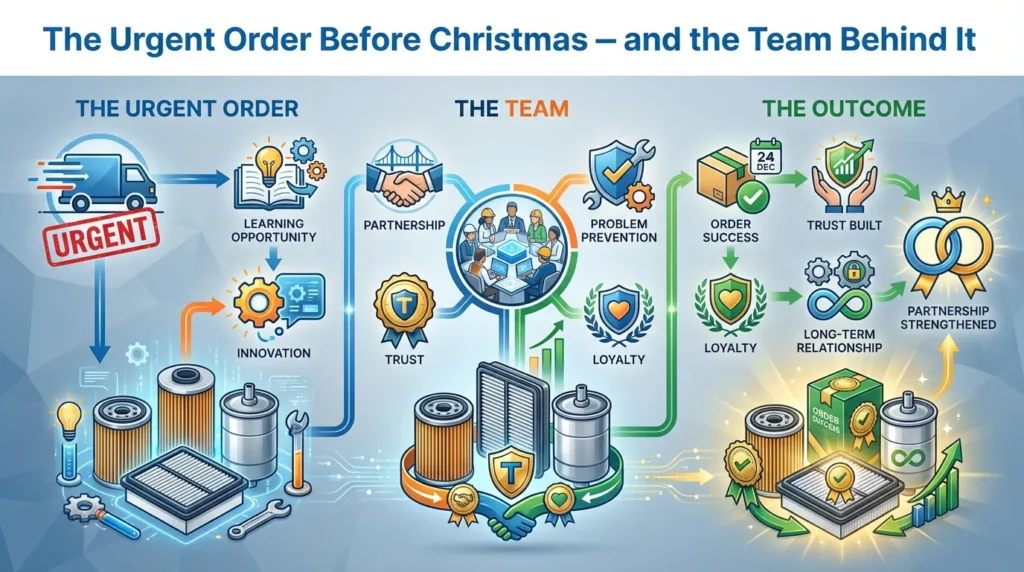
Two weeks before Christmas,
most people are thinking about holidays, family, and slowing down.
In the aftermarket business,
that’s often when urgent orders appear.
Last December, a long‑term customer from Europe
sent me a message at 10:30 pm (China time):
“Bruce, one of our key fleets just won a big contract.
We urgently need filters for their trucks before year end.
Can you help?”
The request was clear and heavy:
- 📄 22 filter references
- 📦 1 x 40’ HQ container
- ⏱️ Ship within 7 days
Our normal lead time?
If I followed our standard process,
the answer would have been easy:
“Impossible, sorry. Lead time is 25–30 days.”
But this time, I knew something else:
- This fleet could become his strategic account.
- If he failed now, he might lose them to a competitor.
So the question wasn’t just:
It was:
“Can we support our customer
at a critical moment without breaking our own system?”
The answer depended on one thing:
the team behind the email.
The Late‑Night Message and What Was Really at Stake
At 10:30 pm, my phone lit up with his message.
This wasn’t just another order.
This was about:
- a key fleet in his country
- a big new contract he had just won
- a deadline before year end
If he failed to deliver:
- his fleet customer might switch to another supplier
- his competitors would be happy to step in
- his reputation as a reliable partner would suffer
On our side:
- our planning and production were already organized
- factories were under pressure before holidays
- shipping lines were crowded before year end
From a purely internal view, it was a bad moment to push extra.
From a long‑term partnership view,
it was the perfect moment to show what kind of supplier we are.
I decided not to answer immediately with “yes” or “no.”
Instead, I went to the office early the next morning.
The “War Room” Meeting: How Can We Make This Possible?
The next morning, I called an internal “war room” meeting.
In the room were:
- 🏭 Production
- 📦 Packing
- 📊 Planning
- 📑 Documentation / Export
On the whiteboard, we wrote one sentence:
“How can we make this possible
without breaking our system?”
This sentence was important because:
- We didn’t want to promise something we couldn’t keep.
- We didn’t want to damage other customers’ orders unfairly.
- We needed to protect both our customer and our team.
Instead of starting with “we can’t,” we asked:
- “What would it take to say yes, and still stay in control?”
Step 1 – Checking Stock in Components, Not Just Finished Goods
If we only checked finished goods,
the answer would be very simple:
- We didn’t have all 22 SKUs ready in finished form
- Normal production and packing time is 25–30 days
- So the answer would be: “Impossible.”
But we decided to look deeper.
We checked:
- available caps
- available filter media
- available cores and components
- semi‑finished parts in different stages
This is a different mindset:
Don’t just ask: “Do we have finished filters?”
Ask: “Do we have the parts to assemble them quickly?”
By doing this, we discovered:
- many of the requested models shared common components
- we had enough materials for a fast‑track assembly
- some SKUs were closer to completion than others
This gave us the first green light:
- If production and packing could focus,
- we could assemble and finish a large part of the order in time.
Step 2 – Re‑Prioritizing Non‑Urgent Orders (With Transparency)
To free capacity for this urgent order,
we had to make choices:
- which production slots to adjust
- which packing tasks to move
- which orders could be shifted slightly
We decided to re‑prioritize some non‑urgent orders, but with one rule:
Always communicate clearly with those customers.
We contacted a few customers whose orders:
- were not time‑critical
- had flexible delivery windows
- would not be seriously affected by a short delay
We explained:
- that we had an urgent case for a long‑term partner
- that we needed to re‑allocate capacity
- that their orders might ship a few days later
Most professional B2B customers understand this,
as long as you:
- inform them early
- give them realistic new dates
- show that you’re not neglecting them,
but managing priorities responsibly
This step allowed us to free up production and packing time
without creating chaos or hidden delays.
Step 3 – Designing a Split Shipment Plan as a Safety Net
When timing is tight, things can go wrong:
- a component shortage
- an unexpected machine issue
- a last‑minute logistics delay
To avoid an “all or nothing” risk,
we prepared a split shipment plan.
The idea:
- If everything went perfectly,
the whole 40’ HQ would ship together. - If something slipped,
we would still ensure that at least 70% of the order shipped first.
Why this mattered:
- The fleet needed filters urgently to start the contract.
- They didn’t necessarily need 100% of the stock on day one.
- Partial, prioritized delivery could still save the situation.
So we designed:
- which SKUs and quantities would go in the first wave
- which could be delayed slightly if absolutely necessary
This plan gave us:
- a target (full shipment in 7 days)
- and a safety net (most critical volume on time, even if something goes wrong)
Seven Days of Focus: What It Takes Behind an “Urgent Order”
For the next 7 days, the team worked with unusual intensity—but controlled.
They:
- stayed late in production
- coordinated urgently, but without cutting quality corners
- double‑checked labels, cartons, and packing lists
- talked daily with the forwarder to secure vessel space in the pre‑holiday rush
Key behaviors that made the difference:
6.1 Production: Speed Without Sacrificing Quality
The production team:
- adjusted schedules
- optimized assembly for the 22 SKUs
- made sure all parts matched specs
They knew:
- If we shipped fast but made mistakes,
we would create bigger problems later.
So speed was important—but accuracy was non‑negotiable.
6.2 Packing: Details Matter Under Pressure
Packing teams:
- prepared cartons and labels in advance
- ensured each SKU was correctly identified
- verified barcodes, branding, and language requirements
In a rush, mislabeling or mixed cartons can easily happen.
We insisted on:
- double checks
- cross‑verification
Because an urgent shipment that confuses the customer’s warehouse
is not a real success.
6.3 Documentation: No Paperwork, No Vessel
Our documentation team:
- prepared commercial invoices, packing lists, and other export docs
- coordinated with the forwarder for cut‑off times
- checked all details to prevent customs or shipping issues
Under tight timing,
a small documentation error can cause:
- a missed vessel
- a delay of weeks instead of days
So they treated paperwork like a critical part of the product.
Day 7, 8:15 pm – “Your Christmas Container Is on the Road”
On day 7 at 8:15 pm,
I received a message from our logistics team:
“Container loaded, sealed, on the way to port.”
I went to the loading area,
looked at the sealed 40’ HQ,
and took a photo.
Then I sent that photo to the customer with one simple line:
“Your Christmas container is on the road.”
A few minutes later, his reply came:
“Bruce, please say THANK YOU to your whole team.
You didn’t just ship filters,
you helped us win a critical fleet.”
For us, it was:
- one intense week
- one big container
For him, it was:
- the difference between keeping and losing
a strategic fleet account.
Later, he told me:
- the fleet contract was extended
- our filters are now part of their standard maintenance plan
One urgent order,
handled with care and coordination,
turned into:
- stable, long‑term business
- a stronger relationship
- deeper mutual trust
Why This Worked: Process + Flexibility + Team Spirit
Many suppliers say:
- “We care about urgent orders.”
But in practice, caring means:
- sacrificing other jobs without control
- pushing workers too hard
- improvising without planning
What made this case successful was a combination of three things.
8.1 We Respected Our Own System
We didn’t just say “yes” emotionally.
We asked:
- What do we have in components?
- What can we realistically assemble?
- Which orders can be reprioritized without harming others?
- What backup plan do we need if something goes wrong?
We pushed hard—but inside a controlled framework.
8.2 We Treated the Customer’s Situation as Our Own
We tried to think like him:
- “If I fail to deliver, I might lose a strategic fleet.”
- “This is not just about one shipment; it’s about my position in the market.”
That mindset changed our behavior:
- we didn’t look at it as “just another urgent PO”
- we looked at it as “helping our partner win an important battle”
8.3 We Remembered It’s a Team Effort, Not a Sales Hero Story
It would be easy to tell this as:
- “Salesperson saves the day.”
But that’s not true.
Behind every urgent order, there are:
- planners reshuffling capacity
- production staff working late
- packers checking details under pressure
- documentation staff racing against cut‑off times
- logistics staff fighting for vessel space
In B2B, real success is built on teams,
not on individuals.
What This Means for Fleet Maintenance and Aftermarket Buyers
If you manage:
- a fleet maintenance program
- an aftermarket distribution network
- key accounts with tight service windows
you know that “urgent” situations are part of reality:
- tenders won at the last minute
- new contracts starting earlier than expected
- unexpected consumption peaks
When choosing suppliers, it’s worth asking:
- “What happens if I need something urgently?”
- “Can you check components and fast‑track assembly if needed?”
- “Are you able to reprioritize production in real emergencies?”
- “Do you have a plan for split shipments if everything can’t be ready at once?”
No supplier can be “urgent” every day.
But a serious partner will:
- tell you honestly what is and isn’t possible
- be willing to push for you when the situation is critical
- coordinate internally, not just say yes on email
Our Approach to Urgent Orders in International Trade
We don’t promise:
- that every order will ship in 7 days
- that we can always compress lead times dramatically
But we do promise:
- to listen carefully when your key customers are on the line
- to check stock and components, not just finished goods
- to explore realistic options without breaking our system
- to communicate transparently about what’s possible
When you face:
- a new fleet contract
- a last‑minute tender win
- a sudden stock shortage on key references
we want to be the kind of partner you can call and say:
- “This is critical. Can you help me explore options?”
Sometimes we will say:
- “We can make it work—here is how.”
Sometimes we will say:
- “We can’t do everything, but we can do this part on time and this part later.”
And sometimes we must say:
- “This time it’s not realistic, and here’s why.”
But in all cases,
you will get:
- an honest assessment
- a team discussion behind the answer
- a commitment to your long‑term success, not just the next PO
If You Want a Filter Partner Who Can Think Beyond Standard Lead Times
If you’re looking for a filter partner who:
- understands the pressure you face with fleets and key accounts
- is willing to mobilize teams for truly critical orders
- can think creatively with components, planning, and split shipments
- treats your urgent situation as more than “just another request”
I’d be glad to stay connected and talk about:
- how we plan production and lead times
- how we handle urgent cases without damaging quality
- how we support distributors and fleet suppliers in Europe and other regions
📩 bruce.gong@belingparts.com
🌐 www.belingparts.com
Because in B2B,
real loyalty is not built when everything is easy—
it’s built in the weeks when time is short,
pressure is high,
and a team chooses to care a little more.