
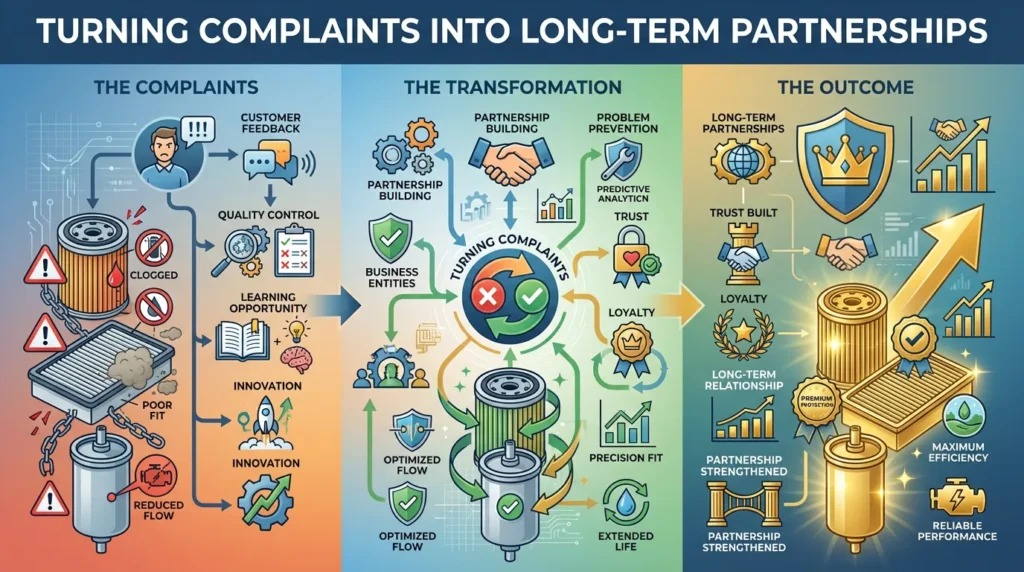
“Can we return the whole shipment?”
That was the first line of a 2am email from a new customer.
His subject line was just one word:
“Problem.”
If you work in auto parts export, you know that feeling in your stomach:
- first container with a new client
- big expectations on both sides
- and then… a serious complaint, very early
This story could have ended with:
- a lost customer
- a damaged reputation in a new market
- expensive returns and arguments
Instead, it turned into a stronger partnership and a better product for an entire market.
Here’s exactly what happened, step by step, and how we now use complaints at Beling to build trust instead of lose it.
-
The Complaint: A New Customer, a First Container, and a Big Problem
1.1 The First Order Looked Perfect
Last year, a new distributor from the Middle East placed his first container with us at Beling:
- mainly air filters and cabin filters
- focused on fast‑moving Japanese and Korean applications
- new line, new brand, new hope for his team
Everything went smoothly at the beginning:
- samples were approved
- packaging was confirmed
- shipment was loaded and sailed
- he received the goods and started to supply his workshop network
From our side, it looked like a successful start.
1.2 The Email That Changed the Mood
Three weeks after the goods arrived, his email came in at 2am (our time):
“We are receiving complaints.
Some filters don’t fit well into the air box.
Our mechanics say installation is not smooth.
Can we return the whole shipment?”
At first glance, it looked bad:
- he was a new client
- this was his first big order
- and he was already talking about returning everything
In that moment, we had to decide:
Do we defend ourselves first?
Or do we solve first?
How you respond to this first big test can determine whether you:
- lose a customer forever
- or gain a long‑term partner who trusts you under pressure
-
Step 1 – Calm Down, Clarify, and Collect Facts
2.1 The First Response: Appreciation, Clarification, Evidence
When emotions are high, it’s easy to react defensively:
- “Are you sure it’s our problem?”
- “We followed your drawing.”
- “No other customers complained.”
At Beling, our rule is simple:
Don’t argue with feelings.
Work with facts.
So I replied with three elements in my first email.
1️⃣ Appreciation
“Thank you for telling us immediately.
Let’s solve this together. We take this very seriously.”
This shows:
- we are not hiding
- we welcome the complaint as something to work on
- we respect his transparency
2️⃣ Clarification
“Can you help confirm:
– Which part numbers have this issue?
– Is it all pieces or some?
– Is it tight, loose, or different shape?”
We needed to move from:
- “some filters don’t fit” → which ones, how many, in what way?
3️⃣ Evidence Request
“Could you send us:
– Photos of the filter installed in the air box
– A short video showing the fitting problem
– Label / batch number on the carton”
We wanted:
- objective visual information
- batch traceability
- clear proof to investigate
2.2 Moving From Emotion to Information
Within a day, he sent:
- photos of 3 SKUs with poor fitting
- a short video filmed in his workshop, showing tight installation
- batch numbers and packaging photos
Now we could move from emotion to information.
From this point on, our internal discussion stopped being:
- “Is it really our fault?”
and became:
- “What is really happening, and how do we fix it?”
This mindset shift is critical in B2B exports:
Complaints are not personal attacks.
They are data about how your products behave in the real world.
-
Step 2 – Internal Investigation (and Being Ready to Admit Fault)
3.1 Involving the Right People
I forwarded everything to:
- our QC team
- our R&D engineers
- our production manager
We pulled out:
- the original drawings
- the sample he approved before mass order
- the production records for that batch
- the inspection reports for those SKUs
We wanted to answer:
- Did we really produce according to the approved spec?
- Did anyone deviate from the process?
- Was there any sign of non‑conformity during production or QC?
3.2 Testing on Real Air Boxes
Our engineers then tested the same SKUs on:
- OEM air boxes (original equipment specification)
- Aftermarket replacement air boxes from different suppliers
They reproduced:
- how mechanics in his market would install the filter
- the exact fitting behavior in various boxes
Then we found the real reason:
- the filter was within our drawing tolerance
- but his local aftermarket air box from another supplier
had slightly smaller internal dimensions
- result: fitting was too tight, installation not smooth
In simple terms:
By drawing and spec, the filter was “correct.”
But in his market reality, with his local air box supplier,
it was not okay in practice.
3.3 The Critical Moment: Blame or Responsibility?
At this point, many factories choose the easy answer:
- “Our size is correct. It’s not our problem.”
On paper, they are “right.”
But in B2B, being technically right and losing a customer is not much of a victory.
We decided to take a different approach:
Even if the root cause is shared,
we will share the responsibility and help him fix it.
Because:
- his brand is on the box
- his mechanics face the customer
- his reputation is at risk
And if we want a long‑term partnership, we must care about his reality, not just our drawing.
-
Step 3 – Take Shared Responsibility and Give a Clear Plan
4.1 A Video Call Instead of a Long Email Fight
I scheduled a video call with him and his workshop supervisor.
On the call, I did three things.
1️⃣ Acknowledge His Pain
“I understand your mechanics are under pressure.
If they don’t trust this filter, they won’t recommend it.
We don’t want that – for your brand or for Beling.”
This told him:
- we understood the human part of the problem
- we were not just looking at numbers and specs
2️⃣ Explain the Finding in Simple Words
“Your air box supplier made the box a bit smaller.
Our filter is okay by design, but in your market reality
the fitting is too tight.
That’s still our problem to help you fix.”
Notice:
- no blaming
- no hiding behind tolerance charts
- we accepted that his real‑world condition is what matters
3️⃣ Present a Concrete Solution, Not Excuses
We offered:
- to re‑design these 3 SKUs with 1–2 mm adjustment to fit his boxes
- to send free replacement filters for the problematic quantities in the next shipment
- to share test reports and new drawings for his confirmation before production
I also said clearly:
“We won’t leave you alone with this.
Even if the root cause is shared,
Beling will stand behind this order.”
This is where trust is built:
- not by saying “we are perfect,”
- but by saying “when something goes wrong, we stay and fix it with you.”
-
Step 4 – Quick Action: Design, Test, and Replace
5.1 Engineering Changes Focused on His Market
After the call, our R&D team immediately started working:
- adjusted the PU edge dimensions for each problem SKU
- simulated installation on 3 different air boxes
- OEM version
- local aftermarket version
- another common brand in that region
We ran:
- fitment tests
- assembly force checks
- visual inspections
Everything was recorded as:
- photos
- videos
- updated drawings
We then sent him:
- new drawings for review
- photos and videos of the new fitting
- a short explanation of what changed and why
His reply was simple:
“This is exactly what my mechanics need.”
5.2 Replacement and System Update
We then:
- produced the new batch of filters
- included them as free replacements in his next order
- added a note in our ERP/MRP system:
“Special dimension version – for [Country] market.”
This meant:
- next time any client from his country orders these SKUs,
we automatically use the optimized design
So the impact of this complaint became:
One complaint → Design improvement →
Better fit for an entire market.
We didn’t just solve one shipment.
We improved our system and product database.
-
The Real Result: More Than Just Solving a Problem
6.1 Yes, We Lost Some Money – But We Gained More
Let’s be honest:
- we lost some money on that first container
- we invested extra time on engineering and testing
- we provided free replacements
But 6 months later, he shared something much more important:
- complaints on those SKUs dropped to almost zero
- his mechanics now trust his brand more
- he increased his yearly forecast with us by 40%
For us, this was a clear signal:
- short‑term loss
- long‑term gain
6.2 The Sentence That Summarized Everything
He told me:
“The reason I stay with Beling is not because you never have problems.
It’s because when there is a problem, you face it with me
and solve it professionally.”
For a company like us – with:
- 17+ years automotive filter experience
- IATF 16949 and ISO certifications
- 32 million filters yearly capacity
- clients in 30+ countries
This is exactly the kind of partnership we want.
Not “no problems ever” (that’s not realistic in real‑world usage).
But:
“When there is a problem, we don’t run away.”
-
Key Lessons: How to Turn Complaints into Partnership Capital
From this case, I learned several important lessons as a B2B export salesperson.
7.1 Lesson 1 – Don’t Take Complaints as Attacks. Take Them as Data.
Many buyers don’t complain.
They simply:
- reduce orders quietly
- change suppliers without explanation
- tell their team “don’t push this brand”
If someone is willing to send you a long, detailed complaint, it means:
- they still care enough to talk
- they still hope you will fix it
Behind every complaint, there is usually:
- a process issue
- a market difference
- or a communication gap
Your job is to find which one it is.
7.2 Lesson 2 – Separate “Specification Correctness” from “Market Correctness”
On paper, our filter size was okay.
By drawing and tolerance, we were “correct.”
But in his market:
- with his local air box supplier
- in his real installation conditions
the filter was not acceptable.
In B2B, “We are within tolerance” is not enough.
The real question is:
“Does it work smoothly in your workshop, for your mechanics, with your parts?”
If the answer is “no,”
then you still have a problem to solve, even if your spec is technically right.
7.3 Lesson 3 – Share Responsibility, Even When It’s Not 100% Your Fault
If you want long‑term contracts, you must be ready to:
- share some cost
- share some risk
- share the work to fix things
At Beling, we prefer:
A short‑term loss
→ for a long‑term, more profitable cooperation.
This doesn’t mean saying “yes” to everything.
It means:
- being fair
- being transparent
- and looking at the lifetime value of the relationship, not just one shipment
7.4 Lesson 4 – Turn Every Complaint into a System Improvement
We didn’t just fix his batch and move on.
We:
- updated drawings for those SKUs
- added ERP notes for that country’s version
- updated our internal “market difference” database, noting that:
- in some Middle Eastern markets, local air boxes can be slightly smaller
So next time, sales and engineers already know:
“Middle East version – use optimized size.”
This way:
- each complaint makes our system smarter
- future customers benefit from past lessons
- we reduce repeated issues and save everyone time
-
Our Standard Complaint Handling Process at Beling
Over time, we turned this approach into a repeatable process.
For any serious complaint, we follow these steps:
1️⃣ Listen first, don’t argue.
- Let the customer explain fully
- Acknowledge their frustration
2️⃣ Ask for clear photos/videos and batch info.
- Installed photos
- Short videos from workshops
- Carton labels, batch numbers
3️⃣ Run an internal investigation with QC + R&D.
- Check drawings, samples, records
- Test in realistic conditions
4️⃣ Share findings honestly, even if it’s uncomfortable.
- Avoid blaming others
- Be transparent about what was found
5️⃣ Offer a win–win solution.
- Replacement
- Redesign
- Credit note
- Or a combination
6️⃣ Save everything in our system to prevent repetition.
- ERP/MRP notes
- Drawing updates
- “Market difference” database entries
This is how we live our slogan in real life:
“Beling – Save Your Time & Cost”
Not by avoiding problems,
but by:
- solving them fast
- learning from them
- and making sure the same issue does not come back.
Beling – Save Your Time & Cost
Handling complaints is not the most comfortable part of international trade.
But it is one of the most important.
At Beling Filters, we don’t pretend that real‑world usage is always perfect.
We know that:
- different markets have different parts and conditions
- sometimes compatibility gaps appear
- sometimes expectations and drawings don’t fully match reality
What defines us is:
- we face problems with our customers
- we investigate with QC + R&D + production
- we redesign where needed
- we turn every serious case into a system improvement
If you want a filter supplier who:
- doesn’t disappear when there is a complaint
- understands the pressure from mechanics and workshops
- prefers long‑term partnership over short‑term profit
We are ready to talk.
📩 bruce.gong@belingparts.com
🌐 www.belingparts.com
Beling – your automotive filter partner with:
- 17+ years experience
- 32M filters yearly capacity
- 95%+ global vehicle model coverage
- IATF 16949 & ISO‑certified quality management
- customers in 30+ countries