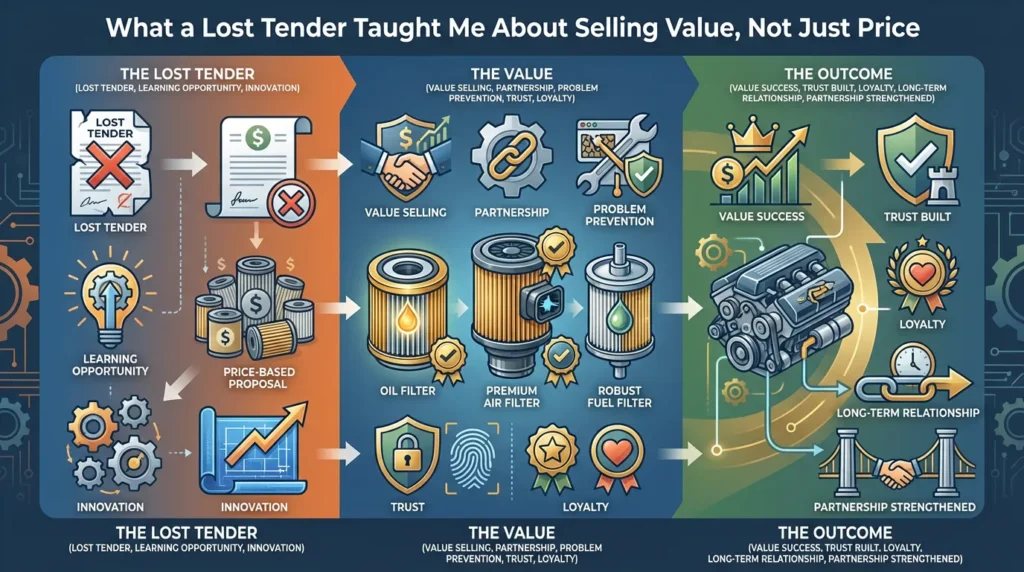
A few years ago, I worked for weeks on a tender for a big fleet operator.
- The annual volume was huge.
- The brand visibility would be great.
- It was exactly the kind of project every auto filter supplier hopes to win.
We did everything we thought was “right”:
- detailed quotation
- optimized packaging
- very competitive price
I felt confident.
Then the email arrived:
“Bruce, thank you for your proposal.
We decided to go with another supplier.”
I did what any serious B2B salesperson should do:
I asked why.
Their answer was simple… and painful:
“Your price is OK, but the other supplier showed us
how their filters will reduce downtime
and simplify our stock management.
They talked about our total cost, not just unit price.”
That single comment changed how I see fleet business, pricing, and value.
Because I realized:
- I had been busy proving we were “cheap enough.”
- They had been busy proving they were “valuable enough.”
This article is about what that lost tender taught me about selling value, not just price, especially in the automotive filter business for fleets.
How We Lost a “Perfect” Tender by Thinking Like a Commodity
In that tender, I thought we had done a very solid job.
We had:
- broken down every part number
- prepared clean and clear pricing
- optimized packaging dimensions to improve container loading
- sharpened the unit price as much as possible
From a traditional RFQ perspective, our offer checked all the boxes:
- technically acceptable
- reliable supply
- competitive pricing
So when we lost, it hurt—but it was also a wake‑up call.
When I asked for feedback and heard:
“They talked about our total cost, not just unit price.”
I understood the key mistake:
We had answered the question written in the tender,
but not the real question in the customer’s business.
The fleet operator wasn’t only thinking:
- “How many cents per filter?”
They were also thinking:
- “How much will my trucks stop?”
- “How complex is my stock?”
- “How many mistakes will my mechanics make?”
- “What is the overall cost to keep my fleet running reliably?”
We had sold filters.
The winning supplier had sold uptime and simplicity.
Price vs. Value in Fleet Filter Supply
To understand what happened, I had to separate two concepts:
- Unit price – what you pay for 1 filter.
- Total cost of ownership (TCO) – what it really costs to keep a vehicle operating, including:
- downtime
- labor
- stock management
- errors
- emergency purchases
Many suppliers (including us at that time) focus on unit price because:
- it’s easy to compare
- it looks clean in a spreadsheet
- it’s the main line in a tender form
But fleet managers, especially professional ones, care deeply about:
- cost per kilometer
- cost per operating hour
- average downtime per vehicle
- number of SKUs they need to manage
- error rate at maintenance
The winning supplier in that tender didn’t win because they were necessarily cheaper per piece.
They won because they showed how they would:
- reduce downtime
- simplify stock
- support the fleet’s operation
They sold value, not just price.
Visiting a Fleet Customer: Seeing the Real Cost Drivers
After that experience, I didn’t want to just guess what “value” meant.
I went to see it.
I visited one of our existing fleet customers and spent time in their operation.
Not in the meeting room — in the workshop and warehouse.
I watched:
- how often vehicles came in for filter changes
- how many different filter models they kept in stock
- how mechanics searched for the right part
- how trucks lined up and waited
3.1 Vehicle Maintenance Patterns
I observed:
- service intervals
- average oil change frequency
- how they planned maintenance to minimize downtime
I noticed that:
- some vehicles came in earlier than necessary “just to be safe”
- others stretched intervals too much, increasing technical risk
There was an opportunity to:
- align filter life and service schedules more intelligently
- support them with recommendations that fit their operation pattern
3.2 SKU Complexity in the Warehouse
In the warehouse, I saw shelves full of filters:
- many different part numbers
- similar filters for similar vehicle types
- lots of small quantities of rarely used references
The warehouse manager told me:
- “We constantly fight with space and slow-moving items.”
- “Sometimes we buy a small batch of a rarely used filter, and then it sits for a long time.”
High SKU complexity meant:
- more stock value frozen on shelves
- higher risk of obsolete stock
- more administrative work
- more chances for picking errors
3.3 Time Mechanics Spent Searching for Parts
In the workshop, I watched how mechanics:
- went to the parts window
- requested filters
- sometimes described them by vehicle, not part number
- sometimes received the wrong filter and had to come back
Every mistake cost:
- extra minutes of mechanic time
- delayed completion of the job
- truck staying in the workshop longer instead of on the road
None of these costs appear in the unit filter price.
But they absolutely affect the real cost for the fleet.
Where We Could Create Real Value (Beyond Price)
Based on what we saw, we realized we could add value in at least three areas:
- Reducing SKU complexity
- Aligning service intervals with real operation
- Making part selection and cross‑reference easier
4.1 Reducing SKU Complexity: Fewer Part Numbers, Same Coverage
We analyzed their vehicle parc and realized:
- some vehicles used filters that could be standardized
- several references were very close in function
- with intelligent selection, we could reduce the number of SKUs without sacrificing coverage
By standardizing several references, we could help:
- reduce the total number of filters they needed to stock
- simplify warehouse management
- reduce risk of wrong picks
- improve stock rotation
For the fleet, fewer SKUs mean:
- less money frozen in inventory
- easier forecasting
- fewer mistakes
We were still selling filters, but now we were also offering catalog and stock optimization.
4.2 Recommending Service Intervals That Fit Their Operation
We reviewed:
- their typical mileage between services
- the kind of routes the trucks ran (long haul, regional, urban)
- engine types and working conditions
Then we discussed:
- service intervals that fit their real operation
- how certain filters could be safely used longer
- how better planning could reduce emergency stops
We didn’t just say:
“Here is a filter with X micron rating.”
We said:
“With this filter and this interval plan,
your trucks can come in fewer times per year
without increased risk.”
Fewer service stops mean:
- less downtime
- less labor cost
- more time on the road earning money
4.3 Providing Clearer Cross‑Reference and Application Charts
We also improved:
- cross‑reference charts
- application lists for their main vehicle models
- labeling and documentation
This helped:
- mechanics and parts staff pick the right filter faster
- reduce wrong parts being issued
- cut down on time lost to part‑related errors
It sounds basic, but in a busy fleet workshop, clarity is a big value.
None of these actions changed the unit price of the filters.
But they changed:
- the total cost of running the fleet
- the user experience for the people maintaining the fleet
And that is what fleet operators really care about.
Rebuilding Our Sales Approach Around Total Cost of Ownership
After these experiences, we completely reconsidered how we talk to fleet customers.
We stopped thinking of ourselves as “filter sellers” and started thinking of ourselves as:
Partners in reducing total operating cost
through better filter selection, planning, and management.
We changed three key parts of our approach.
5.1 Always Ask About Downtime Cost, Not Just Part Cost
Now, when we speak with fleet managers, we ask:
- “What does one hour of downtime cost you?”
- “What is your average daily revenue per truck?”
- “How do you schedule maintenance to avoid lost trips?”
By understanding this, we can show:
- how a slightly better or longer‑life filter might reduce the number of stops
- how that translates into real money saved
For example:
- If one truck generates $X per day,
- and a more durable filter allows you to avoid one extra stop per year,
- that saved day may be worth much more than the difference in filter price.
5.2 Calculate Yearly Savings from Longer Life and Fewer SKUs
We started doing simple, clear calculations for customers:
- how many filters they use per year
- how many service stops they make
- how many SKUs they manage
Then we modeled:
- scenarios with standardized SKUs
- adjusted service intervals
- reduced emergency replacements
We showed:
- estimated inventory reduction (value of stock)
- potential reduction in picking errors
- reduced labor time for parts and mechanics
This turned our proposals into something more powerful than a price list.
They became mini cost-of-ownership plans.
5.3 Show the Cost of a Truck Parked, Not Moving
We also started talking explicitly about:
- “the cost of a truck parked in the workshop, not moving.”
Even if the filter is cheap,
if it fails early or causes extra unplanned maintenance,
the fleet loses real money.
We now highlight:
- reliability
- stability
- predictable performance over the full service interval
Because for fleets, a filter is not just a part.
It is a small but critical piece of their uptime strategy.
Joining Tenders with a “Cost of Ownership” Proposal
The next time we joined a big tender,
we didn’t just send a unit price sheet.
We sent:
- a proposal that included TCO thinking
- SKU optimization ideas
- maintenance pattern suggestions
- simple, clear calculations of potential savings
We made sure to:
- respect the tender format,
but also - add a value story: how our approach could reduce their total costs, not just filter spend.
Did we suddenly win 100% of all tenders?
No. Nobody does.
But:
- our win rate improved
- the quality of customers we attracted improved
- we started working more with fleets that think long‑term and understand value
Those are the customers who don’t change suppliers every year just for a few cents,
and those are the partnerships worth building.
The Core Lesson: Competing on Value Makes You a Partner, Not a Commodity
This whole experience taught me a clear lesson:
If you only compete on price,
you teach your customer that you are a commodity.
And if you are a commodity:
- you will always be compared on the cheapest line
- someone will always be ready to go 1–2% lower
- loyalty will be weak
- margins will always be under pressure
On the other hand:
When you understand the customer’s real operation
and speak the language of total cost,
you stop being “the cheapest supplier”
and start being a partner that protects their profit.
For fleets, that means talking about:
- uptime
- maintenance planning
- inventory complexity
- error rate
- labor time
- predictability
Not just:
If You’re a Fleet Operator, Importer, or Distributor
If you manage or supply fleets, you already know:
- a truck only makes money when it’s moving
- maintenance is necessary, but also a cost
- parts that look “cheap” can become very expensive if they cause more stops, more errors, or more stock complexity
So when you evaluate filter suppliers, consider asking:
- “How can you help us reduce downtime?”
- “Can you help us simplify our filter SKUs?”
- “Can you show us a cost‑of‑ownership comparison, not just unit price?”
- “What have you done for other fleets facing similar challenges?”
A supplier who can answer these questions clearly is more likely to:
- think with you
- protect your operation
- support your profitability
Instead of just being another number on your price comparison sheet.
If You Want a Filter Supplier Who Talks About Total Cost, Not Just FOB
We learned our lesson from that lost tender.
Now, when we work with fleets and distributors, we focus on:
- uptime, not just unit cost
- stock pressure, not just carton design
- total cost of ownership, not just FOB price
If you want a filter supplier who:
- asks about your downtime cost, not only your purchasing budget
- helps you reduce SKUs and simplify stock
- provides clear cross‑references and application support
- can build cost‑of‑ownership proposals for your management
I’d be glad to discuss your fleet or your customers’ fleets:
- vehicle types and routes
- current maintenance strategies
- stock challenges
- where you feel you’re under pressure on price but not getting enough value
📩 bruce.gong@belingparts.com
🌐 www.belingparts.com
In B2B, price will always matter.
But when you learn to sell and buy based on value,
you build partnerships that last much longer than any single tender.