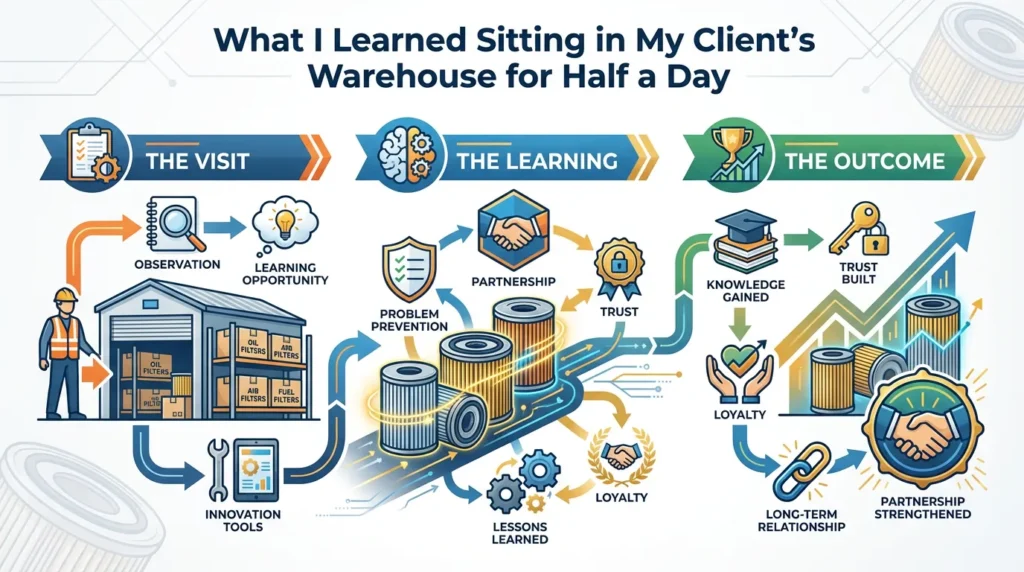
During a visit to a European aftermarket client,
I asked for something unusual:
“Can I spend a few hours just sitting in your warehouse?”
No meeting room.
No PowerPoint.
No prepared agenda.
Just me, a notebook, and their daily reality. 📝
For half a day, I simply watched.
And those few hours changed how we design packaging, labels, and even how we think about our filters once they leave our factory.
Why I Asked to Sit in a Customer’s Warehouse
1.1 Most Supplier Visits Stop at the Meeting Room
In typical supplier visits, the schedule looks like this:
- tour the office
- sit in a meeting room
- exchange presentations
- talk about prices, forecasts, and “strategy”
All of that is useful.
But it only shows one side of the truth.
For an aftermarket filter supplier, the real test is not:
- how good your PowerPoint looks
- or how many certifications you can list
The real test is:
- how easy your products are to stock, find, pick, and sell in your customer’s warehouse and workshop.
That’s why, on this trip, I asked:
“Instead of more meeting room time, can I just sit in your warehouse for a few hours and observe?”
The owner looked a bit surprised, then smiled:
“If you really want to understand our business, that’s the place to be.”
1.2 The Simple Setup: Just Watching and Taking Notes
So we did something very simple:
- I took a chair
- found a corner in the warehouse
- opened my notebook
- and watched how mechanics, warehouse staff, and the owner interacted with filters all day
No one prepared a special show for me.
I saw their real daily chaos:
- rush orders
- last-minute calls
- “where is this reference?”
- “we’re out of that again?”
In that messy reality, I started to understand how our product really “lives” after leaving our factory gate.
What I Saw in Half a Day: Real Life in a European Aftermarket Warehouse
2.1 Mechanics, Not Just Numbers
From my corner in the warehouse, I watched:
- 🚚 mechanics walking in, asking for:
“That filter for the blue truck”
not
“Reference XYZ123 for engine ABC”
This was important.
It showed me:
- many mechanics and workshop customers think in terms of:
- vehicle color
- brand
- rough description
rather than precise OE reference numbers
The warehouse staff had to:
- translate these vague descriptions into actual stock references
- quickly identify the right filter on the shelves
Our packaging and labels either helped this process or slowed it down.
2.2 Warehouse Staff Searching, Scanning, Opening Boxes
I also saw:
- 📦 warehouse staff searching racks, scanning labels, and sometimes opening boxes to double-check what was inside
- some boxes stacked high
- some references placed in random corners
I noticed the patterns:
- when labels were small or unclear, staff had to come closer
- when fonts from different suppliers were different, it slowed their ability to scan visually
- when part numbers were too small, they had to pick up the box or turn it around
Every one of these extra seconds adds up when:
- a mechanic is waiting at the counter
- phones are ringing
- multiple orders are being prepared at once
2.3 The Owner’s Phone Calls: “Out of Stock Again”
From time to time, the warehouse door would open and the owner would:
- come in with his phone to look at stock
- or shout toward the racks asking:
“Do we still have this reference?”
I heard him say at least twice:
“Sorry, that reference is out of stock again.”
It made me realize:
- availability is not just about having product in the country
- it’s also about having the right references visible, reachable, and easy to reorder
If our packaging and labeling did not support:
- fast stock checking
- fast picking
- and clear reordering
we were adding friction to his business without even being there.
The Small, Painful Details I Noticed
After a while, some very specific details started to jump out at me.
3.1 Boxes Stacked Too High, Getting Soft and Ugly
I saw:
- some filter cartons stacked too high
- outer boxes starting to get soft
- corners slightly crushed
- boxes losing their shape
This caused several problems:
- visually, they looked old or damaged
- staff were more careful when lifting them
- sometimes they avoided putting them at the front for customers to see
It hit me:
- our carton strength was not just a logistics issue
- it directly affected how professional and reliable our products looked in the warehouse
If our boxes couldn’t handle real stacking conditions,
even a good filter inside could look like a low-quality product.
3.2 Labels From Different Suppliers: Different Positions and Fonts
On the same rack, I saw filters from:
- us
- other brands
- white label suppliers
Their labels:
- were in different positions on the box
- used different font sizes and styles
- sometimes had key information hidden on smaller sides
For warehouse staff:
- this meant more time scanning
- more chance of picking the wrong item
- and more mental load every time they prepared an order
For mechanics or customers looking at shelves:
- it was harder to compare or quickly identify a brand or reference
We had been designing our labels from a factory perspective,
not a warehouse reality perspective.
3.3 Our Own Filters in a Dark Corner
At one point, I noticed:
- a few of our own references placed in a dark, difficult-to-reach corner
Not because the client disliked us, but because:
- our references had lower movement in that specific period
- our packaging didn’t stand out
- there was no practical reason for staff to put us in a more visible position
If our filters:
- are harder to see
- harder to reach
- and less visually clear
they become the last option when someone is in a hurry.
This is not a quality issue.
It’s a visibility and convenience issue.
3.4 How Their Team Actually Remembered Brands
Another important detail:
- their team did not remember brands mainly by product codes
- they remembered colors and visuals
I heard things like:
- “The yellow boxes”
- “The blue-and-white brand”
- “The red logo one”
Not:
- “the one with part number X in font Y”
At one point, a mechanic picked up one of our boxes and asked:
“Is this the same brand as that one?”
Our design was:
- similar in concept
- but not clear enough to be instantly recognized as “the same brand”
In a busy warehouse, “similar” is not good enough.
It needs to be immediately obvious.
The Moment I Realized Our Packaging Was Not Helping
When the mechanic asked:
“Is this the same brand as that one?”
I realized:
- we had invested in product quality
- we had invested in certificates
- we had invested in internal processes
But we had not invested enough in:
Helping our client’s team sell and handle our products more easily.
Our packaging and labels were:
- good from our point of view
- but not optimized for their reality
For a mechanic in a hurry, for a warehouse worker under time pressure:
- if the brand is not clear
- if the part number is not visible from a distance
- if boxes cannot stack well and stay neat
then our product is harder to find and harder to sell,
even if technically our filter is excellent.
At that moment, I wrote in my notebook:
“Our packaging design is designed for us, not for them.
We need to reverse this.”
What the Client Said on the Way Back
Later, in the car back to the hotel, the owner said something that stayed with me:
“Bruce, you are the first supplier who wanted to see where your products ‘live’.
Most only care about where they ‘leave’ – your factory gate.”
That sentence is a perfect summary of a big problem in B2B:
- suppliers focus on production and shipment
- but rarely on how products are stored, found, sold, and used
We talk a lot about:
- FOB, CIF, EXW
- container loading
- lead times
But we talk too little about:
- how our boxes fit on their shelves
- how easy it is to read our labels in a dark warehouse
- how our brand looks when placed next to 10 competitors
For him, the fact that I spent a few hours sitting quietly in his warehouse:
- was a sign of respect
- and a sign that we were serious about helping his business, not just selling our filters
The 3 Concrete Changes We Made After That Visit
Back in China, we did not just say, “That was interesting.”
We turned what I saw into specific actions.
6.1 Enlarged Part Numbers and Applications on the Label
First, we redesigned our labels.
We:
- 1️⃣ enlarged part numbers significantly
- so they can be read from a distance
- without needing to pick up the box
- highlighted vehicle applications more clearly
- main models or engine / vehicle families
- in terms that mechanics can relate to
The goal:
- make it easy for warehouse staff and mechanics to find the right filter
- even when they only roughly remember:
- “the one for that blue truck”
- or “the one for that 3.0 diesel”
6.2 Strengthened Outer Cartons for Better Vertical Stacking
Second, we strengthened our outer cartons.
We:
- increased cardboard strength
- improved structural design for stacking
- tested how many layers could safely stack without deformation
The goal:
even after months in a warehouse.
This helps:
- warehouse efficiency (easier stacking, less damage)
- brand perception (boxes look reliable, not tired and soft)
For a client, this means:
- fewer damaged boxes
- better-looking shelves
- easier daily handling
6.3 Created Color Codes by Product Family
Third, we introduced color coding by product family:
Each category has:
- a clearly identifiable color scheme
- consistent design across all references
This means:
- mechanics and staff can quickly recognize:
Even when they can’t see the small details, the color and visual language guide them to the right family.
This makes our brand:
- easier to remember
- easier to explain
- easier to find quickly during busy hours
The Result: “Same Filters, Same Prices, Easier to Sell”
On my next visit, the client told me:
“Same filters, same prices,
but my team says your products are now the easiest to find and sell.” 🙌
We had not:
- changed the internal quality of the filter
- changed the price
- changed the lead time
We had changed:
- packaging structure
- label clarity
- color coding
And this small set of changes made our filters:
- faster to locate
- easier to understand
- more convenient to sell
That’s when I fully understood:
Product improvement is not only what happens inside the filter.
It’s also what happens around the filter – the box, label, and how it lives in the warehouse.
The Lesson: You Don’t Really Understand Your Product Until You See Where It Lives
You don’t really understand your product until you see how it “lives” in your customer’s world:
- 🏭 in their warehouse
- 🧰 in their workshop
- 🛒 on their shelves
Real product improvement doesn’t always start in the factory.
It often starts in the place where someone says:
- “I can’t find it.”
- “This is hard to sell.”
- “These boxes always get damaged.”
8.1 Where Suppliers Should Spend More Time
If you are a manufacturer, ask yourself:
- Have you ever spent half a day in your customer’s warehouse, just watching?
- Have you asked the mechanics:
- “What frustrates you about this packaging?”
- “What makes a brand easy or hard to work with?”
- Have you seen how your product looks:
- after 6 months on a shelf?
- when stacked with 10 other brands?
Many answers to product design questions are not in your office.
They are in your client’s:
- racks
- workbenches
- and counter desks
8.2 Aftermarket Filters: More Than Just What’s Inside
In the automotive aftermarket, especially for filters:
- the buyer often cannot see the internal media
- they judge by:
- reputation
- packaging
- how easy it is to work with
By caring about:
- stacking strength
- label clarity
- visual recognition
you are not just “doing marketing”.
You are directly improving:
- warehouse efficiency
- picking accuracy
- sales speed
If You Want an Aftermarket Filter Partner Who Cares About Life After Delivery
At Beling Filters, we care about what happens:
- inside our factory
- on the production line
- during testing
But we also care deeply about what happens after the goods arrive at your place:
- how your team stores them
- how easily your mechanics find them
- how your shelves look to your customers
If you want an aftermarket filter partner who:
- is willing to sit quietly in your warehouse
- watch your daily operations
- and use those observations to improve packaging and service
I’d be happy to talk — or to come and learn from your reality.
📩 bruce.gong@belingparts.com
🌐 www.belingparts.com
Real partnership doesn’t end at the factory gate.
That’s where it begins.