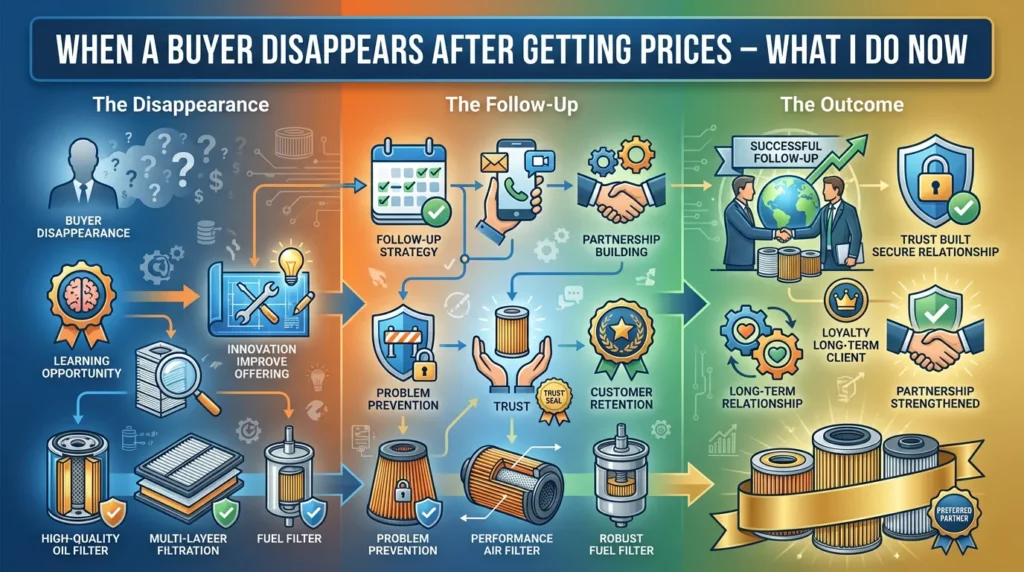
For many years, this was one of the most frustrating parts of my work in the automotive filter business:
- A new buyer sends an RFQ.
- I spend hours preparing a detailed quotation.
- I hit “Send”…
- And then: complete silence.
No reply.
No feedback.
No “too expensive”, no “too slow” – just nothing.
If you work in B2B sales or international trade, you probably know this feeling very well.
This is the story of how I changed my approach to “ghosting buyers”
– and what has happened since I stopped chasing and started understanding.
The Old Nightmare: When a Buyer Goes Silent After Your Filter Quotation
1.1 How I Used to Handle Inquiries
A typical situation from a few years ago:
- A new buyer emails me from Europe, Latin America, or the Middle East.
- He asks for a detailed filter quotation:
- I spend hours preparing:
- 📊 cross references
- OE numbers
- competitor numbers
- our own references
- 💵 best prices
- trying to be aggressive and competitive
- 📦 packaging suggestions
- neutral box
- private label option
- carton quantity proposal
- I double-check everything, attach an Excel file, and hit “Send”.
Then I wait.
1.2 The Silence That Follows
But instead of a clear response, I get:
- no reply
- no “thank you”
- no “too high”
- nothing
Days turn into weeks.
My old reaction looked like this:
- send updated prices
- send another email:
“Any news?”
“Have you checked our quotation?”
“Is there any feedback?”
I kept trying, sometimes for weeks or months.
The results?
- either no answer at all
- or a very cold:
“We will let you know.”
I felt like I was chasing someone who was already walking away.
The Moment I Realized the Emails Were All About Me
One day, after another “ghosting” case, I did something different:
- I re-read the entire email thread.
- I looked carefully at every sentence I had written.
And I noticed something very important.
2.1 My Emails Were Focused on My Side Only
Every message from my side was about:
- my prices
- my MOQ (minimum order quantity)
- my lead time
- my packaging options
- my payment terms
Almost nothing was about:
- their real situation
- their market challenges
- their current supplier problems
- their fast-moving references
In other words:
My emails were all about me;
almost nothing was about them.
I was treating the RFQ like an exam:
- “Give the best answers to the questions (prices and conditions)”
But I was not trying to understand:
- why they were really asking
- what problem they were trying to solve
- how they made decisions
I realized:
- I was acting like a “quotation machine”,
- not like a business partner.
That needed to change.
A New Approach: One Calm, Simple Message
Instead of sending more price updates or “Any news?” emails,
I decided to try something different.
Now, when a buyer disappears after receiving my quotation,
I send one calm, simple message, like this:
“Hi ___,
Just a quick check-in.
I understand you may be comparing different offers.
To see if we are a good fit,
could you share:
– 3–5 of your fastest-moving references
– your typical purchasing cycle
– any quality or packaging issues with current suppliers?
Even if we don’t work together now,
I’d be happy to give you feedback based on what we see in other markets.”
Let’s break down why this works better.
3.1 The Tone: Calm, Respectful, No Pressure
The message is:
It does not say:
- “Why are you not answering?”
- “Please see my quotation again.”
- “Our prices are very competitive.”
It accepts the reality that:
- they are probably comparing multiple offers
- we might or might not be the right supplier
Instead of pressure, it shows understanding.
3.2 The Questions: About Their Business, Not My Price
I ask for:
- 3–5 of their fastest-moving references
- this tells me which filters really drive their business
- I can check if we are strong on those items in quality, price, and lead time
- their typical purchasing cycle
- do they buy monthly, quarterly, seasonally?
- do they buy per full container or partial shipments?
- any quality or packaging issues with current suppliers
- this reveals what they really care about
- late deliveries?
- inconsistent quality?
- weak packaging?
- wrong labeling?
These questions move the conversation from:
to:
- “What is your business really like?”
- “Where can we add value beyond price?”
3.3 Offering Value Even If We Don’t Work Together
The last part is important:
“Even if we don’t work together now,
I’d be happy to give you feedback based on what we see in other markets.”
This shows:
- I am willing to help, not just to sell.
- I respect their decision, even if they choose another supplier.
Many buyers are used to suppliers who:
- disappear if they lose the first deal
- only talk seriously when there is a PO on the table
By offering honest feedback, I position myself as:
- a resource
- not just a cost in their inbox
What Started to Happen: Three Types of Responses
After I started using this new message,
I began to see three main types of reactions.
4.1 Type 1 – “Your Prices Are Okay, But Our Main Problem Is Actually…”
Some buyers replied with something like:
“Thanks Bruce, your prices are okay,
but our main problem is actually slow delivery from current suppliers.”
This changed everything.
Before, in my mind, the problem was always:
- “Maybe our prices are too high.”
But in many cases, that was not the real issue.
For these buyers, the main pain was:
- late shipments
- unstable lead times
- no stock availability on fast-moving parts
With this information, I could respond:
- by explaining our lead time control
- by suggesting a stock plan for their top references
- by offering split shipments or flexible loading
The conversation moved from:
- “Compare my Excel sheet with others”
to:
- “Let’s solve a specific business problem together.”
That is where real partnerships begin.
4.2 Type 2 – “We Chose a Cheaper Offer, But Let’s Keep in Touch”
Others answered more honestly:
“We chose a cheaper offer, but we want to keep in touch.”
In the past, this would have felt like:
- a “loss”
- a failed opportunity
Now, I treat it differently.
I answer politely, for example:
“Thank you for letting me know.
I respect your decision and wish you good business with this project.
I’ll send you a short market update every few months.
If you have any issues or need a second option in future,
you know where to find me.”
Then, every few months, I send:
- a short market update, such as:
- changes in raw material costs
- freight situation
- new references we developed for similar markets
I do not push prices aggressively.
I simply stay present, helpful, and professional.
What happened?
- One of these buyers came back one year later.
He told me:
“Bruce, we had quality issues with that cheaper supplier.
Remember the offer you made last year?
Can we restart our discussion?”
Because I stayed polite and never burned the bridge,
I was the first person he wrote to when he decided to change.
4.3 Type 3 – No Reply at All (And That’s Okay)
Of course, there is still a third group:
- buyers who never reply, even to the new message.
And that’s okay.
I had to accept that:
- not every inquiry is a real opportunity
- some buyers send RFQs just to get a benchmark
- some are under internal pressure
- some are not ready to change suppliers at all
Instead of seeing every silence as a personal failure,
I learned to see it as filtering:
- serious partners answer
- not-serious ones don’t
- both are useful information
What I Learned About B2B Sales and International Trade
After using this approach for a while,
I realized several important lessons.
5.1 Chasing a Silent Buyer With More Prices Rarely Works
Sending:
- more price updates
- more discounts
- more “Any news?” emails
almost never revives a cold lead.
If they are not answering, the problem is usually:
- misalignment in expectations
- lack of trust
- no clear value beyond price
Lowering your price in the dark is:
- like talking louder in a language the other person doesn’t understand
- it doesn’t fix the real issue
5.2 Trying to Understand Their Business Sometimes Does
When you:
- ask smart questions
- show genuine interest in their market and challenges
- offer insights, not just numbers
some buyers feel:
- respected
- understood
- open to share more
And even if they don’t place an order immediately,
you are building:
- a professional image
- a memory in their mind:
“This supplier behaves differently.”
5.3 Changing My Goal: From “Close Every Inquiry” to “Build Serious Partnerships”
In the past, my mental goal was:
- “I must try to close every inquiry.”
That led to:
- frustration
- wasted time
- endless follow-ups with no answer
Today, my goal is different.
My goal is to:
- ✅ identify serious partners
- buyers who are open, clear, and long-term oriented
- ✅ add value even before the first order
- by sharing market insights
- by helping them avoid common problems
- by suggesting better product mixes or packaging options
- ✅ leave a professional impression
- so even if they choose someone else today,
they remember “Bruce from Beling” when they are ready to change
This mindset has:
- reduced my stress
- improved my relationships
- and actually resulted in more good customers,
even if fewer emails turn into immediate orders.
For Buyers: What to Expect If You Contact Us
If you are a filter importer, distributor, or wholesaler,
and you contact me for a quotation, here is what you can expect:
- I will provide detailed, transparent prices.
- I will also ask questions like:
- “Which references move fastest for you?”
- “What issues do you have with current suppliers?”
- “What does a ‘good supplier’ mean in your situation?”
Because:
- I am not trying to “win a race to the bottom price”.
- I am trying to see if we can build a partnership
where:- our production capabilities
- and your market position
fit together for the long term.
If that sounds interesting to you,
then we are likely to work well together.
If You Want a Filter Supplier Who Asks Smart Questions
At Beling Filters, we don’t see RFQs as just “price competitions”.
We see them as:
- an opportunity to understand your business
- a first step to long-term cooperation
- a chance to add value even before the first container ships
If you’re looking for a filter supplier who:
- prefers asking smart questions over pushing prices
- is happy to give honest feedback, even if you don’t order immediately
- focuses on serious, long-term partners, not just quick deals
I’d be happy to talk:
📩 bruce.gong@belingparts.com
🌐 www.belingparts.com
In international trade, you can always find someone cheaper.
Finding someone who understands your business and respects your decisions
is much harder — and often much more valuable.