
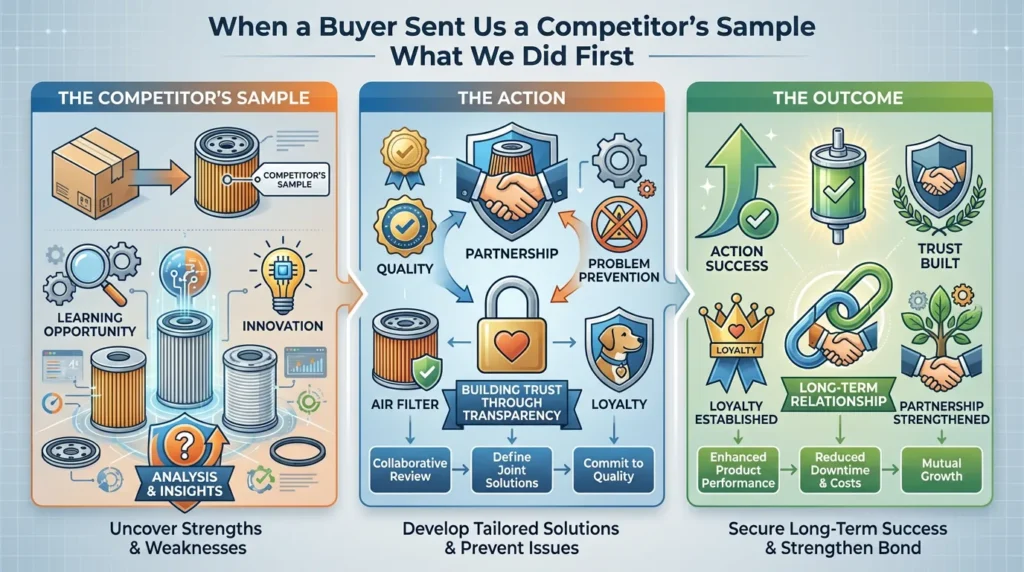
A new buyer from the Middle East once wrote to me:
“Bruce, this is the filter brand we’re using now.
Can you make the same quality, but better price?”
A few days later,
a small carton arrived at our factory:
For many suppliers, when a competitor’s sample arrives, the process is simple:
We decided to start differently.
Not with price.
Not with “yes, we can copy.”
We started with understanding.
When a buyer sends you a competitor’s sample, it often means:
Most suppliers treat samples as:
But in B2B, a sample is also:
If you only see:
“Can you make same quality, better price?”
you may miss the real questions behind it:
A new buyer from the Middle East once wrote to me:
“Bruce, this is the filter brand we’re using now.
Can you make the same quality, but better price?”
A few days later,
a small carton arrived at our factory:
For many suppliers, when a competitor’s sample arrives, the process is simple:
We decided to start differently.
Not with price.
Not with “yes, we can copy.”
We started with understanding.
When a buyer sends you a competitor’s sample, it often means:
Most suppliers treat samples as:
But in B2B, a sample is also:
If you only see:
“Can you make same quality, better price?”
you may miss the real questions behind it:
That’s why we didn’t start with the calculator.
We started with the lab.
The first thing we did after receiving the box was a complete teardown in our lab.
We didn’t just look at it from the outside and guess.
We carefully analyzed each element:
2.1 What We Measured and Checked
In our lab, we:
We treated the sample like an engineering exercise, not a copying project.
2.2 What We Found: “Average” Quality
Objectively, the conclusion was:
In our assessment:
This was an important moment.
If we had simply:
we might have reproduced the same weaknesses and complaints the buyer already had.
The lab told us:
“You can copy this easily.
But is that really what the market needs?”
The next step was to ask questions before we quoted anything.
Instead of sending a quick price list,
I wrote back to the buyer:
“Before I quote,
can you tell me who mainly uses these filters?
Fleets? Garages? Retail?”
He replied:
“Mostly fleets and big workshops.
We’ve had some complaints:
filters clog too fast on older engines.”
Now we understood much more.
3.1 The Real Issue Was Not Just Price
His message told us:
This means:
So the real problem was not:
“We want the same filter, cheaper.”
It was:
“Our current filters are not performing well in dusty and tough usage.
And we also have price pressure.”
If we had simply copied the competitor’s design at a lower cost,
we would have reproduced the same field problems.
We needed a smarter answer.
Instead of sending a single “copy & cheaper” offer,
we prepared two distinct options:
1️⃣ Standard version – similar specs, similar cost
2️⃣ Enhanced version – improved design for tougher conditions
4.1 The Standard Version: For Price‑Sensitive Segments
The standard version was:
This option was created for:
We wanted to say:
“If you only need something comparable at a better price,
we can do that reliably.”
4.2 The Enhanced Version: For Fleets and Heavy‑Duty Users
The enhanced version was where we added real value.
Based on our lab analysis and his user profile, we:
This version was not primarily designed to be cheaper.
It was designed to:
In my email to him, I explained:
“If your market is very price‑sensitive,
the standard version will work.
But for fleets and workshops who care about downtime,
I recommend testing the enhanced version.
Attached is our lab comparison
between your sample and both options.”
We didn’t hide the differences.
We showed them.
Along with the quotation,
we sent a simple technical comparison:
We compared:
This did three things:
His reaction said it all:
“Bruce, you are the first supplier
who doesn’t just say ‘we can copy cheaper’.
You actually analyzed the filter and my customers’ use.”
That sentence is exactly the difference between:
He agreed to test both versions.
After around six months,
he shared feedback from his market.
The results were clear:
Over time, something important happened:
Most of his key fleets switched to the enhanced version,
even at a slightly higher price.
This confirmed a key principle:
The buyer was now able to:
And we had moved from:
When a buyer sends a competitor’s sample,
the easy path is:
The smarter path is to ask:
Because in B2B:
You don’t win long‑term
just by being cheaper.
You win by being:
That’s how you build:
This experience shaped our standard approach when new buyers send us samples.
Instead of:
we typically:
This positions us as:
And it helps our customers:
If you are an importer, distributor, or buyer in the aftermarket and you:
you can get much more value if you:
Questions you might ask your supplier:
The right supplier will not only say:
They will say:
If you’d like a filter partner who can:
I’d be happy to discuss your current brands and challenges.
We can:
📩 bruce.gong@belingparts.com
🌐 www.belingparts.com
Because in B2B aftermarket:
The fastest way to lose trust is to copy cheaper.
The best way to build it
is to understand deeper.
That’s why we didn’t start with the calculator.
We started with the lab.
The first thing we did after receiving the box was a complete teardown in our lab.
We didn’t just look at it from the outside and guess.
We carefully analyzed each element:
In our lab, we:
We treated the sample like an engineering exercise, not a copying project.
Objectively, the conclusion was:
In our assessment:
This was an important moment.
If we had simply:
we might have reproduced the same weaknesses and complaints the buyer already had.
The lab told us:
“You can copy this easily.
But is that really what the market needs?”
The next step was to ask questions before we quoted anything.
Instead of sending a quick price list,
I wrote back to the buyer:
“Before I quote,
can you tell me who mainly uses these filters?
Fleets? Garages? Retail?”
He replied:
“Mostly fleets and big workshops.
We’ve had some complaints:
filters clog too fast on older engines.”
Now we understood much more.
His message told us:
This means:
So the real problem was not:
“We want the same filter, cheaper.”
It was:
“Our current filters are not performing well in dusty and tough usage.
And we also have price pressure.”
If we had simply copied the competitor’s design at a lower cost,
we would have reproduced the same field problems.
We needed a smarter answer.
Instead of sending a single “copy & cheaper” offer,
we prepared two distinct options:
1️⃣ Standard version – similar specs, similar cost
2️⃣ Enhanced version – improved design for tougher conditions
The standard version was:
This option was created for:
We wanted to say:
“If you only need something comparable at a better price,
we can do that reliably.”
The enhanced version was where we added real value.
Based on our lab analysis and his user profile, we:
This version was not primarily designed to be cheaper.
It was designed to:
In my email to him, I explained:
“If your market is very price‑sensitive,
the standard version will work.
But for fleets and workshops who care about downtime,
I recommend testing the enhanced version.
Attached is our lab comparison
between your sample and both options.”
We didn’t hide the differences.
We showed them.
Along with the quotation,
we sent a simple technical comparison:
We compared:
This did three things:
His reaction said it all:
“Bruce, you are the first supplier
who doesn’t just say ‘we can copy cheaper’.
You actually analyzed the filter and my customers’ use.”
That sentence is exactly the difference between:
He agreed to test both versions.
After around six months,
he shared feedback from his market.
The results were clear:
Over time, something important happened:
Most of his key fleets switched to the enhanced version,
even at a slightly higher price.
This confirmed a key principle:
The buyer was now able to:
And we had moved from:
When a buyer sends a competitor’s sample,
the easy path is:
The smarter path is to ask:
Because in B2B:
You don’t win long‑term
just by being cheaper.
You win by being:
That’s how you build:
This experience shaped our standard approach when new buyers send us samples.
Instead of:
we typically:
This positions us as:
And it helps our customers:
If you are an importer, distributor, or buyer in the aftermarket and you:
you can get much more value if you:
Questions you might ask your supplier:
The right supplier will not only say:
They will say:
If you’d like a filter partner who can:
I’d be happy to discuss your current brands and challenges.
We can:
📩 bruce.gong@belingparts.com
🌐 www.belingparts.com
Because in B2B aftermarket:
The fastest way to lose trust is to copy cheaper.
The best way to build it
is to understand deeper.
Privacy Policy Powered by 2uncle