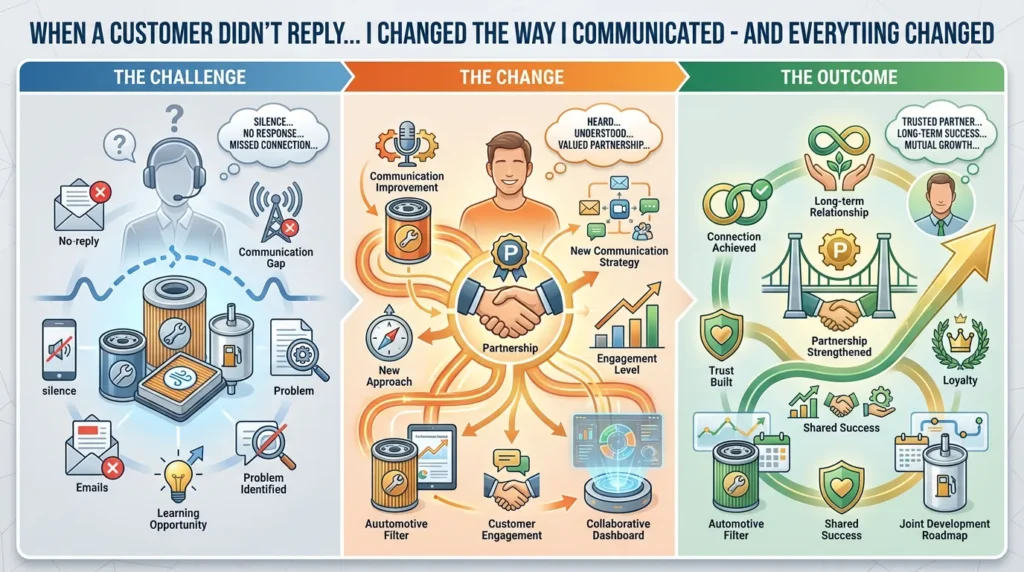
In international B2B, we often focus on:
- product quality
- price negotiation
- lead time
But there is another factor that can quietly decide whether a deal moves forward or dies in the inbox:
How you communicate — and through which channel.
One short experience with a new customer who didn’t reply to my emails completely changed how I think about communication in the automotive filter business.
It also showed me how powerful visual communication can be for overseas buyers.
Three Emails. Zero Replies. One Picture Changed Everything
1.1 The Silent Inbox
A while ago, I was following up with a new customer about sample production.
We had already:
- discussed specifications
- confirmed part numbers
- prepared the samples in our factory
I sent him an email:
- polite
- clear
- with all the necessary details
No reply.
Two days later, I sent a second follow‑up.
Still no answer.
Then a third email:
- carefully written
- clearly structured
- including lead time and packing information
Again: silence.
At this point, many suppliers would:
- assume the customer lost interest
- get frustrated
- stop following up
I didn’t want to give up, but I also didn’t want to become annoying in his inbox.
1.2 Trying Something Different: A Simple Photo
Instead of sending a fourth email, I tried a different approach.
The samples were already finished.
They were on my desk.
So I:
- arranged them neatly
- made sure labels were visible
- used a clean background
- took a clear photo with my phone
Then I opened WhatsApp and sent him a simple, human message:
“Your samples are ready 😊”
No long explanation.
No long paragraphs.
No detailed bullet points.
Just:
- one photo
- one short sentence
He replied within one minute:
“Wow! Thanks Bruce.
Sorry for the delay — I was traveling.
Let’s arrange shipping.”
All the questions I had — “Is he still interested? Did he see my emails?” — were answered in one minute.
That moment taught me something simple but powerful:
👉 It wasn’t the content.
It was the communication channel.
And even more:
👉 Sometimes a picture communicates faster than paragraphs.
What That Moment Really Revealed About B2B Communication
2.1 It Wasn’t a “Bad Customer”
At first, I wondered:
- Is he ignoring me?
- Is he not serious?
- Is he playing games with time?
But the reality was:
- He was traveling
- His inbox was full
- He hadn’t had time to sit down and answer detailed emails
He didn’t reply because he didn’t care.
He didn’t reply because:
- Email requires a different kind of attention
- Writing a proper answer takes mental energy
- Long texts are easy to postpone
But a photo on WhatsApp:
- is fast
- is visual
- demands almost no effort to understand
- is easy to reply to with just a few words
2.2 The Real Problem: Not What You Say, But How You Say It
This experience made something very clear:
In international business, communication is not only about what you say.
It’s deeply about how and where you say it.
Your buyer:
- is managing multiple suppliers
- is handling different product categories
- is receiving dozens (sometimes hundreds) of emails per day
- is constantly traveling, in meetings, or under time pressure
In this context:
- Long emails can easily get buried
- Non‑urgent topics get postponed
- Important but non‑critical messages can sit unread for days
But a visual message:
- stands out
- is instantly understandable
- creates a feeling of “this is happening now”
That’s when I realized:
Sometimes, one photo can do more than five emails.
Why Visual Messages Work So Well for Overseas Buyers
3.1 Buyers Are Overloaded, Visuals Cut Through the Noise
European, Middle Eastern, and American buyers all share similar working patterns:
- They juggle many projects at once
- They work in different time zones with their suppliers
- Their email inbox is always busy
- They don’t always sit at a desk — many work from mobile devices
For them, visual communication has several advantages:
- A photo takes less time to understand than a long text
- A video immediately shows reality, not just promises
- A screenshot is more convincing than “I will update the PI soon”
In other words:
Pictures reduce uncertainty.
Uncertainty kills decision‑making.
When buyers see:
- a photo of finished samples
- a short video of production running
- an image of packing or pallet wrapping
- a screenshot of a shipping document
they feel:
- “This is real.”
- “This is moving.”
- “I can trust this update.”
3.2 What Visuals Create That Text Alone Often Cannot
A good, honest photo or video generates:
- ✔ Clarity
- They see exactly what stage the order is in.
- ✔ Confidence
- They feel the supplier is transparent.
- ✔ Urgency
- “The goods are ready; I need to confirm the shipment or payment.”
- ✔ A “this is happening now” feeling
- It connects their decision to real activity at the supplier’s side.
- ✔ Emotional connection
- They see real products, real pallets, real people working.
It turns cold communication into something human and present.
Practical Examples of Visual Communication in the Auto Filter Supply Chain
4.1 Photos of Finished Samples
Instead of writing:
- “Your samples have been completed and are ready for dispatch.”
You can simply send:
- a clear photo of the finished samples
- labels visible
- quantities shown
Result:
- Faster response: “OK, please ship by DHL and send tracking.”
4.2 Video of Production Progress
During mass production, instead of only saying:
- “We started production last week; everything is on schedule.”
You can send:
- a short video of the production line
- filters being assembled
- media pleating, molding, or curing
This gives the buyer:
- proof of progress
- a stronger feeling that their order is being taken seriously
4.3 Packing and Label Confirmation Images
Before shipment, you can share:
- photos of carton labels
- pallet stacking
- inner packing layout
This allows the customer to:
- confirm that labeling format is correct
- verify barcodes, SKUs, and branding
- feel safe that the goods will arrive “store ready”
Sometimes this prevents:
- misunderstandings about packaging
- complaints about wrong label positions or missing data
4.4 Screenshot of Packing List or Proforma Invoice
Instead of just saying:
- “I will send you the updated packing list soon.”
You can:
- send a screenshot of the key part of the packing list (or PI)
- highlight the changed lines
This helps the buyer quickly:
- confirm corrections
- notice differences
- approve without needing to open multiple attachments on the phone
Visual Communication as a Competitive Advantage
Many suppliers still communicate in a very traditional way:
- only email
- only text
- long explanations without proof
But buyers increasingly:
- use mobile devices
- rely on messaging apps
- expect quick, visual confirmation
If you can:
- adapt to their preferred channels
- show real‑time status visually
- reduce their uncertainty
you become:
- easier to work with
- more reliable in their mind
- more likely to be chosen for repeat and bigger orders
Visual communication is not a “soft” add‑on.
It’s becoming a hard competitive advantage in international trade.
How We Use Visual Communication at Beling Filters
At Beling Filters, we have integrated visual communication into our daily operations — for both samples and mass production orders.
6.1 Visual Updates for Every Order
For every project, we provide, when relevant:
- ✔ Production photos
- Filters on the production line
- Media, caps, seals, and components visible
- ✔ Video updates
- Short clips showing key processes
- Evidence that production is on track
- ✔ Packaging confirmation images
- Single box
- Master carton
- Pallet stacking
- Labels and barcodes
- ✔ Visual QC checkpoints
- Photos of key checks
- Dimensions or test setup images when helpful
These visuals:
- support internal documentation
- reassure customers
- reduce misunderstanding about spec or packing
6.2 WhatsApp + Email Dual‑Channel Communication
We use a dual‑channel approach:
- Email
- For formal documents
- For quotations, POs, invoices, packing lists
- For detailed explanations and records
- WhatsApp (or similar apps)
- For real‑time updates
- For quick clarifications
- For sharing photos and videos directly
This combination means:
- important information is structured and traceable (email)
- urgent or practical communication is fast and human (WhatsApp)
We adapt to the customer’s workflow:
- Some prefer email for almost everything
- Others reply much faster on messaging apps
- Most appreciate having both options
Our goal is not just “replying fast.”
Our goal is:
communicating clearly, visually, and in the channel that works best for the buyer.
Beling – Save Your Time & Cost
One new customer didn’t reply to three emails.
One photo on WhatsApp changed everything.
That experience taught me:
- It’s not always the content that’s the problem — it’s the channel
- Buyers are busy; visuals help them decide faster
- A picture can build trust and urgency much faster than paragraphs
At Beling Filters, for every order — samples or mass production — we provide:
- ✔ Production photos
- ✔ Video updates
- ✔ Packaging confirmation images
- ✔ Visual QC checkpoints
- ✔ WhatsApp + email dual‑channel communication
We don’t just “send updates.”
We show you what’s happening.
If you want a supplier who adapts communication to your workflow — not the other way around — we’d be glad to connect and build a smooth, visual, efficient supply chain together.
📩 bruce.gong@belingparts.com
🌐 www.belingparts.com
Your valuable automotive filter partner since 2008.