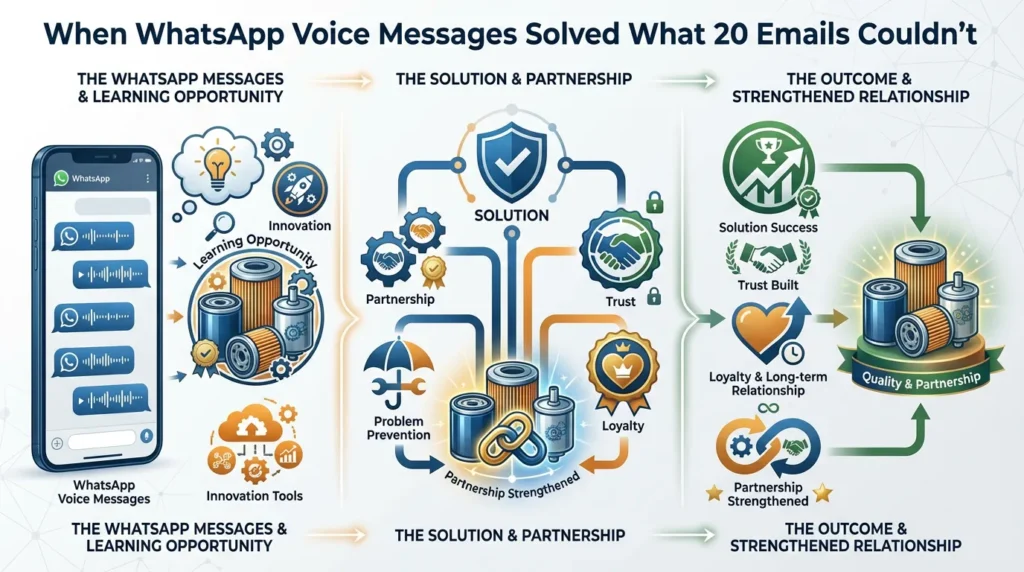
In international B2B trade, we love to think that more emails mean more clarity.
But sometimes, the opposite is true.
Last year, one project with a new buyer from South America reminded me of a simple truth:
The channel you use to communicate
can be just as important as the message itself.
This is the story of how 20+ emails created confusion,
and how 15 minutes of WhatsApp voice messages solved what weeks of typing couldn’t.
The Project That Looked Simple – Until We Started Emailing
This buyer from South America was:
- a serious company
- with good volume potential
- and a clear interest in building a long-term relationship
On paper, it was exactly the kind of partner we like to work with.
We started our first project together, expecting it to go smoothly.
Very quickly, it felt… painful.
1.1 Twenty Emails, Little Real Progress
Over the first couple of weeks, we exchanged at least 20 emails about:
- 🔢 cross references
- matching OE numbers to our references
- checking competitor numbers
- aligning their catalogue with ours
- 📦 packaging details
- individual box design
- carton quantity
- label information
- barcodes and branding
- 📏 size differences between OE and aftermarket filters
- small differences in height or diameter
- tolerances between original equipment and aftermarket production
Each time I thought:
“Now we are finally aligned.”
…his reply would show that we were still not on the same page.
We weren’t arguing.
We simply kept missing each other in small but important details.
The Hidden Problem: Email Was Working Against Us
The more we emailed, the more I saw the same pattern:
- our intentions were good
- our information was correct
- but the channel – email – was creating extra confusion
2.1 Typical Email-Based Misunderstandings
Some examples of where things went wrong:
- He thought “bulk packing” meant one thing,
I meant another.- For him: maybe “no individual box, just plastic bag in big carton”
- For us: a more specific internal definition
- I wrote, “We can use your artwork,”
and he thought we would design it from scratch.- My meaning: “We can apply your existing design files to our box template”
- His understanding: “You will create the design for us”
- He asked for “better media,”
and I wasn’t sure if he meant:- a specific media brand
- a higher filtration level
- a longer service interval
Each misunderstanding was small on its own.
But together, they slowed the project and increased frustration on both sides.
2.2 The Buyer’s Frustration
At one point, he wrote:
“Bruce, maybe this project is too complicated.”
That sentence worried me.
Not because the project itself was truly complicated,
but because our communication style was making it feel complicated.
Email is:
- slow
- easy to misread
- formal by default
And when you add:
- different time zones
- different native languages
- technical details
it doesn’t take much for the simplest message to be misunderstood.
I realized:
Email itself had become part of the problem.
Changing the Channel: From Email to WhatsApp Voice Messages
At that moment, I decided to try something different.
I asked him:
“Do you use WhatsApp?
If yes, can we try to explain everything
in 5–10 minutes of voice messages?”
He said “yes.”
That small “yes” changed the entire project.
3.1 Why I Suggested WhatsApp
I chose WhatsApp voice messages for several practical reasons:
- Nearly everyone in South America uses WhatsApp daily
- It’s fast and easy to use on mobile
- Voice messages allow:
- tone
- emphasis
- natural explanations
In a 30–60 second voice note, you can:
- clarify a concept
- give context
- use examples
much faster than in a long written paragraph.
3.2 My First Round of Voice Messages
I started by sending a few short voice messages:
🎙 I explained the three media options we offer, with simple examples:
- standard media – suitable for typical service intervals
- premium media – for fleets or markets that demand longer life or tougher conditions
- economy media – cost-optimized but still within our internal quality standards
🎙 I described how we usually handle artwork vs. full design:
- if the client has ready artwork:
- we apply it to our die-lines and adjust to print
- if the client has only a logo or basic idea:
- we can propose a layout, but that’s a separate, clearer step
🎙 I clarified our standard packing and two alternative solutions:
- standard: individual box + outer carton
- option 1: bulk packing for certain markets and price levels
- option 2: reinforced packaging for tough logistics or premium positioning
I complemented the voice messages with:
- a few quick photos
- and two short videos from our packing line
This way he could see what I was describing.
His Voice Messages: Market Reality in His Own Words
Shortly afterward, he replied with his own voice messages.
🎙 He described his market positioning:
- which segment his brand targets
- whether he wants to compete on price, quality, or balance
- how his customers perceive current brands in the market
🎙 He explained how his competitors pack and present filters:
- whether they use strong boxes or very light ones
- whether they highlight technical specs or just brand logo
- what kind of shelf presence works best in his country
🎙 He shared what his mechanics complain about most:
- weak packaging that breaks during transport
- filters that don’t fit perfectly in certain applications
- confusion with part numbering or cross-reference mistakes
In written form, this information would have taken:
- many emails
- lots of back-and-forth
- and probably still left room for misinterpretation
In voice form, I could hear:
- his tone
- his priorities
- where he felt real pressure from his market
That made it much easier to respond with the right solutions.
15 Minutes That Solved What 2 Weeks of Email Couldn’t
We exchanged voice messages back and forth for about 15 minutes.
What happened during those 15 minutes?
- We cleared up all the misunderstandings about:
- media options
- packaging definitions
- artwork expectations
- We aligned on:
- his market positioning
- which technical and visual elements mattered most
- where he was willing to invest, and where he wanted to save
Suddenly, everything that had felt “complicated” became simple.
5.1 The Concrete Results
After this short WhatsApp session:
- ✅ We finalised the specifications in one day
- no more rounds of “What do you mean by…?”
- clear decisions for each reference and packaging type
- ✅ We confirmed artwork within the same week
- he understood exactly what we would do
- we understood exactly what he expected
- revisions were minimal
- ✅ The first order shipped smoothly
- no last-minute surprises
- no emergency changes because of unclear expectations
A few months later, he joked:
“Bruce, if we had used voice messages from day one,
we would both have more hair now.” 😄
And he was right.
Why Voice Messages Work So Well in International B2B
This experience was not just a “fun story”.
It confirmed something I had seen before in other projects.
6.1 Email Is Great – Until It Isn’t
Email is powerful for:
- sending formal documents
- keeping a clear record of agreements
- sharing detailed lists and spreadsheets
But email can create problems when:
- the subject is highly contextual
- language levels differ
- important details are hidden between lines
Text alone cannot show:
- tone of voice
- hesitation
- emphasis on what is truly important
A short phrase can be read in different ways, for example:
- “We can do that”
- Is that enthusiastic? Reluctant? Conditional?
In voice, you can hear the difference.
6.2 Voice Messages Bring Back the Human Side of B2B
Voice messages:
- feel more human
- are faster for complex explanations
- allow you to use:
- examples
- analogies
- informal language that is easier to understand
In international trade, where:
- language barriers exist
- cultural nuances are different
- technical terms can be interpreted differently
voice helps bridge the gap.
You don’t need a perfect accent or grammar.
You just need to talk.
Practical Ways We Use WhatsApp, WeChat, and Video Calls
Today, we don’t use voice messages for everything.
But we use them strategically, when they bring real value.
7.1 When We Switch From Email to Voice
We often suggest switching to WhatsApp, WeChat, or a quick video call when:
- email threads become too long and circular
- small misunderstandings keep appearing
- the buyer writes things like:
- “I am not sure I understood this part”
- “Maybe this is too complicated”
In those cases, a 5–10 minute voice exchange often saves:
- days of back-and-forth
- hidden frustration on both sides
7.2 How We Combine Voice and Written Confirmation
We follow a simple routine:
First step – Voice messages or call
- to clarify concepts
- to share context
- to align expectations verbally
Second step – Written summary
- we send a clear summary by email:
- final specs
- agreed packaging
- artwork responsibilities
- any special conditions
This way, we get:
- the speed and clarity of voice
- and the safety and structure of written confirmation
Best of both worlds.
The Lesson: The Channel Can Be as Important as the Message
The main lesson from this story is simple:
In international trade, the channel you use to communicate
can be as important as the content of your message.
When you notice that:
- emails are creating more confusion than clarity
- misunderstandings keep repeating
- the project feels more complicated than it really is
it may be time to change the channel.
A simple voice message can:
- reduce stress
- clear up confusion
- and remind both sides that there are real people behind the screen
This is especially true in the automotive aftermarket where:
- technical details matter
- market positioning varies by country
- small differences in understanding can have big consequences
If You Value Clear, Flexible Communication With Your Supplier
If you prefer working with a supplier who is:
- flexible in communication channels:
- email
- WhatsApp
- WeChat
- video calls
- and focused on clarity, not just sending documents
then we are likely a good match.
At Beling Filters, we believe:
- good products and good prices are not enough
- clear, human communication is a core part of a successful partnership
We are happy to adapt to:
- the tools you already use
- the style that makes things easiest for your team
If you’re working with:
and want a supplier who:
- helps you avoid misunderstandings
- uses the right channels at the right time
- and puts real effort into making complex projects simple
I’d be glad to connect:
📩 bruce.gong@belingparts.com
🌐 www.belingparts.com
Sometimes, the fastest way to move a project forward
is not another detailed email –
it’s pressing “record” and talking like two people sitting at the same table.