
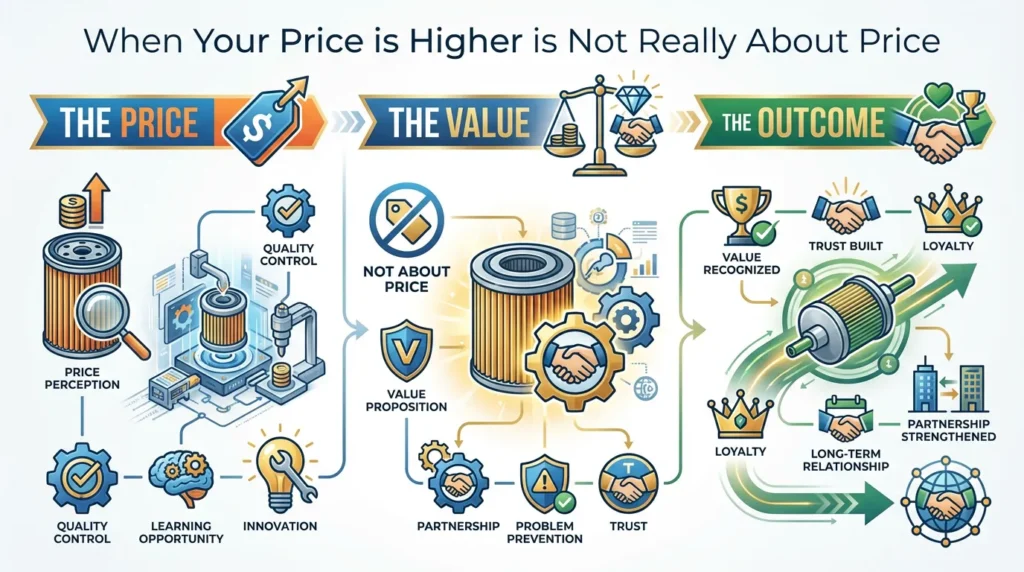
When “Your Price Is Higher” Isn’t Really About Price

When “Your Price Is Higher” Is Not Really About Price


If you work in auto parts export, you probably hear this sentence every week:

“Your price is higher.”

At Beling, I heard it again recently –
and this time, it turned into a 17‑minute turning point.

I was talking with a new buyer from Latin America.
The beginning was very “typical”:

  • “Send me your full price list.”
  • “Other supplier is 0.25 USD cheaper on this air filter.”
  • “If you give me Chinese price, we can do long term business.”

For almost two weeks, our conversation was stuck on numbers.

Last week he texted again:

“For this air filter, other factory gives me 0.25 USD lower. Can you match?”

I looked at that message and realized:

If we keep playing the “who is cheaper” game, there will be no real winner –
not for him, and not for us.

So instead of sending another discount, I asked:

“Do you have 15–20 minutes now?
Let me show you how this filter is made,
and then you tell me if the price difference is reasonable.”

He replied:

“Ok.”

I grabbed my phone, walked out of my office in Beling,
and turned on the camera.

For the next 17 minutes, he followed me on a simple “live factory tour,”
inside a company that has been making automotive filters since 2008,
now with 32 million filters annual production capacity and 95%+ global vehicle models coverage.

What happened next completely changed the conversation.

  1. Why “Your Price Is Higher” Often Isn’t About Price

1.1 The Real Meaning Behind the Sentence

When a buyer says:

“Your price is higher.”

it can mean many different things:

  • “I don’t see the difference between you and a cheaper factory.”
  • “My boss will ask why I chose you if you cost more.”
  • “My current supplier is cheaper, but I’m not fully happy either.”
  • “I only have numbers in front of me, not the full picture.”

In most cases, it does not mean:

  • “I only care about the lowest price, no matter what.”

Instead, it often means:

“No one has clearly shown me what I’m paying for.”

That was exactly the situation with the Latin American buyer.

1.2 Why the Conversation Was Stuck on Numbers

For two weeks, our messages were like many typical B2B conversations:

  • price list
  • unit price differences
  • comparisons with “other factory”

He kept repeating:

  • “Other supplier is 0.25 USD cheaper on this air filter.”
  • “If you give me Chinese price, we can do long term business.”

On a PDF quotation, my price was higher.
But the PDF could not show:

  • our material choices
  • our process controls
  • our testing routines
  • our stability and experience

So in his world, all suppliers looked similar.
When suppliers look similar, buyers have to compare by price.

That’s when I decided to change the method –
from “fighting with numbers” to “showing the factory.”

  1. Turning a Price Objection into a Live Factory Tour

2.1 Moving from Email to Real-Time Video

Instead of sending another discount or another long explanation, I asked:

“Do you have 15–20 minutes now?
Let me show you how this filter is made,
and then you tell me if the price difference is reasonable.”

He said:

“Ok.”

This was important:

  • I did not push him with a big presentation
  • I simply invited him to see with his own eyes

I took my phone, turned on the camera, and walked directly into the factory.

The idea was simple:

If he can see the difference,
he can understand the price difference.

2.2 A 17‑Minute “Live Factory Tour”

In those 17 minutes, he saw four key areas:

  1. Raw material area
  2. Production line
  3. Testing corner
  4. Finished goods warehouse

It wasn’t a polished marketing video.
It was a real‑time walk, showing him exactly how we build air filters at Beling.

And step by step, “your price is higher” started to look very different.

  1. Stop Competing Only on Price: Show the Raw Materials

3.1 Raw Material Area – Where Filter Quality Really Starts

We started in the raw material area.

I showed him our filter paper rolls:

  • labels with efficiency grade
  • thickness and specifications
  • test reports from suppliers and our internal checks

Then I took another roll: a cheaper, “economic” paper.
I put it next to our usual paper for a direct comparison.

I explained:

“This paper is not the cheapest one.
On your dusty roads, cheaper paper will block too fast.
Fewer complaints = more repeat business for your brand.”

He could see the difference:

  • texture
  • density
  • structure

I also explained how Beling’s material inspection team works:

  • we don’t just buy “whatever is cheap”
  • we check every batch for consistency
  • we verify performance vs. spec

This is where price really starts:

  • better paper → longer life, better engine protection, fewer returns
  • cheaper paper → more complaints, more workshop dissatisfaction

The raw material area already made one thing clear:

The buyer was not comparing the same product.
He was comparing a different level of filter with just a unit price.

3.2 Why Cheaper Paper Is Risky in Dusty Markets

For markets like Latin America, Middle East, Africa:

  • roads are dusty
  • service intervals are not always respected
  • engines often work in tough conditions

Using the cheapest paper may:

  • block faster
  • create higher pressure drop
  • shorten engine life
  • increase complaint rates

So a 0.25 USD difference at procurement level can become:

  • lost customers
  • damaged brand reputation
  • higher warranty costs

This is where “price” becomes total cost, not just unit cost.

  1. Production Line: Why Stable Processes Cost More (and Are Worth It)

4.1 On the Air Filter Production Line

Next, we walked to the air filter production line.

He saw:

  • automatic folding machines
  • PU foaming lines
  • operators carefully doing visual checks on foam – no bubbles, no cracks

I explained:

“We could run the machine faster to save cost.
But we don’t. We want the PU to be fully cured.
Because you don’t want filters coming back due to small cracks.”

Running machines faster:

  • reduces cycle time
  • may lower cost
  • but increases risk of:
    • air leaks
    • weak bonding
    • cracking during use

We prefer:

  • stable speed
  • fully cured PU
  • controlled process

4.2 Experience and Volume as Proof of Stability

I also told him:

“Last year alone, we produced over 30 million filters.
If our process is not stable, our European and Asian distributors
would never stay with us for so many years.”

This matters because:

  • long‑term distributors are sensitive to quality drift
  • unstable factories can’t keep them for many years
  • stability is built by:
    • proper machine settings
    • trained operators
    • consistent QC

All of that has a cost – but it also has value:

  • fewer returns
  • fewer disputes
  • fewer surprises

At this point, the buyer started to see:

He was comparing our stable, high‑volume, IATF‑driven process
with a factory that might run faster and cheaper – but less controlled.

  1. Testing Corner: Why 1% Efficiency Difference Matters

5.1 Inside the Testing Area

Then I walked into our lab area.

I explained that Beling is certified under:

  • IATF 16949:2016

Our quality team runs:

  • regular tests, not only “when there is a problem”

On one wall, there was a simple comparison chart:

  • Regular paper: 98.5% efficiency
  • Our usual paper for this model: 99.5% efficiency

I told him:

“For car owners, 1% looks small.
But for engine life – and for your brand reputation –
1% is not small at all.”

5.2 The Cost of 1% – and the Value of 1%

That extra 1% efficiency means:

  • better particulate capture
  • less dust reaching the engine
  • improved long‑term performance

It can directly influence:

  • how long engines run smoothly
  • how mechanics judge the quality of the filter
  • how many Google reviews and workshop comments your brand receives

Our QC team and R&D engineers work together to balance:

  • stable quality
  • reasonable cost

We don’t use the most expensive paper in the world.
But we also don’t chase the cheapest possible option.

We choose the right paper for:

  • the vehicle
  • the application
  • the market environment

He realized that each efficiency point, each test, each calibration, all contribute to:

fewer complaints, and a stronger brand in the eyes of mechanics and drivers.

  1. Finished Goods Warehouse: Seeing the Brand Impact

6.1 Walking Through the Warehouse

Finally, we went to the finished goods warehouse.

He saw:

  • shelves with filters arranged by OEM number
  • private label boxes for different regions:
    • Europe
    • Middle East
    • Southeast Asia

I showed him some co‑branding projects (without disclosing client names) and said honestly:

“Some customers pay more than you.
Not because they like to spend more,
but because they are tired of complaints and returns.”

These customers:

  • run their own strong brands
  • value reputation more than small unit price differences
  • measure success by:
    • mechanic feedback
    • warranty statistics
    • long‑term repeat purchases

6.2 Speaking the Language Importers Understand

Throughout the call, I avoided heavy technical terms.

Instead, I used words every importer or distributor understands:

  • complaints
  • returns
  • warranty
  • mechanics’ feedback
  • Google reviews
  • long‑term profit vs. short‑term margin

Because at the end of the day, most buyers care about:

  • growing their brand
  • increasing sell‑out
  • reducing headache

Price is only one part of that equation.

  1. The Turning Point: When Price Becomes Value

7.1 His Reaction After Seeing the Factory

When we ended the video call, there was silence for about a minute.

I was ready to hear:

“Still, your price is high.”

Instead, he wrote:

“Now I understand why your price is different.”

Then he added:

“For my low‑end customers, maybe I still need cheaper filters.
But for my own brand, I don’t want the cheapest…
I want stable quality and less headache.”

That was the real turning point.

He was no longer just asking:

“Who is 0.25 USD cheaper?”

He was now asking:

“Which filters are right for which segment of my market?”

7.2 Redesigning His Product Range by Value, Not Just Price

Together, we re‑designed his product range:

  • An economic line for price‑sensitive segments
    • For markets where customers really want the lowest price
    • With clearly defined expectations
  • A more stable line for his own branded products
    • Better materials
    • More consistency
    • Lower complaint risk
  • Clear decisions on which models must use higher‑grade materials
    • Key references with high sales volume
    • Models critical to his brand image

The first order was not huge –
about 30% higher value than his initial plan (because of the upgraded line).

But 6 months later, he messaged me:

“We have almost zero complaints on your filters.
My team is more confident to sell them now.”

That message told me:

  • price discussion had successfully become value discussion
  • the buyer was now building a long‑term brand, not just chasing the cheapest offer
  1. What a Price List Cannot Show – But a 20‑Minute Call Can

8.1 The Invisible Part of “Price”

My biggest takeaway from this “day in the life” moment:

Many overseas buyers are not “quality blind.”
They simply never had a chance to see what they are paying for.

A PDF price list cannot show:

  • our 17+ years of filter experience
  • our IATF 16949 quality system and ISO certifications
  • our stable supply chain and ERP/MRP order management
  • how our people inspect raw materials and finished products
  • the discipline on the production line
  • the tests we run even when there is no complaint

But a 15–20 minute video call can.

8.2 “Save Your Time & Cost” Is Not Only About Lower Prices

At Beling, we often say:

“Save your time & cost”

This does not only mean:

  • getting the lowest unit price

It also means:

  • reducing complaints
  • reducing returns
  • reducing hidden risks
  • reducing lost time in problem‑solving
  • reducing brand damage from inconsistent quality

As an automotive filter exporter,
I realized my job is not only to send quotations.

My job is to:

  • make quality visible
  • make long‑term value understandable
  • help our partners in 30+ countries choose the right combinations of:
    • price
    • performance
    • segment positioning
  1. How Overseas Buyers Can Use This Approach in Their Own Business

If you are a distributor, importer, or brand owner, you can:

  • classify your product lines (economic / mid / premium)
  • define where you truly need stable quality
  • measure total cost:
    • complaints
    • returns
    • lost customers
    • workshop feedback

And when you feel:

“This supplier’s price is higher,”

ask yourself:

  • Have I really understood what I am paying for?
  • Have I seen their factory and processes?
  • Have I talked with them beyond email quotations?

Often, a 20‑minute call can save you:

  • months of frustration
  • hundreds of after‑sale issues
  • lost confidence from your sales team

Beling – Save Your Time & Cost

At Beling Filters, we are not the cheapest in the market.
And we don’t try to be.

We are a specialized automotive filter manufacturer with:

  • 17+ years of experience (since 2008)
  • 32M annual production capacity
  • 95%+ global vehicle model coverage
  • IATF 16949:2016 certified quality system
  • stable supply chain and ERP/MRP order management

When a buyer tells me:

“Your price is higher.”

I don’t just send a discount.
I invite them to see:

  • our raw materials
  • our production lines
  • our testing routines
  • our warehouse and private label projects

Because once value is visible,
price starts to make sense.

If you want a filter partner who:

  • helps you reduce complaints and returns
  • supports your brand positioning
  • explains quality in a way your team can understand

Let’s talk.

📩 bruce.gong@belingparts.com
🌐 www.belingparts.com

In the photo: me on a video call from our production line at Beling,
showing how we produce air, cabin, oil, and fuel filters for our global partners.

When your client says “your price is higher,” how do you respond?
Do you just send a discount… or do you show your value?

More to read

⭐ A Single Vehicle Model Mistake Led Me to Build a New OE Double Confirmation System

10 Red Flags: Your Automotive Filter Supplier Might Be Dragging Down Your Profits

2026 Global Automotive Filter Market Trends: OEM vs Aftermarket Outlook

Privacy Policy Powered by  2uncle