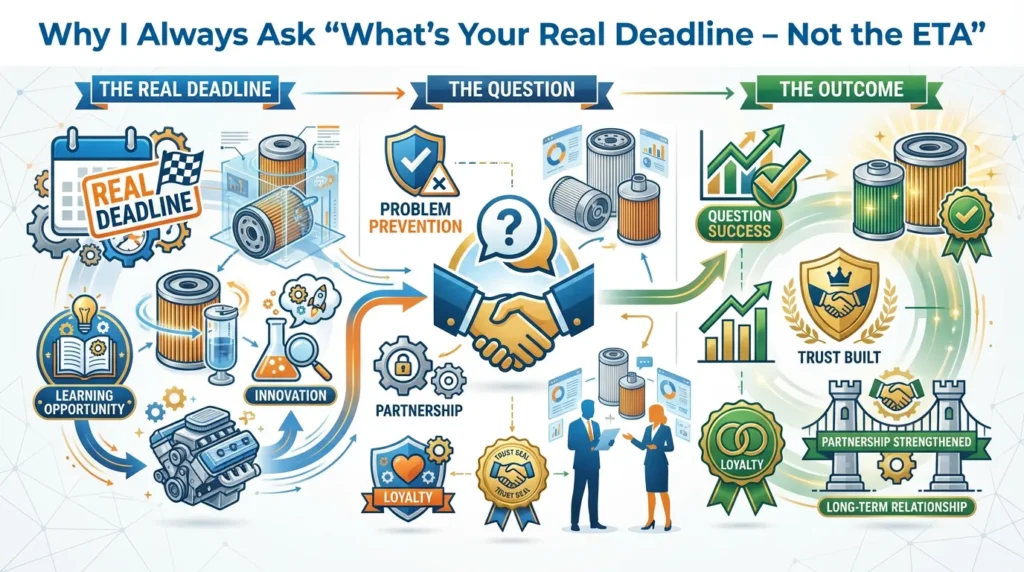
A few years ago, a European client sent me a big order:
- 🧾 multiple filter references
- 🚢 requested ETD (Estimated Time of Departure): end of June
- 📆 required ETA (Estimated Time of Arrival): end of July
Everything looked normal on paper.
Our production plan was tight, but doable.
The forwarder said there were available sailings.
From a typical supplier’s point of view, it was:
“Produce → load → ship → arrive end of July → job done.”
But on a call, I casually asked him one extra question:
“What’s your real deadline?
I mean, when do your customers actually need the stock?”
He paused.
Then he said something that changed the whole picture:
“Honestly, Bruce,
if the filters arrive 1 week later than ETA,
the contract with one of our fleets will be at risk.
We promised them stock in the first week of August.”
Suddenly, we were no longer talking about:
- a simple ETA date on a document.
We were talking about:
- his fleet customer’s service schedule
- a new contract he had just signed
- his reputation as a reliable supplier in his market
If I only focused on the ETA,
I would treat this like any other shipment.
But now I knew:
- ⏰ a delay here was not “small”
- ⚠️ it was business‑critical
That one question—“What’s your real deadline?”—
changed how we handled everything.
Why ETA Is Not the Same as a Real Business Deadline
In international trade, we love acronyms:
- ETD – Estimated Time of Departure
- ETA – Estimated Time of Arrival
- CY/CFS cut‑off, transit time, etc.
These dates are necessary for:
- booking vessels
- planning production
- managing warehouse and inventory
But in B2B, an ETA is often only a technical date.
Behind it, there is usually a business date that really matters.
Examples of what an ETA might be hiding:
- a service commitment to a fleet
- a tender clause with penalties for late delivery
- a promotional campaign with retailers
- a maintenance window in a workshop schedule
If a shipment arrives 5–7 days late, the impact can range from:
- “No big deal, we hold extra stock”
to - “We may lose a major fleet we’ve served for years.”
The problem is:
Most suppliers only see the ETA on the Proforma Invoice (PI)
and logistics system, not the real downstream consequences.
That’s why I started asking about real deadlines,
not just the dates on paper.
The Call That Changed How We Handled the Order
On the phone, after he explained his situation, we understood:
- His “ETA end of July” was not just a random date.
- It was directly tied to a promise he made to a fleet.
- That fleet expected stock in the first week of August.
To be safe, he had built:
- about one week of buffer between ETA and the fleet’s need.
But he also knew:
- if something went wrong in production or shipping,
and the container arrived a week late,
he would fail on that promise.
For him, the consequences of a late arrival were:
- possible contract penalties
- loss of credibility with a key fleet
- risk of that fleet trying another supplier
For us, a typical shipping delay often means:
- a few apology emails
- some stress with the forwarder
- extra tracking work
For him, it meant:
- potential loss of business.
Once we understood that,
we realized we needed to treat this order differently.
How We Adjusted Once We Knew the Real Deadline
As soon as I understood his real risk, we took three key steps.
3.1 Step 1 – Pulling Forward His Production in Our Schedule
We reviewed our production plan and:
- moved his order earlier in the queue
- adjusted some less urgent orders
- ensured his filters were not dependent on a last‑minute rush
This meant:
- protecting his delivery from internal delays
- reducing the risk that a small production issue would push us past his real deadline
We communicated transparently with other clients where minor shifts were possible
and prioritized his job because the business impact was higher.
3.2 Step 2 – Reserving Space With the Forwarder Earlier Than Usual
Instead of waiting until production was almost done,
we:
- reserved space with our forwarder in advance
- explained that this shipment was time‑critical
- asked them to flag any schedule changes early
In busy periods, vessel space and stable schedules are not guaranteed.
By booking early and clearly stating the importance, we:
- increased the chance of keeping his container on a suitable sailing
- got earlier visibility if something changed
3.3 Step 3 – Building a Buffer Plan With Alternative Routes
We also created a buffer plan:
- If the original vessel changed or was delayed,
we had an alternative route ready.
That meant:
- identifying other sailings we could switch to
- considering slightly different routes or transshipment ports
- checking cut‑off times that would still fit our production completion
This kind of planning takes extra effort,
but when a shipment is business‑critical,
it’s worth it.
Dealing With Real‑World Issues: Port Congestion and Vessel Changes
During that period, there were port congestion issues.
It was one of those times when:
- vessels changed schedules
- some calls were skipped
- transit times were updated last minute
The original sailing plan changed twice.
Because we already knew the business risk,
we:
- monitored his booking closely
- stayed in daily contact with the forwarder
- reacted quickly when schedule changes appeared
When the first vessel change was announced,
we reviewed:
- the new ETA
- impact on his real deadline
It still looked okay, but tight.
When the second change came,
we decided not to wait and hope.
We moved his container to another vessel and route,
one that still allowed us to hit his true business deadline.
Without that proactive move,
his filters might have arrived too late.
The Final Result: Arrival Before the True Deadline
In the end:
- 📦 The goods arrived 4 days before his true deadline.
- 😌 His fleet customer had zero disruption.
- 🤝 He secured another year of cooperation with that fleet.
After everything was done,
he wrote to me:
“Bruce, the key was that you asked
about my real deadline, not just the ETA.”
That message stayed in my mind.
Because from a purely logistics standpoint,
what we did was nothing extraordinary:
- adjust production
- book space early
- monitor vessels
- switch routes if needed
But from a business standpoint,
those actions protected:
- his customer relationship
- his tender performance
- his reputation as a reliable supplier
All because of one extra question at the start.
The Two Questions I Now Always Ask About Delivery Dates
Since then, whenever a new order comes,
I always ask two simple questions:
1️⃣ “What is the promised date to your customer?”
- Not just your internal ETA.
- The date written in your contracts, offers, or agreements.
2️⃣ “What happens if the goods are 5–7 days late?”
- Is it just a bit more stock cost?
- Or is there a real risk of losing a fleet, tender, or retailer?
The answers help me understand:
- whether this shipment is normal
- or critical
Sometimes the answer is:
“No big issue, just higher stock cost.
We have buffer in our warehouse.”
In that case:
- we still aim for on‑time delivery
- but we know the business risk is moderate
Other times the answer is:
“We may lose a tender / a fleet / a retailer
if we fail this date.”
In that case:
- we treat the order like a priority project
- we plan production, booking, and contingency more aggressively
The difference is not about:
The difference is about:
- risk level behind the dates.
Why This Matters for Aftermarket and Fleet Maintenance
If you’re in the automotive aftermarket or fleet maintenance business, you know:
- fleets plan maintenance and parts usage
- workshops promise service dates to their customers
- tenders often have specific availability clauses
Delays in filter supply can lead to:
- rescheduled maintenance
- vehicles waiting for parts
- emergency local purchases at higher cost
- disappointed fleet managers
But many importers and distributors only tell their suppliers:
- ETD and ETA they need
- not the story behind those dates
By sharing the real deadline and the risk behind delay, you allow your supplier to:
- prioritize correctly
- allocate resources better
- build realistic buffer plans
Without that, your supplier may:
- treat all POs as equal priority
- assume 5–7 days late is not critical
- react too slowly when logistics issues appear
How We Manage Lead Times and Business Risk, Not Just Containers
When we work with clients on automotive filters,
we don’t want to be only:
- a factory that ships containers
We want to be:
- a partner that helps manage business risk connected to those containers.
Our approach includes:
8.1 Understanding the Real Business Context
We ask:
- Who are the key end customers behind this order?
- Are these goods for a specific tender, fleet, or campaign?
- What are the penalties or consequences if something is delayed?
8.2 Adjusting Priority Based on Criticality
We don’t promise:
- that every customer is always number one
But we do:
- adjust planning when a shipment is clearly more critical
- communicate openly about what we can and can’t prioritize
8.3 Working with Forwarders Proactively
We:
- book early for time‑sensitive shipments
- ask forwarders to alert us of changes quickly
- are ready to switch vessels or routes when needed
8.4 Keeping Clients Informed
For critical POs:
- we share schedule updates
- we explain options if something changes
- we help clients adjust their own communication with fleets and workshops
What This Means If You’re an Importer, Distributor, or Fleet Supplier
If you are buying filters for:
- fleets
- large distributors
- key retail chains
consider sharing with your supplier:
- the promised date you gave your customers
- what happens if a shipment is 5–7 days late
You don’t need to do this for every small order.
But for strategic contracts, it makes a big difference.
It allows us to:
- avoid treating a critical shipment like an ordinary one
- set clear internal and logistics priorities
- help you avoid the “sorry, vessel delayed” avalanche at the worst possible moment
Because at the end of the day:
The dates on a PI or Bill of Lading
are not just numbers.
Behind each date there is:
- someone’s promise
- a contract clause
- a customer expectation
A good supplier doesn’t only manage containers and documents.
We help manage the risk behind the dates.
If You Want a Filter Partner Who Cares About What Dates Really Mean
If you want a filter partner who:
- cares about what your dates actually mean to your end customers
- asks about real deadlines, not just ETAs
- helps you build buffer and contingency in production and shipping
- understands that losing a fleet or tender is more serious than a small delay
I’m always happy to talk.
We can:
- review your key contracts and fleet commitments
- identify which shipments are truly critical
- design a lead time and booking strategy that supports your promises
- help you turn delivery reliability into a competitive advantage
📩 bruce.gong@belingparts.com
🌐 www.belingparts.com
Because in B2B,
what keeps customers loyal
is not only the quality of the product,
but also how you handle the dates
that matter most to them.