In the automotive aftermarket, people talk a lot about:
- product quality
- price
- lead time
But there is another factor that strongly influences:
- whether a distributor loses sales
- whether a market stays supplied
- whether a supplier is viewed as “reliable” or “rigid”
That factor is:
Packaging and pallet flexibility.
Not the design on the box.
Not just the strength of the carton.
But how much room your system leaves for last‑minute changes.
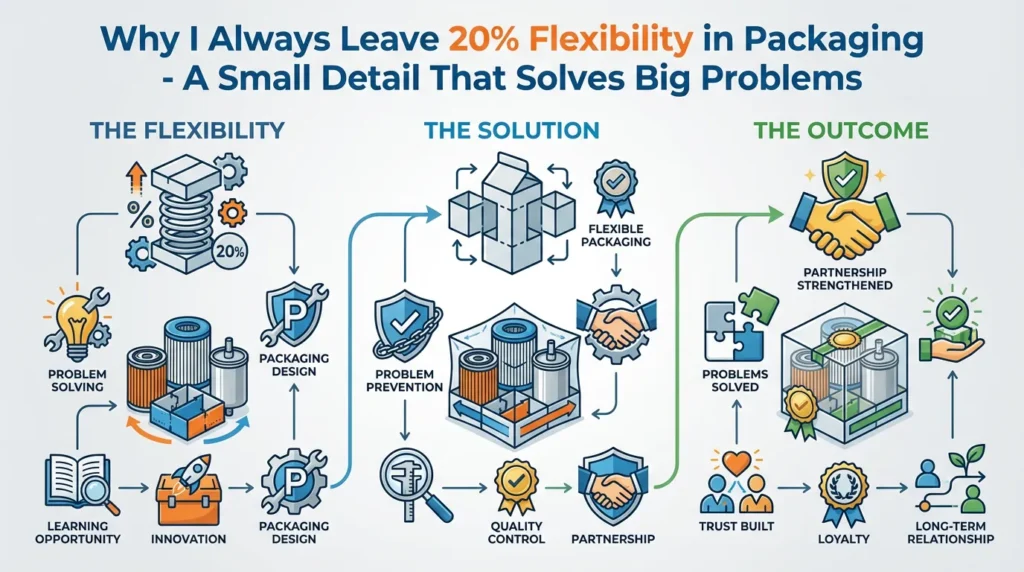
One urgent message from a customer made the value of this flexibility very clear — and confirmed why I always leave about 20% flexibility in our packaging plans.
“Bruce, Can We Add Two More SKUs to This Shipment?”
1.1 The Urgent Request
A customer once sent me a message:
“Bruce, can we add two more SKUs to this shipment?
If not, we will run out of stock next week.”
The situation at that moment:
- Production for the original order was finished
- Cartons were already packed
- Pallets were wrapped
- Labels were printed
In most factories, the standard answer at this stage would be:
- ❌ “Too late. Wait for the next batch.”
Because for many operations:
- Once pallets are wrapped, the system is “closed”
- Any change means extra work, re‑labeling, and process disruption
But a year earlier, I had already made a decision that changed how we operate.
1.2 The Decision I Made One Year Earlier
That decision was:
👉 Always design packaging and palletization with around 20% flexibility.
Flexibility in:
- space
- cartons
- labels
- pallet structure
- SKU grouping
Why?
Because in the aftermarket:
- sudden changes are normal
- forecasts shift
- retailers place emergency orders
- competitors run out of stock
- seasonal demand appears sooner or stronger than planned
And distributors need fast reaction from their suppliers.
So when the customer asked to add 2 SKUs, I didn’t panic.
I simply checked our pallet layout and packaging buffer.
My reply:
“Yes, we can add them.
They will fit into the flexible space we reserved.”
We:
- inserted the new SKUs
- adjusted the pallet labels
- updated the packing list
- sent him photos and confirmation
His response:
“Bruce, this saved us.
Otherwise we would have lost sales next week.”
One small packaging decision:
- prevented his stock‑out
- protected his market
- strengthened his trust in us
- helped secure the next‑year contract
Why I Design Packaging With 20% Flexibility
2.1 The Nature of the Aftermarket: Unpredictable by Default
Unlike OEM supply, the aftermarket is:
- demand‑driven
- promotion‑driven
- seasonally influenced
- dependent on competitor stock situations
This means:
- Orders change
- Priorities change
- SKUs that looked “safe” suddenly become urgent
- Distributors need to respond to market events, not just planning spreadsheets
If your packaging and pallet structure are rigid, you push all this stress back onto the distributor:
- “Sorry, too late.”
- “Next container.”
- “We need to wait for the next cycle.”
But if you build flexibility into your system, you can say:
- “We can still add that.”
- “We can adjust the pallets.”
- “We can consolidate and optimize this shipment.”
2.2 What “20% Flexibility” Means in Practice
When I say “20% flexibility”, I mean:
- leaving around 20% space or structuring in our packaging and pallet plan that can be:
- filled with additional SKUs
- used to adjust SKU quantities
- used to handle emergency items
This does not mean:
- underloading containers
- wasting space
It means:
- designing the shipment and pallets smartly so that there is controlled room for last‑minute optimization.
This flexibility can appear as:
- some free volume inside certain pallets
- one or two pallets planned as “mix pallets”
- labels and documentation prepared for possible additional SKUs
How We Build Flexibility Into Packaging and Pallet Structure
3.1 Flexible Packaging Structures
We design packaging structures to be adaptable:
- Carton sizes are standardized where possible
- Pallet footprints are planned to accommodate small adjustments
- Overhang and height are controlled so that adding extra cartons remains safe
This allows us to:
- add or remove a few cartons without re‑engineering the entire shipment
- absorb small changes without a full redesign of the packing plan
3.2 Adjustable Pallet Layouts
We plan pallet layouts with adjustment in mind:
- Some pallets are “fixed structure” (full SKU, full layer)
- Some are “flexible structure” (mix SKUs, with controlled pattern)
This makes it possible to:
- add extra SKUs in the flexible area
- redistribute small quantities if priorities change
- respond to last‑minute customer instructions
The key is:
- The overall pallet remains stable and safe
- The labeling and documentation always reflect reality
3.3 Extra Buffer Carton Planning
We also plan buffer cartons:
- Additional printed cartons available
- Some label flexibility (pre‑printed + on‑demand)
This means:
- If a customer increases a certain SKU at the last minute
- Or asks to include a new reference that shares a common carton format
we can:
- respond quickly
- pack without waiting for new material production
3.4 Fast SKU Addition Mechanisms
Operationally, we have built processes that support quick addition of SKUs:
- Clear internal communication between sales, production, warehouse, and documentation
- Defined steps:
- Sales receives request
- Checks inventory / production status
- Confirms feasible quantity and placement with warehouse
- Updates the loading and pallet plan
- Documents changes in packing list and labels
This reduces:
- confusion
- errors
- inconsistent records
3.5 Dynamic Packing List Update Systems
We treat the packing list as a living document until loading is finalized:
- It can be updated in a controlled way
- Every change is logged
- Final version is checked against physical pallets
So when a customer says:
- “Can you add 10 cartons of this SKU if they fit?”
We can:
- re‑calculate
- adjust
- re‑issue the packing list
Without chaos.
The Strategic Role of Flexibility in Supply Chain Management
4.1 Flexibility: The Lubricant of the Supply Chain
In supply chain management:
👉 Flexibility is the lubricant.
It doesn’t replace:
But it allows:
- the entire system to keep moving smoothly when reality changes.
If your system is too rigid:
- Small changes create big problems
- Stress increases
- Customer relationships suffer
If your system is flexible:
- Adjustments are easier
- Urgent needs can be handled
- Customers feel safer working with you
Speed is important.
Accuracy is important.
But:
Flexibility is what saves customers in urgent moments.
4.2 A Rigid Packaging Plan Makes Everyone Nervous
A packaging plan that is “perfect” on paper but impossible to adjust:
- creates stress in your own team
- creates stress for the customer
- can lead to lost sales when reality does not match the forecast
In contrast:
- A flexible packaging plan makes both sides feel safe.
The customer knows:
- “If something urgent happens, my supplier has room to help.”
You know:
- “If the customer asks for a small change, we can handle it.”
This safety feeling is extremely valuable in long‑term relationships.
Why 20% Packaging Flexibility Matters So Much to Overseas Distributors
5.1 The Two Big Fears of Distributors
Most distributors around the world fear two things:
1️⃣ Overstock → cash flow pressure
- Too much capital locked in stock
- Slow‑moving items filling the warehouse
- Risk when the market changes
2️⃣ Out‑of‑stock → lost customers, lost shelf space, lost market
- Retailers switch to other brands
- Workshops lose trust
- Competitors take over the space
They try to balance:
- not ordering too much
- not ordering too little
This is much harder when:
- market conditions are unstable
- demand is volatile
- promotions and tenders suddenly appear
5.2 How a 20% Buffer Helps Them Handle Both
A 20% packaging and pallet buffer helps them:
- keep inventory lean without increasing risk of stock‑outs
- react quickly when a model suddenly sells more
- add emergency SKUs into an already planned shipment
This flexibility supports:
- just‑in‑time adjustments
- safer decision‑making
- better cash flow management
5.3 Concrete Benefits of Flexible Packaging for Distributors
Flexible packaging helps overseas distributors:
- ✔ React faster
- Quickly respond to retailers who want more stock
- ✔ Avoid retail penalties
- Deliver on time to chains that punish stock‑outs
- ✔ Consolidate shipments
- Add missing SKUs into an existing container to avoid a separate small shipment
- ✔ Add emergency SKUs
- Include urgent lines without resetting the whole plan
- ✔ Reduce shipping costs
- Use available container or pallet volume more efficiently
- ✔ Maintain market continuity
- Avoid empty shelves and service disruption
This is why top‑tier distributors prefer suppliers who:
- plan for unpredictability
- don’t treat the packing plan as a rigid, unchangeable formula
How Beling Filters Builds Flexibility Into Every Shipment
At Beling Filters, we manufacture OE‑level air, cabin, oil, and fuel filters — but we also invest heavily in how they are packed and shipped.
6.1 Flexible Packaging Structures
We design packaging structures to support:
- mixed SKUs where needed
- efficient use of carton and pallet space
- safe stacking even after late adjustments
This allows us to:
- adapt to new priorities
- support trial SKUs in running shipments
- maintain transport safety while making changes
6.2 Adjustable Pallet Layouts
Our pallet layouts are built with:
- defined “fixed” areas
- defined “flexible” areas
This structure means:
- we know exactly where we can change things
- we keep the center of gravity and stability under control
- we can still respect pallet height limits and container utilization
6.3 Extra Buffer Carton Planning
We maintain buffer carton planning:
- Additional standard cartons ready
- Extra labels prepared or printable on short notice
So if a customer asks:
- “Can you add 30 pcs of this new reference?”
we can:
- pack them properly
- label them correctly
- integrate them into the shipment
6.4 Fast SKU Addition Mechanisms
We have fast SKU addition mechanisms connecting:
- sales team
- warehouse team
- documentation team
This enables:
- quick feasibility checks
- rapid updating of the load plan
- smooth recording of changes in the final documents
6.5 Dynamic Packing List Update Systems With IATF 16949 Traceability
All of this is managed under:
IATF 16949 traceability and documentation discipline
Our dynamic packing list update system ensures:
- every change is recorded
- the final packing list matches exactly what is loaded
- traceability is preserved even with flexible changes
Our goal is not only to ship products.
Our goal is to protect your stock health — avoiding both overstock and out‑of‑stock.
Beling – Save Your Time & Cost
A customer urgently needed two more SKUs.
Because we had built 20% flexibility into our packaging and pallet plan, we could say:
That simple “yes”:
- prevented his stock‑out
- protected his market
- earned long‑term trust
- helped secure next year’s contract
At Beling Filters, we manufacture OE‑level air, cabin, oil and fuel filters with:
- ✔ Flexible packaging structures
- ✔ Adjustable pallet layouts
- ✔ Extra buffer carton planning
- ✔ Fast SKU addition mechanisms
- ✔ Dynamic packing list update systems
- ✔ IATF 16949 traceability
If you want a supplier who plans with flexibility, not rigidity —
and who helps keep your market supplied without interruption:
Let’s connect.
📩 bruce.gong@belingparts.com
🌐 www.belingparts.com
Your valuable automotive filter partner since 2008.