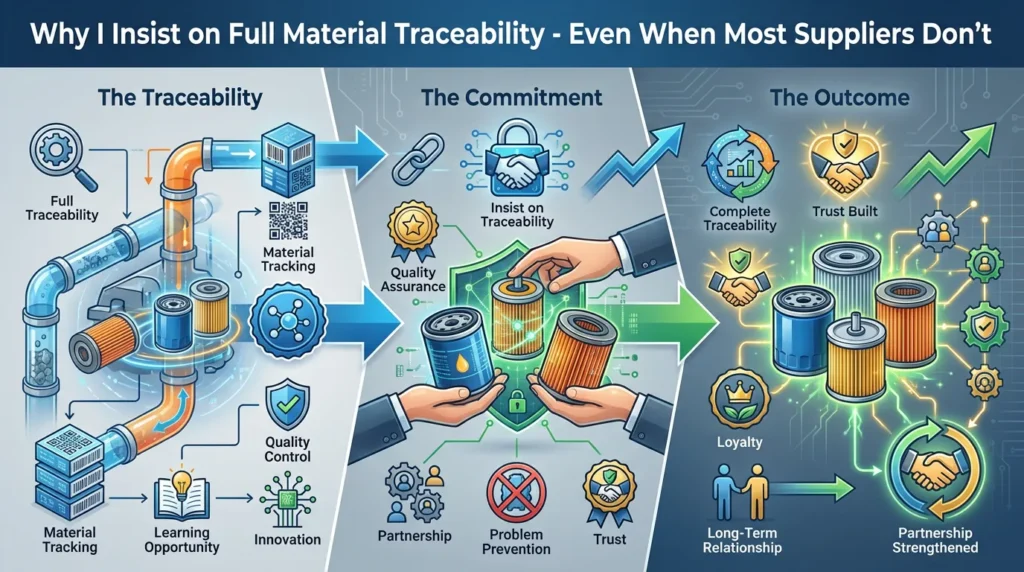
In the automotive filter business, many factories talk about:
- price
- capacity
- catalog size
Far fewer are willing to talk — in detail — about traceability:
- Where did each material come from?
- Which batch was used?
- Who produced it?
- Under what conditions?
For me, traceability is not “extra paperwork.”
It’s the foundation of accountability, problem‑solving, and brand protection.
A simple question from a customer, and a small issue with a cabin filter, showed exactly why I insist on full material and process traceability, even when most suppliers don’t.
“Why Do You Track Everything?” – A Customer’s Question
1.1 The Question Behind the Question
A customer once asked me:
“Bruce, why do you track every batch of filter media, resin, PU foam, and steel components?
Most factories don’t go that far.”
I smiled, because I knew exactly why he asked.
For many factories, traceability means:
- maybe a basic production date
- maybe a lot number on the carton
But nothing that actually lets you:
- trace back to material batches
- identify specific process conditions
- pinpoint root causes quickly
To them, going deeper looks like:
- unnecessary cost
- extra complexity
To me, it looks like:
a non‑negotiable requirement for serious, long‑term business.
Not long before his question, we had lived through a real‑world example that proved why.
1.2 A “Small” Cabin Filter Issue That Most Would Ignore
A different customer reported a small issue with a cabin filter:
- a slight variation in media texture
- barely noticeable
- performance was still within spec
To many suppliers, this would be dismissed as:
- “normal production variation”
- “nothing to worry about”
They might respond with:
- “It’s normal.”
- “It’s within tolerance.”
- “Don’t worry, it will work.”
But I didn’t want “normal.”
I wanted facts.
So instead of guessing or giving generic answers, we went straight to our traceability system.
How Full Traceability Solved a Problem in 20 Minutes
2.1 Pulling the Complete Traceability Record
For that cabin filter, we pulled the full traceability record:
- ✔ Raw material supplier → matched
- ✔ Lot number of filter media → matched
- ✔ Resin batch → matched
- ✔ Curing temperature log → normal
- ✔ Workstation/operator code → matched
- ✔ Humidity and temperature records → matched
In other words:
- Everything on the surface looked correct
- No obvious deviation or alarm
Yet the customer had noticed a subtle difference in media texture.
Because we had full material and process traceability, we could keep digging — not by guessing, but by checking real data.
2.2 Finding the Root Cause: A Mixed Sub‑Batch
After reviewing the records in detail, we found it:
A different supplier sub‑batch of media had been mixed into the same production day.
Important details:
- Still within specification
- Still safe and functional
- No direct performance failure
- But slightly different in texture and “feel”
From a technical viewpoint, the product was:
From a brand sensitivity viewpoint:
- it created a visible — though small — variation
Because we had traceability, we could:
- identify exactly which sub‑batch was involved
- confirm which production lots were affected
- understand why the texture looked slightly different
And we did this in about 20 minutes:
- without guessing
- without excuses
- without “maybe the material was like this”
2.3 Fixing the Problem, Updating the Process, and Being Transparent
Once the root cause was clear, we:
- updated our process to prevent future sub‑batch mixing in that way
- strengthened internal rules on how mixed batches are managed
- documented the incident and the corrective actions
Then we shared everything transparently with the customer:
- what happened
- why it happened
- what the risk level was (low, safe, but visually noticeable)
- what we had changed to prevent recurrence
The customer’s reply:
“Bruce, this is the level of control we need for our brand.”
That moment reinforced something I already believed, but now had a powerful real‑world proof:
👉 A supplier without traceability is a supplier without accountability.
The Lesson: Quality Is What You Can Trace
3.1 In Automotive Filters, Quality Is More Than the Final Product
In automotive filter manufacturing:
👉 Quality is not just what you make.
It’s what you can trace.
Two factories can:
- use similar media
- have similar machines
- produce similar‑looking filters
But without traceability, one of them:
- cannot prove consistency
- cannot find root causes quickly
- cannot provide credible answers when something unusual appears
3.2 What Traceability Actually Enables
A properly designed traceability system allows you to:
- ✔ Find root causes
- Which batch of material?
- Which operator?
- Which shift?
- Which conditions?
- ✔ Fix problems quickly
- Reduce investigation time from days to minutes
- Stop guessing and start acting
- ✔ Prevent recurrence
- Update process parameters
- Adjust supplier controls
- Improve training and checks
- ✔ Prove compliance
- For audits
- For OEM or high‑level aftermarket customers
- For internal quality systems
- ✔ Protect customers’ brands
- Avoid “mystery issues”
- Provide clear explanations instead of vague promises
- ✔ Stabilize long‑term cooperation
- Show you are in control
- Build trust that survives occasional issues
Without traceability:
- every problem becomes a mystery
With traceability:
- every problem becomes solvable
And in B2B, your ability to solve issues is just as important as your ability to avoid them.
Why Overseas Buyers Value Traceability So Highly
4.1 The Risks and Pressures They Face
European, Middle Eastern, and American distributors operate under real‑world pressure:
- Warranty risk
- Each field issue can cost money and reputation
- Retailer audits
- Large chains request documentation, batch trace, and quality evidence
- Strict documentation requirements
- For technical approvals, certifications, and compliance
- Multi‑brand product management
- Distributors handle several brands — each problem affects their credibility
- Sensitive consumer markets
- End users and workshops are quick to share negative experiences
For them, a “small” unexplained variation can:
- create uncertainty
- weaken confidence in the brand
- generate difficult discussions with retailers
4.2 The Questions Professional Buyers Need Answered
Professional buyers and product managers need suppliers who can answer questions like:
- ✔ “Which batch was this made from?”
- ✔ “What material was used, from which supplier?”
- ✔ “Who operated the station that day?”
- ✔ “What were the production conditions (humidity, temperature, curing profile)?”
- ✔ “Can you prove consistency between this batch and the previous one?”
If the supplier:
- cannot answer
- or gives vague, non‑specific answers
then:
- the buyer carries all the risk
- the distributor becomes the “shock absorber” for hidden factory problems
4.3 Shifting Risk Back to Where It Belongs
Traceability does something very important in the relationship:
It transfers the risk away from the buyer and back to the supplier, where it belongs.
When traceability is strong:
- the supplier can be held accountable
- issues can be investigated and solved
- preventive actions can be verified
This is one of the main reasons why:
- serious overseas buyers value traceability
- traceability is often a hidden deciding factor for long‑term partnerships
How We Implement Full Traceability at Beling Filters
At Beling Filters, we insist on full traceability — from raw materials to final cartons and pallets — for every OE‑level Air / Cabin / Oil / Fuel filter we produce.
5.1 Filter Media Batch & Supplier Lot
We track:
- the filter media batch used for each production lot
- the supplier lot number
This allows us to:
- compare performance between different lots
- identify specific media‑related issues quickly
- communicate clearly with upstream suppliers when needed
5.2 Resin Penetration and Related Logs
We record key resin‑related parameters:
- resin batch and code
- penetration settings and process conditions (where applicable)
- curing and drying data
Because:
- resin behavior strongly affects media stability, pleat integrity, and long‑term dust‑holding performance
Any pattern that might impact performance is traceable back to precise conditions.
5.3 PU Foaming Batch Codes and Sealing Data
For filters with polyurethane end caps or sealing:
- we trace PU foaming batch codes
- we log mixing ratios where monitored
- we record sealing torque data for relevant operations
This helps us ensure:
- sealing integrity
- structural stability under heat and vibration
- consistent bonding quality
5.4 Workstation/Operator Trace
Every production step includes:
- workstation and operator codes
This provides:
- accountability at the human level
- data for identifying training needs if repeated issues appear at specific stations
It is not about blame — it is about control and improvement.
5.5 Production Date, Shift, and Environmental Conditions
We log:
- production date and shift
- humidity and temperature conditions during critical stages (e.g. media handling, curing, foaming)
Environmental conditions can change how:
- materials behave
- curing processes complete
- foams and resins set
Having this data gives us a richer understanding when investigating any anomaly.
5.6 QC Checkpoints Throughout the Process
We integrate QC checkpoints into:
- incoming material inspection
- in‑process control
- final product checks
Each checkpoint:
- is logged
- is tied to specific lots and batches
So any QC note or deviation is not isolated — it is linked to the full traceability chain.
5.7 Carton & Pallet Traceability
Traceability does not stop inside the filter. We also track:
- carton batch and ID
- pallet groupings and load plans
This way:
- if a specific carton or pallet grouping is involved in a downstream issue (e.g. transport damage, labeling problem), we can trace that as well
5.8 Supported by IATF 16949 and 30+ Country Export Experience
All of this is supported by:
- the IATF 16949 quality system
- over 30 countries of export experience
This combination means:
- our traceability system is not just theory
- it has been tested in real markets, real audits, and real problem‑solving situations
For us:
Traceability isn’t paperwork.
It’s your guarantee of predictability and trust.
Beling – Save Your Time & Cost
A customer once asked me why we track every batch of filter media, resin, PU foam, and steel components when “most factories don’t go that far.”
The answer is simple:
- Because when something unusual appears, we don’t want guessing.
- We want facts.
- And we want to protect our customers’ brands with clarity and speed.
Another customer experienced this directly when a small cabin filter variation appeared.
Thanks to traceability, we:
- found the cause in 20 minutes
- fixed the process
- documented everything
- and shared it transparently
His response:
“Bruce, this is the level of control we need for our brand.”
At Beling Filters, we insist on full traceability for every product:
- ✔ Filter media batch & supplier lot
- ✔ Resin penetration logs
- ✔ PU foaming batch codes
- ✔ Workstation/operator trace
- ✔ Sealing torque data
- ✔ Production date & shift
- ✔ Humidity/temperature logs
- ✔ QC checkpoints
- ✔ Carton & pallet traceability
All under:
- IATF 16949 quality management
- 30+ country export experience
If you want a supplier who can trace every filter back to its origin —
not just produce it —
Let’s connect and build a supply chain with zero ambiguity.
📩 bruce.gong@belingparts.com
🌐 www.belingparts.com
Your valuable automotive filter partner since 2008.