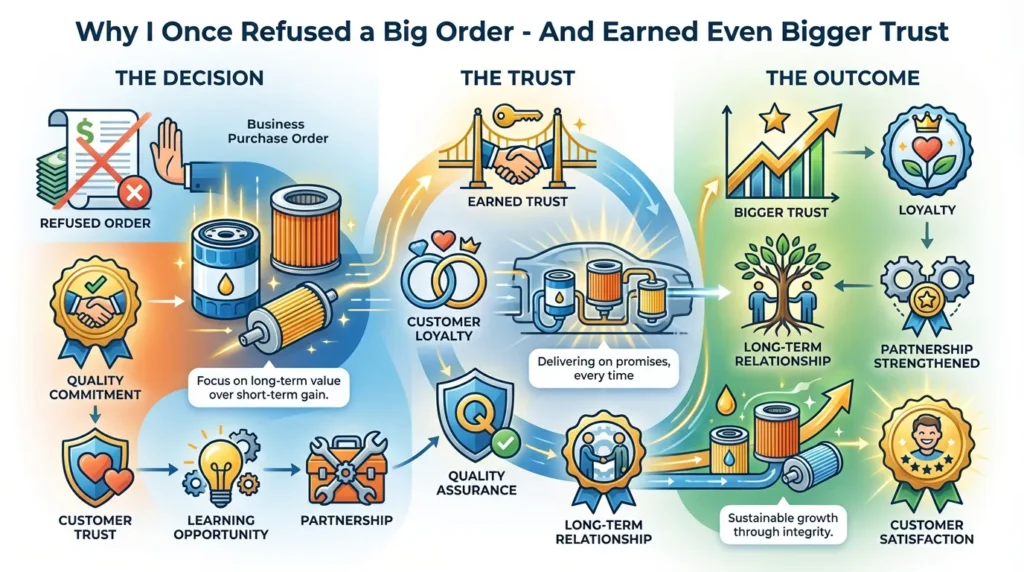
In international trade, a “big order” is the dream of many suppliers:
- high volume
- attractive revenue
- strong reference for the portfolio
But sometimes, a big order comes with a condition that quietly attacks the most important asset in the relationship:
Your customer’s brand reputation.
One conversation with a distributor forced me to choose between short‑term volume and long‑term brand protection — and it became one of the clearest examples of why I will not sacrifice material integrity for price.
The “Big Opportunity” With a Hidden Cost
1.1 A Distributor With Strong Market Potential
A distributor once approached me with what looked like an excellent opportunity:
- a large order
- good volume
- strong potential in his local market
- the chance to become a long‑term key account
From a typical business perspective, this is exactly the kind of project every supplier wants.
We discussed:
- vehicle coverage
- OE cross references
- packaging details
- delivery schedule
Everything was moving in a positive direction — until one condition appeared.
1.2 The Condition: “Can You Use Lower‑Grade Materials?”
The distributor said:
“Bruce, can you use lower‑grade materials to match the competitor’s price?”
More specifically, he asked to:
- downgrade the filter media
- reduce resin penetration
- simplify the sealing process
On paper, this looked simple:
- Use cheaper media
- Reduce manufacturing cost
- Match or beat the competitor’s offer
In the short term, it seemed like an easy “yes”:
- ✔ win the order
- ✔ increase shipment volume
- ✔ boost revenue
But those short‑term gains were a trap, because I knew the long‑term consequences.
What Happens When You Downgrade Filter Materials
2.1 The Technical Impact of Lower‑Grade Media
In automotive filters, the material is not a decoration — it is the core performance driver.
When you downgrade the filter media (e.g. switching from HV / Ahlstrom or similar high‑performance media to low‑grade, unbranded paper), several things happen:
- ❌ Reduced dust‑holding capacity
- The media loads faster
- The filter clogs sooner
- Service intervals get shorter
- ❌ Shorter service lifespan
- The filter can no longer safely reach the intended mileage
- The end user may need to replace it earlier than expected
- ❌ Unstable filtration efficiency
- More fine particles may pass into the engine or cabin
- Engine wear and cabin air quality can be affected
2.2 The Risk of Lower Resin Penetration and Simplified Sealing
To save cost, some suppliers reduce:
- resin penetration in pleats
- sealing level at end caps and gaskets
This creates new risks:
- ❌ Higher risk of leakage
- Dust bypasses the media through poorly sealed areas
- Oil or fuel leaks at the gasket or end cap region
- ❌ Deformation under pressure or temperature
- Inadequate sealing can fail under engine conditions
- The filter can lose structural stability
2.3 The Commercial Consequences for the Brand
From the outside, the filter may look similar:
- same dimensions
- similar packaging
- similar labeling
But internally, performance has been compromised. Over time, this leads to:
- ❌ More customer complaints
- Mechanics notice the filters don’t last
- Drivers complain about performance and reliability
- ❌ Brand credibility damage
- Retailers and workshops lose trust in the brand
- The brand becomes associated with “cheap and unreliable”
- ❌ Unstable market performance
- Sales increase quickly, then drop when complaints spread
- Competitors use the weakness to regain market share
In short:
You save a few cents today, but you pay heavily later — in reputation, margin, and market stability.
Saying “No” to the Wrong Kind of Business
3.1 The Decision Many Suppliers Avoid
Faced with this situation, many suppliers would quietly accept:
- Use lower‑grade media
- Reduce sealing quality
- Match the lowest price on the market
They tell themselves:
- “If we don’t do it, another supplier will.”
- “We’ll upgrade quality later once we get the order.”
- “The customer pushed us into it.”
But the reality is:
- Once you accept that compromise, you have told the customer:
“Your brand is not worth protecting.”
So I made a decision many suppliers avoid:
👉 I said “No.”
I refused to downgrade the materials to that level.
3.2 Not Just “No” — Explaining the Why
However, saying “no” is not enough in professional B2B.
I didn’t just reject his request; I took time to educate and explain:
I showed him:
- a comparison of filtration media
- HV / Ahlstrom / high‑efficiency domestic vs low‑grade paper
- Structure, fiber uniformity, and performance differences
- pressure drop curve differences
- How low‑grade media can cause either higher initial restriction or faster restriction over time
- Impact on engine performance and fuel consumption
- expected lifespan variance in dusty climates
- How filters with weaker media fail faster in harsh, dusty environments
- Why this would cause more frequent replacements and more complaints
- failure modes with cheap sealing materials
- Bypass due to incomplete or cracked sealing
- Gasket failure leading to oil leakage
- Structural issues in high temperature or vibration conditions
- case studies of other brands that collapsed due to aggressive cost‑cutting
- Strong initial sales, followed by a wave of complaints
- Lost trust from key distributors and retailers
- Market collapse when reputation was destroyed
Then I told him clearly:
“You can save a few cents today,
but you will lose your brand tomorrow.”
3.3 The Customer’s Reaction
He didn’t reply immediately.
For two days, there was silence.
I didn’t push, because I knew:
- He needed time to process
- He might be discussing the information internally
Two days later, he wrote back:
“Bruce, thank you for being honest.
I wish more suppliers told me the risks, not just the price.”
He placed the order — with the original OE‑level materials.
That day, I didn’t just win an order.
I won something more important:
I earned his trust.
The Lesson: Reputation vs. Short‑Term Volume
4.1 A Big Order vs. a Big Reputation
In B2B manufacturing:
👉 A big order is not as valuable as a big reputation.
- Orders come and go
- Projects fluctuate
- Markets change
But your reputation for:
- honesty
- material integrity
- long‑term thinking
will keep generating new opportunities.
4.2 Saying “Yes” Is Easy. Saying “No” Responsibly Is Leadership
Suppliers who say “yes” to everything:
- may win the first order
- may look flexible and “cooperative”
But:
- they often lose trust later
- they become part of the problem when failures appear
Real partners:
- push back when needed
- explain risks clearly
- protect performance consistency
- think beyond one shipment
Saying “no” responsibly is not being difficult.
It is leadership.
4.3 Real Partnership Means Protecting Each Other’s Brand
A true supplier‑customer relationship is not about:
- “How cheap can you make it?”
It is about:
- “How can we grow this brand safely and sustainably?”
Real partners:
- refuse shortcuts that damage market stability
- accept that some orders should be lost to protect long‑term value
At Beling Filters:
We would rather lose one order
than help a customer lose their market.
Why Overseas Buyers Respect This Approach
5.1 What Procurement Managers Really Dislike
European, Middle Eastern, and American procurement managers often tell me they hate one thing:
❌ suppliers who say “yes” to everything just to win orders.
They’ve seen what happens when:
- suppliers quietly downgrade materials
- performance becomes unstable
- complaints start from workshops and end users
They don’t want:
- surprises
- hidden cost‑cutting
- suppliers who change specs without explanation
5.2 What They Actually Prefer
Professional buyers and product managers prefer suppliers who:
- ✔ push back when needed
- Raise a red flag when a request is technically dangerous
- ✔ explain risks
- Show data, curves, and examples
- ✔ think long term
- Consider 3–5 years of market development, not just next month’s sales
- ✔ protect performance consistency
- Keep quality stable from sample to mass production
- ✔ maintain material integrity
- Do not change media or sealing without agreement
- ✔ value brand reputation over quick sales
- Understand that one major quality failure can destroy years of work
Because in reality, they are not just buying:
They are buying:
market stability, brand safety, customer satisfaction.
How Beling Filters Handles Material Integrity and Brand Protection
At Beling Filters, we see ourselves not only as a factory, but as a brand protection partner for our distributors.
6.1 OE‑Level Materials as Standard
We manufacture OE‑level Air / Cabin / Oil / Fuel filters using:
- ✔ Premium media
- HV
- Ahlstrom
- High‑efficiency domestic media with proven performance
- ✔ Controlled resin penetration
- Ensuring pleat stability and proper dust‑holding behavior
- ✔ Reliable sealing processes
- Consistent end cap bonding
- Stable gasket performance
This gives:
- stable filtration efficiency
- predictable service life
- strong protection in dusty or harsh conditions
6.2 IATF 16949 Quality System
We operate under an IATF 16949 quality system, which means:
- documented processes
- traceable material selection
- change control procedures
We don’t:
- change media casually
- adjust specs secretly
Any significant change must be:
- evaluated
- documented
- communicated for approval when it affects performance
6.3 Strict Material Integrity Rules
We follow strict material integrity rules:
- No hidden substitution of media
- No unapproved changes to sealing or structure
- No “silent downgrade” to close a price gap
If we cannot meet a target price without damaging material integrity, we:
- openly explain why
- offer alternative solutions (range optimization, packaging adjustments, volume planning)
- or politely step back from the opportunity
6.4 Long‑Term Brand‑Building Focus
Our mindset is:
- Support distributors in building a trusted, respected brand
- Aim for stable repeat orders, not “one big shot”
We know:
- The real profit is in long‑term cooperation
- The worst marketing is a field failure due to cost‑cutting
So our decisions are made in that context — even if it means refusing some projects.
6.5 95%+ Vehicle Model Coverage With Stable Performance
We focus on:
- 95%+ vehicle model coverage in our key markets
- Combined with stable performance, not just wide catalog coverage
This ensures:
- distributors can offer a professional range
- workshops and retailers experience consistent quality across all references
Beling – Save Your Time & Cost
A distributor once asked me to downgrade materials to win on price.
I refused — and then showed him the long‑term technical and commercial risks.
He eventually chose to keep OE‑level materials.
He also chose to keep us as a partner.
That experience confirmed:
- A big order without integrity is a risk, not a success
- Saying “no” to harmful shortcuts is part of protecting your customer
- Overseas buyers respect suppliers who think beyond price
At Beling Filters, we manufacture OE‑level Air / Cabin / Oil / Fuel filters with:
- ✔ Premium media (HV / Ahlstrom / high‑efficiency domestic)
- ✔ IATF 16949 quality system
- ✔ Strict material integrity rules
- ✔ Long‑term brand‑building focus
- ✔ 95%+ vehicle model coverage
We would rather lose one order
than help a customer lose their market.
If you want a supplier who protects your brand, not just your budget:
Let’s connect and build value that lasts longer than price.
📩 bruce.gong@belingparts.com
🌐 www.belingparts.com
Your valuable automotive filter partner since 2008.