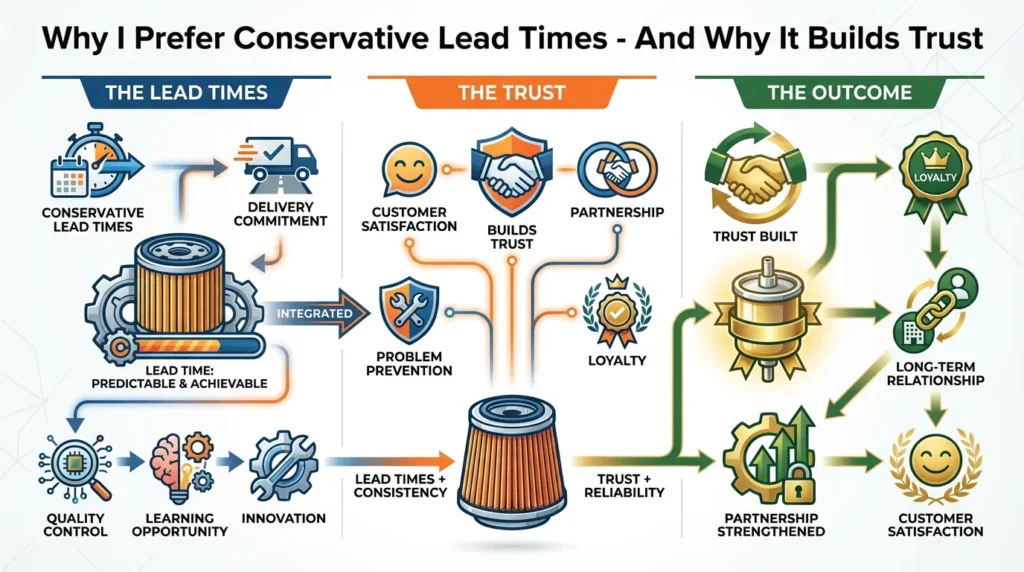
In the automotive filter business, many factories like to advertise:
- “short lead time”
- “fast production”
- “urgent order friendly”
It sounds attractive, especially in a competitive market where buyers are under pressure to keep shelves full and brands visible.
But I learned, the hard way, that fast promises are not the same as reliable delivery.
And that lesson permanently changed how I approach lead times.
A customer once asked me:
“Bruce, other suppliers promise 30 days.
Why do you insist on 45–60?”
The answer is simple:
Because I would rather protect your supply chain with reality than destroy your planning with optimism.
The “Fast Lead Time” That Turned Into a Problem
1.1 When Overconfidence Starts Upstream
Years ago, one of our upstream suppliers was overly optimistic about their own production schedule.
They told us:
“Don’t worry, we can deliver early.”
Believing their confidence, the factory shortened the overall lead time to our customer.
On paper, everything looked perfect:
- production sequenced nicely
- components aligned
- shipment window looked achievable
It seemed like a win for everyone:
- the supplier “looked efficient”
- the customer was pleased with a shorter lead time
- the internal schedule seemed tight but possible
Until reality stepped in.
1.2 When Real Life Destroys Optimistic Schedules
Several things happened — none of them extreme, all of them realistic:
- A curing machine malfunctioned
- A material batch required re‑testing
- A regional holiday slowed logistics
- The vessel schedule shifted unexpectedly
Each of these events, on its own, is manageable.
Together, they turned a “fast lead time” into a dangerous promise.
The shipment was delayed by 8 days.
No product failure.
No quality problem.
Just a missed promise.
The customer wasn’t angry. But he said something that stayed with me:
“Bruce, I prefer a supplier who tells me 60 days and delivers in 50
than someone who promises 40 and delivers in 48.”
That one sentence reshaped how I view delivery commitments.
The Lesson: Accuracy Beats Speed in Global Supply Chains
2.1 What Procurement Teams Really Need
In global supply chains:
👉 Accuracy is more valuable than speed.
👉 A safe promise builds trust; an optimistic one destroys it.
Procurement teams don’t lose sleep over:
- lead times of 45 or 60 days, if they are reliable
They lose sleep over:
- not knowing whether goods will arrive as promised
- confronting last‑minute surprises
- having to explain delays to their own customers and management
2.2 How Delays Ripple Through the Entire Chain
When a shipment is delayed because of an overly optimistic lead time, the effect is never isolated.
Delays create:
- ❌ Stockouts
- Shelves go empty
- Workshops can’t get the parts they expect
- ❌ Missed promotions
- Marketing campaigns or seasonal activities fall apart
- ❌ Warehouse disruption
- Receiving plans need to be re‑arranged
- Other arrivals stack up incorrectly
- ❌ Lost retail shelf space
- Retailers replace your space with another brand
- ❌ Extra logistics cost
- Emergency shipments
- Air freight to “fix” the delay
All because the lead time was built on hope, not risk‑controlled planning.
2.3 The Difference Between “Hope Nothing Goes Wrong” and “Plan for What Usually Goes Wrong”
A supplier who “hopes nothing goes wrong” is risky.
This is the supplier who:
- cuts buffer times to look competitive
- ignores seasonal and logistics realities
- says “we will try” instead of “we have planned for this”
A reliable supplier:
- assumes that some disruptions will happen
- builds a schedule that can survive normal problems
- treats the lead time as a promise, not a marketing number
That’s why my lead times include:
- ✔ Production buffer
- Allowing for machine maintenance, setup changes, minor rework
- ✔ QC timing margin
- Time to re‑check or retest if needed
- No pressure to release unverified parts
- ✔ Raw‑material fluctuation allowance
- Accounting for variations in upstream deliveries
- ✔ Peak‑season prediction
- Recognizing when capacity, shipping, or ports are under stress
- ✔ Shipping schedule variability
- Vessel changes, rollovers, port congestion
- ✔ Risk‑controlled planning
- Building lead times on real historical data
When I give a lead time, I want my partners to plan with confidence,
not hope for luck.
Why Conservative Lead Times Build Stronger Trust
3.1 The Power of Under‑Promising and Over‑Delivering
The customer who told me “60 promised, 50 delivered is better than 40 promised, 48 delivered” understood something fundamental:
- Planning stability is more valuable than 1–2 weeks of theoretical speed
When you:
- promise 60 days
- deliver in 50–55 days consistently
You create:
- confidence
- predictability
- trust
When you:
- promise 35–40 days to look competitive
- repeatedly deliver in 43–48 days
You create:
- doubt
- constant stress
- damaged credibility
3.2 How This Affects Long‑Term Cooperation
Over time, customers start to classify suppliers into two groups:
- Those whose dates can be trusted
- If they say “week 32,” the goods truly arrive around week 32
- Their lead times are conservative but dependable
- Those who always have excuses
- Blame vessels, holidays, ports, suppliers, “unexpected” events
- Promise aggressively, deliver “almost on time,” but not reliably
Buyers know that:
- realistic suppliers may not always look like the “fastest” on paper
- but they free the buyer from constant crisis management
Consistency beats speed.
Reliability beats ambition.
Why Overseas Buyers Respect Conservative, Honest Lead Times
4.1 What European, Middle Eastern, and American Distributors Want
Distributors in Europe, the Middle East, and North America generally prefer suppliers who offer:
- ✔ Predictable lead times
- Dates they can confidently feed into their ERP and planning systems
- ✔ Early delivery when possible
- Not promised, but pleasantly delivered
- ✔ Proactive updates
- Informing them early if something changes
- Allowing them to adjust before it becomes a crisis
- ✔ Transparent risk assessments
- Honest discussions about peak seasons, port congestion, upstream challenges
What they do not appreciate:
- ❌ Unrealistic promises created just to win orders
- ❌ Last‑minute lead time changes
- ❌ Supplier overconfidence without data
- ❌ “We will try” commitments instead of clear planning
4.2 How Conservative Lead Times Reduce Their Risk
For overseas buyers handling:
- multiple brands
- multiple suppliers
- multiple markets
each unreliable supplier adds:
- complexity
- nervousness
- hidden costs
A supplier who:
- gives conservative yet realistic lead times
- often delivers earlier than promised
- communicates delays early when extremely rare events happen
actually helps the buyer:
- reduce safety stock
- optimize warehouse usage
- plan promotions better
- improve their own reputation with retailers and workshops
This is why many serious buyers quietly prefer:
a supplier who says “45–60 days and often delivers around 45–50,”
over a supplier who says “30–35 days” but constantly delivers at 38–42.
How We Build Reliable Lead Times at Beling Filters
At Beling Filters, we design our lead times around what actually happens in real life, not what looks good in a quotation.
5.1 32M Annual Capacity – But Used Responsibly
We have:
- ✔ 32 million annual capacity for filters
But capacity alone doesn’t guarantee on‑time delivery.
What matters is how that capacity is scheduled.
We:
- avoid over‑booking the lines
- balance existing and new customers’ orders
- plan capacity with realistic peaks and troughs
This allows our lead times to:
- remain stable
- absorb normal fluctuations
5.2 Stable Raw‑Material Supply
We work with:
- stable, qualified raw‑material suppliers
- planned purchasing cycles based on forecasts
- buffer for critical materials like media, PU, resin, steel components
This reduces the risk of:
- last‑minute material shortages
- rushed substitutions
- unexpected upstream delays
Stable materials = more accurate lead times.
5.3 IATF 16949 Production Control
Our production is governed by:
- IATF 16949 production control principles
Which means:
- defined processes
- controlled changes
- repeatable cycle times
- discipline in planning and execution
Lead times are not random — they are built on:
- measured cycle times
- real throughput data
- proven QC timings
5.4 Strict Scheduling Discipline
We use strict scheduling discipline:
- not adding orders into already full slots “just to please someone”
- respecting planning rules instead of bending them for short‑term appearances
This is critical, because:
- chaos in scheduling always leads to delays, overtime, and mistakes
- disciplined scheduling makes our promises meaningful
5.5 Based on Real Data, Not Marketing
Our lead times are:
- based on real historical data
- adjusted for:
- product complexity
- order size
- seasonality
- shipping lanes
We do not:
- pick the shortest possible scenario and present it as a standard number
- use lead time as a “marketing weapon” against other suppliers
We use it as:
- an operational commitment
- something we take seriously
5.6 95%+ Global Vehicle Model Coverage Without Losing Control
We offer:
- ✔ 95%+ global vehicle model coverage
A wide catalog often puts pressure on factories:
- many SKUs
- many changeovers
- complex planning
We manage this with:
- categorized product families
- structured planning by platform
- careful sequencing to avoid excessive changeover waste
So even with a broad range, we keep delivery performance under control.
Beling – Save Your Time & Cost
A customer once asked me why I insist on 45–60 day lead times
when other suppliers promise 30 days.
The answer:
- Because I care more about your planning stability than my marketing image.
Years ago, an optimistic upstream promise and a chain of normal disruptions turned a “fast lead time” into a late shipment.
Since then, my approach has been clear:
- I would rather promise safely and deliver earlier
- than promise aggressively and deliver “almost on time”
At Beling Filters, our lead times are built on:
- ✔ 32M annual capacity
- ✔ Stable raw‑material supply
- ✔ IATF 16949 production control
- ✔ Strict scheduling discipline
- ✔ Real data, not marketing
- ✔ 95%+ global vehicle model coverage
We will never gamble with our customers’ inventory.
If you value predictable and stable lead times over risky shortcuts…
Let’s connect and build a supply chain you can truly rely on.
📩 bruce.gong@belingparts.com
🌐 www.belingparts.com
Your valuable automotive filter partner since 2008.