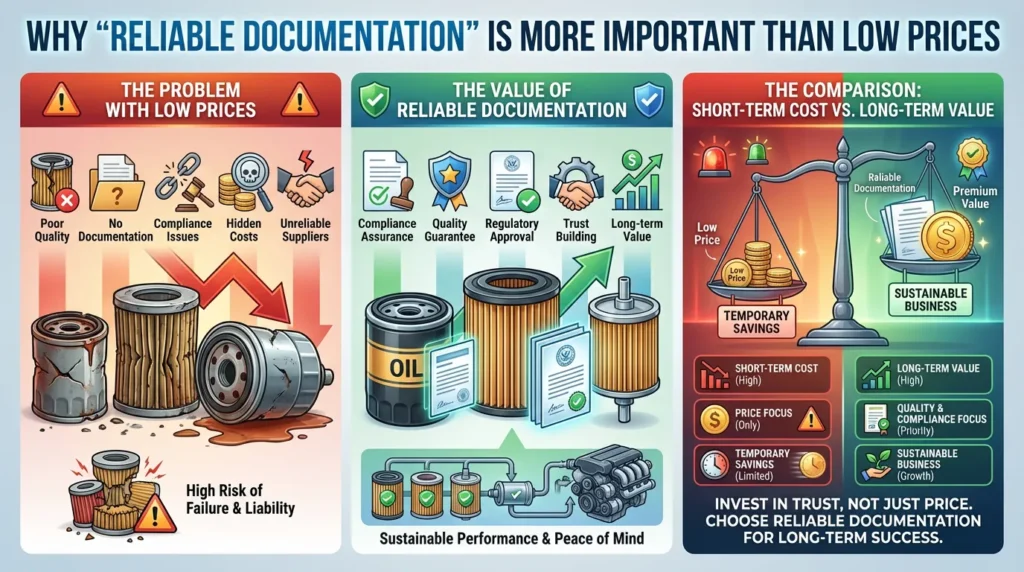
When importers negotiate automotive filter contracts, the conversation often starts with:
“Can you give me a better price?”
Price matters. But in real international trade, especially with automotive filters, reliable documentation usually has a much bigger impact on your profit than a small price difference per piece.
One “cheap but sloppy” shipment can easily wipe out a year of savings gained from negotiating a few cents off the unit price.
This article explains why documentation quality is a strategic asset, not a “back office detail,” and how we structure documentation at Beling to protect your margins, your operations, and your brand.
How One Small Documentation Mistake Can Erase a Year of Savings
1.1 Typical “Small Errors” That Become Big Costs
In overseas automotive filter trade, it is often not the big disasters that hurt the most. It’s the small documentation errors that trigger a chain of costs and delays.
Common mistakes we see importers struggle with:
- HS code missing or wrong
- Incorrect tariff classification
- Missing code on invoice or mismatch with import license
- Packing list quantities don’t match cargo
- Wrong carton count or SKU breakdown
- Discrepancies between physical cargo and listed quantities
- Certificate of Origin (COO) with typos or wrong format
- Wrong country name or inconsistent origin data
- Incorrect issuing chamber or missing stamps/signatures
- Invoice description not aligned with:
- Local customs rules
- Import license wording
- Bank or L/C requirements
These look small on paper but can cause major operational pain.
1.2 The Real Cost of a “Cheap” but Poorly Documented Shipment
When these mistakes happen, the typical consequences include:
- Delays at port
- Containers stuck while corrections are requested
- Goods missing their planned delivery window
- Demurrage and storage charges
- Daily costs accumulating while the issue is resolved
- Extra broker and agent fees
- Additional handling
- “Correction” or “exception” charges
- In bad cases, even:
- Reissuing documents
- Reexporting goodsor abandoning cargo
If you saved $0.05 per filter by pushing your supplier hard on price, one bad shipment with demurrage, rework and penalties can easily destroy those savings — and more.
This is why we always say: documentation is part of your real cost price.
Why Customs & Banks Care More About Paper Than Your Price
2.1 Customs and Banks Don’t See Your Relationship
Customs officers and bank officers don’t know how long you’ve worked with your supplier, how much trust exists, or how committed both sides are. They only see:
- Your documents
- Their own rules and systems
If your documents are:
- Incomplete
- Inconsistent
- Not aligned with your import license or L/C terms
…your relationship with the supplier cannot save you. Customs and banks will simply follow procedure.
2.2 Typical Risks When Documents Are Not Reliable
If documents do not match or do not comply, you risk:
- Inspection and disputes over:
- Value
- Origin
- HS classification
- Blocked clearance
- Customs refuses or delays release of cargo
- Additional physical inspection
- Bank issues such as:
- Late L/C acceptance
- Payment refusal due to discrepancies
- Extra charges for document correction
Even when you eventually solve the problem, you lose:
- Time
- Money
- Credibility with your own customers
2.3 What We Prioritize in Documentation for Automotive Filter Shipments
We invest heavily in document reliability, not as an extra service, but as part of our core offering:
- Clean, detailed commercial invoices
- Correct buyer, consignee, and address details
- Clear product description and HS code (aligned with your broker)
- Transparent values and Incoterms
- Accurate packing lists
- Carton count
- Pallet breakdown (if used)
- Net/gross weights and dimensions
- Correct Certificate of Origin format
- According to your chamber / consulate requirements
- Matching invoices and packing lists
- Invoice description and HS code prealigned with your customs broker before shipping
This attention to detail ensures that your shipments are documented for smooth clearance, not for later firefighting.
Predictable Operations Beat “Best Price Per Piece”
3.1 Where Importers Really Lose Money
Most importers don’t lose money because filters are a little too expensive. They lose money because:
- Stock arrives too late
- Lost sales because customers move to another supplier
- Emergency airfreight to cover gaps
- Containers get stuck in port
- Demurrage, storage and extra handling fees
- They must pay penalties or discounts to key customers
- Service level agreement (SLA) penalties
- Compensation for late delivery in fleet or dealer contracts
These problems are often triggered by documentation issues, not by the product itself.
3.2 The Hidden Value of Predictability
Reliable documentation creates:
- Predictable lead times
- You can plan inventory and promotions more confidently
- Fewer surprise costs
- Less demurrage
- Fewer rework or correction charges
- More stable cash flow
- Shipments clear on time
- Banks process payments smoothly
A supplier who:
- Ships on schedule
- Provides errorfree documents
- Responds quickly when authorities ask questions
…often contributes more to your longterm profitability than a supplier who is just slightly cheaper.
Why Documentation Quality Is Part of Your Brand
4.1 Your Customer Judges You, Not Your Supplier
In your market, your end customer doesn’t see:
- Our factory
- Our document process
- Our internal quality systems
They see:
- Youand your brand
- Your ability to deliver on time
- Your professionalismin handling orders and paperwork
If your supplier sends:
- Wrong COO
- Invoices that banks don’t accept
- Incomplete or inconsistent technical descriptions
…the outside world does not blame the supplier — they blame your company.
4.2 Documentation as a Brand Protection Tool
Poor documentation can create a reputation that:
- Your deliveries are unreliable
- Your team is “always fighting with customs”
- Your company is disorganized
On the other hand, consistent and clean documentation supports your brand:
- You become known as a reliable importer or distributor
- Large customers trust you with:
- Bigger orders
- Longterm contracts
We see documentation as part of brand protection, not just compliance.
How We Structure “Reliable Documentation” at Beling
To turn documentation from a risk into a strength, we follow a clear routine for every shipment of automotive filters.
5.1 Step 1 – PreAlignment
Before production and shipment, we align with you on:
- HS codes and technical descriptions
- Description style for invoices:
- How your broker prefers items to be described
- Whether certain model names or references are needed
- Origin (Made in …) and how it must appear:
- On invoices
- On packing lists
- On labels and cartons
- Incoterms and payment terms
- Ensuring the documents reflect the agreed trade terms
We also adjust our invoice format to your broker and/or bank preferences, where possible, based on your feedback.
5.2 Step 2 – Draft Check
Before finalizing documents and loading the container, we:
- Send draft invoices and packing liststo you
- Allow you or your brokerto review and request adjustments
At this stage, changes are:
Catching issues now avoids major problems after the container is already on the sea or at the port.
5.3 Step 3 – Consistent Final Document Set
After alignment and corrections, we issue the final documents:
- Commercial invoice
- Packing list
- Certificate of Origin (and other required certificates)
We ensure:
- No surprise changesbetween draft and final
- All elements match:
- Invoice
- Packing list
- COO
- Packing marks
- Label origin
This consistency is what customs and banks expect — and what keeps clearance moving smoothly.
5.4 Step 4 – Fast Response During Clearance
Even with perfect documents, occasionally:
- Customs may ask for clarification
- Banks may request supporting information
When that happens, we:
- Provide extra technical details quickly
- Product specs
- Material information
- Application confirmations
- Share factory or production information when needed for:
- HS code disputes
- Origin verification
- Valuation questions
This fast response minimizes delay and shows authorities that your documentation and supply chain are transparent and well supported.
Through this routine, we systematically reduce your real risk and protect your profit beyond the unit price.
How to Negotiate With Us – Price vs Documentation
6.1 Our View on Price Negotiation
We are always open to discuss pricing. Cost matters, and we understand that the automotive aftermarket is competitive.
But we will never reduce our internal cost by:
- Cutting corners on documents
- Rushing paperworkat the expense of accuracy
- Ignoring your local compliance realityjust to save time
Because we know that the real margin in automotive filter imports comes from:
- Smooth customs clearance
- Stable supply
- Zeroerror paperwork
…not from squeezing the last cent on unit cost while risking a blocked shipment.
6.2 Why Documentation Reliability Is a LongTerm Asset
In the long run, your margin depends on:
- How many shipments arrive on time and troublefree
- How rarely you pay avoidable:
- Demurrage
- Warehousing
- Penalties and discounts
- How confident your customers are in your reliability
We prefer to be known as:
“Strong on price, stronger on documentation reliability.”
Because that combination is what genuinely protects your profit, your reputation, and your growth.
Beling – Save Your Time & Cost
Your valuable automotive filter partner since 2008.
Strong on price, stronger on documentation reliability.
Contact Our Team
Bruce Gong – Key Account Manager, Beling Filters
Email: bruce.gong@belingparts.com
WhatsApp: +86 150 5776 4729
LinkedIn: www.linkedin.com/in/brucegong-beling
We’re happy to walk through your current shipping pattern and see where moving from LCL to FCL (or structuring a mix of both) can protect your margin and your reputation.