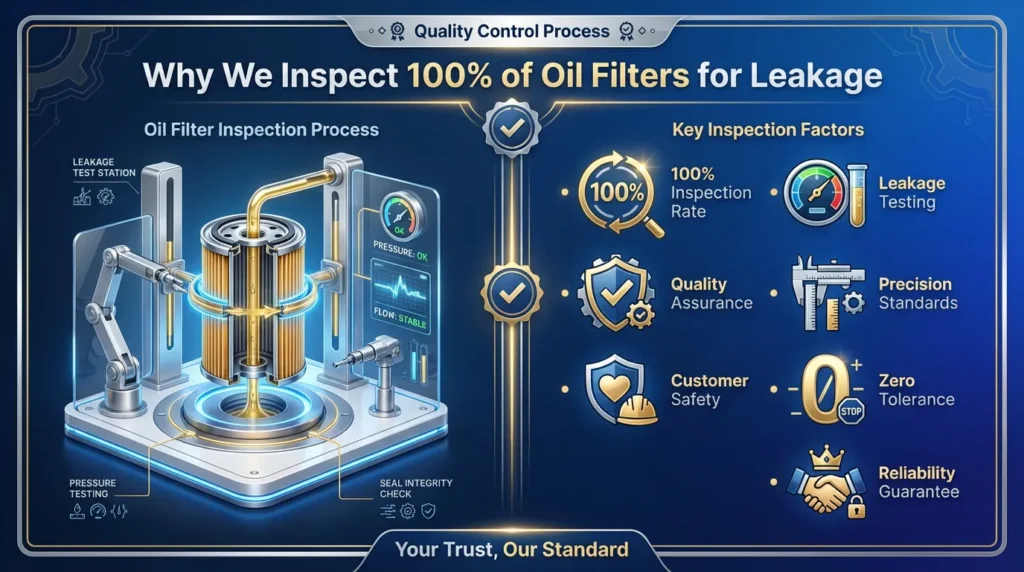
Most end users will never see it, but inside a professional oil filter plant, leakage testing is one of the most critical steps in the entire production process.
Especially for spin-on oil filters, a leakage problem is not a small cosmetic defect. It is a zero-tolerance, safety-related issue that can lead to:
- Loss of oil pressure
- Visible oil spots in the customer’s driveway
- In extreme cases, serious engine damage
At Beling, we made a strategic decision:
100% of our oil filters are inspected for leakage before shipment.
Not random, not sampling – every single piece.
This article explains why we do it, how we do it, and what this means for you as an importer, distributor, or private brand owner.
Beling has been manufacturing automotive filters since 2008, with:
- Supply to 30+ countries
- IATF 16949 certified quality system
- 32 million annual production capacity
Our philosophy is simple: we don’t build business by saving a few cents and creating big risks. We build it by controlling risk and protecting your brand.
Why Oil Filter Leakage Is a Zero-Tolerance Issue
A leaking oil filter is one of the worst possible failure modes in the aftermarket. It is visible, serious, and directly linked to the filter brand in the customer’s mind.
1.1 What Happens When an Oil Filter Leaks
Potential consequences include:
- Loss of oil pressure
- The engine warning light may come on
- In severe cases, oil pressure drops enough to cause accelerated engine wear or damage
- Oil spots under the car
- Customers see oil on the ground or under the vehicle
- They quickly blame the workshop and the filter brand
- Safety and environmental concerns
- Oil on the ground can be a slip hazard
- Leaked oil may contaminate the environment
Even if the leak is small, it destroys trust:
- The workshop feels embarrassed
- The end user feels unsafe
- Your filter brand is associated with “poor quality”
1.2 Why Visual Inspection Is Not Enough
From the outside, a leaking filter usually looks perfectly normal. You cannot see:
- Micro-gaps at the sealing surface
- Tiny pinholes in the shell
- Micro-cracks in welds or seams
- Defects in the base plate crimp
- Insufficient bonding at the center tube and end caps
A simple visual check at the end of the line cannot detect these issues.
You either:
- Test properly for leakage, or
- Take a risk with every shipment
At Beling, we refuse to take that risk on your brand.
Where Oil Filters Can Leak in Real Production
Oil filter leakage usually comes from specific technical points in the design and process. Over many years of manufacturing and field feedback, we see the same weak spots again and again.
2.1 Typical Oil Filter Leakage Points
- Shell welding or seam
- If the welding or rolled seam is not fully sealed, micro-leaks can appear under pressure
- Base plate crimping area
- The joint between the shell and base plate is critical
- Too little or too much crimping force can create leak paths
- Thread / plate interface
- Poor machining or incorrect sealing in the threaded area can cause leakage during installation or operation
- Gasket seating area
- If the gasket does not sit properly on the base plate
- Or if the sealing line on the shell or base plate is not uniform
- Center tube to end cap bonding
- In internal leakage cases, oil can bypass the media through weak bonding
- This may not create external oil on the ground but leads to filter bypass and contamination
Most of these points are process-sensitive:
- A small shift in welding parameters
- Slight variation in crimping force
- Inconsistent adhesive application
Sampling alone will not always catch such micro-defects. That’s why we insist on 100% leakage testing.
How Our 100% Oil Filter Leakage Inspection Works
To control leakage risk, Beling has integrated mandatory leakage testing into the final stage of our oil filter production line.
3.1 Dedicated Leakage Test Station for Every Oil Filter
Every oil filter goes through a dedicated test station, designed to detect even small leakage under pressure.
The process includes three main steps:
3.2 Step 1 – Mounting and Pressurizing the Filter
- The filter is mounted on a test fixture that simulates installation conditions
- A defined test pressure is applied:
- Higher than normal working pressure
- Using oil or a specific test medium, depending on the product and equipment
- The pressure value and test time are set according to:
- Our internal standards
- Product specification and risk level
This ensures the filter is tested under controlled, repeatable conditions that are more severe than normal use.
3.3 Step 2 – Monitoring for Pressure Drop and Leakage
The test machine automatically monitors:
- Whether pressure is maintained within a tight tolerance during the test time
- Any significant pressure drop is recorded
If the pressure drop exceeds our limit, the machine:
- Automatically flags the filter as NG (Not Good)
- Triggers alarms or signals on the line
Depending on filter design and equipment, we also use:
- Additional sensors for micro-leak detection
- Visual confirmation by trained operators for any suspicious cases
This combination of automatic measurement and operator oversight ensures we catch leaks that would be impossible to see with the naked eye.
3.4 Step 3 – Automatic Separation of NG Products
To avoid any risk of a leaking filter entering the packing area:
- Good filters (Pass) move automatically to the packing section
- Failed filters (NG) are:
- Automatically separated from the main flow
- Clearly marked and moved to a quarantine area
These NG filters are:
- Never allowed into cartons
- Collected for:
- Root cause analysis
- Corrective action on the process
All test results are linked to:
- The production order
- The batch or lot number
This directly strengthens our batch-level traceability.
Why We Choose 100% Leakage Testing Instead of Sampling
From a short-term cost perspective, it would be cheaper to:
- Test only a sample per batch
- Assume that if the sample passes, the whole batch is okay
But our experience in export markets shows this is too risky.
4.1 The Real Cost of One Leakage Complaint
A single leakage complaint can:
- Create serious trouble with a key workshop or distributor
- Spread quickly through local mechanic networks
- Damage your brand image far beyond the cost of one filter
In more serious cases, if engine damage is claimed:
- You can face warranty discussions, technical disputes, and potential legal exposure
- You might need to:
- Send technical staff to investigate
- Replace multiple filters as a gesture of goodwill
- Compensate part of the repair cost
The cost and stress of one serious case is often far higher than the savings from not testing 100% of filters.
4.2 Our Logic as a Long-Term Export Partner
For us, the reasoning is simple:
- Oil filters are critical functional parts
- Leakage is an unacceptable failure mode
- Therefore, 100% leakage testing is the only rational strategy for long-term cooperation
We see ourselves not just as a product seller, but as a risk management partner for your filter program.
Our decision to implement 100% testing aligns with:
- Our IATF 16949 quality principles
- The expectations of serious overseas buyers who value stability and brand protection
How 100% Leakage Testing Protects You as a Buyer
When you buy oil filters from Beling, our 100% leakage inspection gives you several clear advantages.
5.1 Lower Risk of Surprise Failures in the Market
Because every oil filter is tested:
- The chance of a batch with hidden micro-leaks reaching your customers is dramatically reduced
- You can sleep more easily knowing that leakage is checked piece by piece, not by assumption
This is especially important when:
- You are launching or upgrading a private brand
- You are entering new markets where first impressions matter
5.2 Stronger Position with Workshops and Key Accounts
Being able to say to your customers:
“All our oil filters are individually pressure-tested for leakage before packing.”
gives you:
- A clear technical advantage over low-cost competitors
- A trust-building message when talking to:
- Workshop owners
- Fleets
- Distributors and retail chains
It shows that you are working with a serious manufacturer, not a purely price-driven source.
5.3 Faster and More Accurate Claim Handling
If a complaint appears in the field:
- We can check:
- Leakage test parameters used for that batch
- Pass/fail statistics
- Any unusual trends in the testing records
This allows us to:
- Confirm whether the product went through a proper test
- Evaluate if there is a systematic issue or a local factor (installation, operating conditions)
- Provide you with a technical report, not just an apology
This level of analysis lets you handle claims with confidence and credibility.
5.4 Better Long-Term Brand Reputation
Over time:
- Fewer critical failures → more trust from workshops
- More trust → easier to:
- Increase your range
- Move up in price level
- Negotiate better positions with key accounts
100% leakage testing is part of our commitment to protect your brand for the long term, not just win one shipment.
Our Quality Philosophy Behind 100% Leakage Inspection
Beling has been producing automotive filters since 2008, supplying Europe, the Middle East, Southeast Asia, and now expanding to the Americas.
We operate with:
- IATF 16949 certified quality management
- 32 million annual capacity
- 30+ countries served
From this experience, we’ve learned:
- You cannot build a sustainable export business by saving tiny costs and creating big risks
- Serious buyers are not just buying a product – they are buying:
- The process stability behind the product
- The risk control behind the brand
That is why we chose:
- 100% leakage inspection for oil filters
- Strong incoming material inspection for media, steel, rubber and components
- Stable order management with ERP/MRP
- Transparent traceability for every batch
We are not trying to be the cheapest in the market.
Our goal is to save your time and cost over the long term by:
- Reducing complaints
- Avoiding critical failures
- Supporting a stable, respected filter brand in your market
If you are looking for an oil filter supplier who takes leakage risk as seriously as you do, we are ready to:
- Share more details about our leakage testing standards
- Provide sample reports
- Support your private label oil filter program with both products and process.
Beling – Save Your Time & Cost
Your valuable automotive filter partner since 2008.
Contact Our Team
Bruce Gong – Key Account Manager, Beling Filters
Email: bruce.gong@belingparts.com
WhatsApp: +86 150 5776 4729
LinkedIn: www.linkedin.com/in/brucegong-beling
We can’t remove all variability from global logistics.
But we can make it visible, manageable and much less painful for your distribution business.